Riyadh on a budget in three days
Riyadh is a car-dependent city, but it isn’t a car-only city. Since the Riyadh Metro opened in stages between December 2024 and early 2025, a visitor without a rental car or a dedicated driver can cover most of the historic centre and the modern districts on their own schedule, topping up with Uber and Careem for the gaps. That’s true for two of these three days. The honest exception is Diriyah: the metro doesn’t reach it conveniently, and a shared or private tour is the realistic way in, not a stretch of “authentic” hardship.
What this three-day budget really costs
Skip the idea that a low-cost Riyadh trip means avoiding every paid activity. It means being precise about where money goes. Inside Riyadh, the metro fare and the odd ride-hailing trip are small. Outside the city, in the desert or in Diriyah, some form of paid transport is unavoidable, because there’s no metro line and taxis rarely wait around at rural sites. This plan keeps those paid legs to one day, and it leaves out anything that would push the budget into a full-day private driver: Edge of the World and the Red Sand Dunes both usually run to a half or full day of hired transport and belong in a different itinerary, not this one.
Cards are accepted almost everywhere in Riyadh, including small shops and cafés, so the running cost of a day is mostly digital. The exception is Souq Al Zal and any roadside stop, where a bit of cash in Saudi riyal (SAR) smooths things over. Prices below are order-of-magnitude only; check the current metro fare and your ride-hailing app for the exact figure on the day.
| Cost category | Rough range per person, per day | Notes |
|---|---|---|
| Riyadh Metro | Low, single-digit SAR per ride | Recharge a card at the station; keep some cash as backup |
| Uber or Careem within the city | Modest, varies with distance and time of day | Fares rise sharply at rush hour |
| Entry to Masmak Fortress, Deera Square, Souq Al Zal | Free or near-free | The historic centre is the cheapest half-day in the city |
| Diriyah tour (shared) | Mid-range, a fixed cost for the day | Check the current fare on the booking page before you go |
| Food | Low to moderate | Local kabsa and cafés cost far less than hotel restaurants |
Day 1: Central Riyadh on foot, metro and ride-hailing
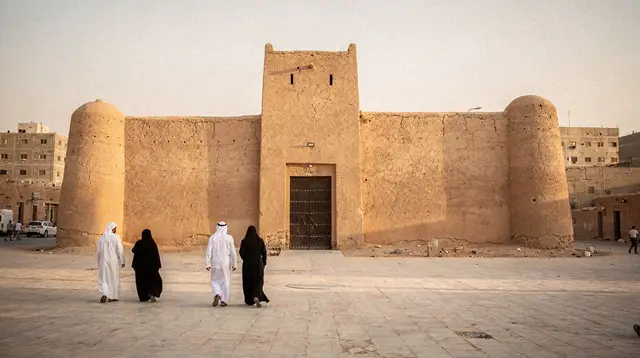
Start in the historic quarter, Al Dirah, also called Deera. This is the cheapest half-day the city offers: Masmak Fortress, the mud-brick fort taken by Abdulaziz Ibn Saoud in 1902, the event that set off the founding of the modern kingdom in 1932, costs little to nothing to walk through and gives a clear sense of pre-oil Riyadh. Right outside, Deera Square and Qasr Al Hukm are open public spaces, and Souq Al Zal next door is worth an hour of browsing rugs, daggers, incense and antiques even if you don’t buy anything. This is where keeping a bit of cash pays off, since some stallholders prefer it; the full breakdown of cards versus cash in Riyadh covers where machines are less reliable.
Reach this area by metro to a station near the old town, or by a short Uber or Careem ride if the walk from the nearest stop feels long in the heat. Either way, it’s a fraction of what a dedicated driver for the morning would cost.
In the afternoon, head to the King Abdulaziz Historical Center in Al Murabba, home to the National Museum of Saudi Arabia and the Murabba Palace, the former residence of the kingdom’s founder. The museum ticket is a modest, fixed cost and gives useful context for everything else on this trip; treat it as one of the few paid entries worth the money on a tight budget. From there, the metro or a short ride-hailing trip gets you back toward Olaya for the evening.
If you want a structured half-day instead of arranging the historic centre yourself, a general orientation tour covers the same ground with a guide:
A half-day city tour through Riyadh’s old and new districtsDay 2: The modern skyline, seen from street level and the metro
Riyadh’s modern skyline doesn’t require an expensive lounge ticket to appreciate. Kingdom Centre, at 302 metres with the Sky Bridge near the top, and Al Faisaliah Tower are both visible and photographable from the street in Olaya at no cost. If the Sky Bridge ticket fits your budget, it’s a reasonable one-time splurge for the view; if not, the towers still define the skyline from below.
Use the metro to move between Olaya, Al Malqa in the north of the city, and KAFD, the King Abdullah Financial District, whose architecture is worth a slow look even from outside the buildings. Ride-hailing fills in the last stretch where a station is too far to walk comfortably, particularly in the afternoon heat; for how the two options compare on a budget day, see metro versus Uber in Riyadh.
For a free-standing green space, Wadi Hanifa runs through the west of the city with walking paths that cost nothing beyond the ride there. If evenings suit you better than daytime heat, an evening cycling route along the wadi is a low-cost way to see a different side of the city after the sun drops, and it’s a paid activity that stays well inside a budget plan:
An evening bike ride along Wadi HanifaRound off the day at Souq Al Zal again if you missed anything, or at one of the casual kabsa restaurants near Olaya, which cost noticeably less than hotel dining and are usually where the best food is anyway; see kabsa and Najdi food to try in Riyadh for what to order.
Day 3: Diriyah and At-Turaif, the one paid transfer
This is the day the budget stops being entirely metro-and-app. Diriyah sits along the Wadi Hanifa, northwest of Riyadh, and isn’t a city neighbourhood: it’s the birthplace of the first Saudi state, founded in the eighteenth century — the full background is in why Diriyah is the birthplace of the Saudi state. The metro doesn’t run there, and standalone taxis are unreliable for a same-day round trip, so a shared tour or a booked driver is the practical choice, not an extravagance; see how to get to Diriyah for the transport options this budget plan is weighing.
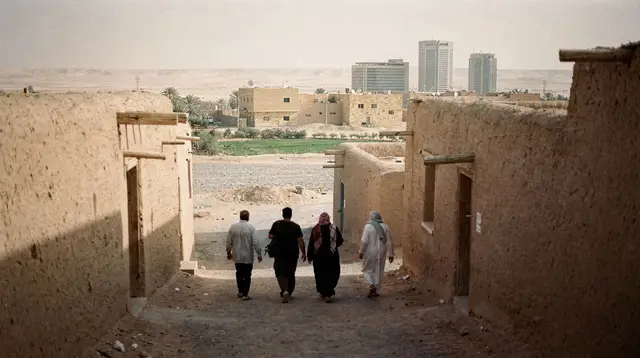
Inside Diriyah, At-Turaif District, the mud-brick citadel of the Al Saoud family, has been UNESCO-listed since 2010, and it’s the single most historically important site within reach of this itinerary. Across the wadi, Al Bujairi Terrace is the restaurant and café district, a reasonable place for a mid-range lunch that still costs less than an equivalent meal in central Riyadh’s business district.
A shared heritage tour is the most cost-effective way to cover At-Turaif and Bujairi Terrace together in one paid transfer:
A heritage tour of At-Turaif and Bujairi TerraceIf you’d rather combine Diriyah with a last look at the modern skyline on the way back, a route that links the two saves a second transfer:
A combined route from Diriyah back through the modern skylineReturn to your hotel by the same shared or private transfer, since ride-hailing pickups from Diriyah in the late afternoon can involve a wait. Budget this one transfer as the trip’s main paid line item, and the rest of the three days stays close to free.
What this budget plan leaves out, on purpose
Edge of the World, 90 to 100 kilometres northwest of Riyadh on a two to two-and-a-half hour drive with a rough final stretch, needs a full-day agreed tour or driver and doesn’t fit a strict budget the way Diriyah does. The Red Sand Dunes are a similar story, an hour west of the city but still requiring hired transport for the whole outing. Both belong in a longer or higher-budget itinerary, such as Riyadh and the desert in four days. Al-Qassim, a full day’s drive further out, and any itinerary paced for children, sit outside this plan entirely; this is a car-free, low-spend version of Riyadh, not a comprehensive one. If three days without a car feels too tight, three days in Riyadh covers the same span with a bit more room to spend.
Practical notes for a budget stay
Dress modestly, shoulders and knees covered, and skip the idea that an abaya is required: it isn’t, for foreign women, and a headscarf is only needed inside mosques; what to wear in Riyadh covers this in more detail. Alcohol isn’t available anywhere in Riyadh, including hotels, so that’s not a cost to plan for either way (can you drink alcohol in Saudi Arabia has the full picture).
The weekend runs Friday and Saturday (the Saudi weekend), and Friday midday prayer is the quietest stretch of the week in the historic centre, worth timing around rather than fighting. If you land at King Khalid International Airport, about 35 kilometres north of the centre, the metro connection or a shared ride-hailing trip is a cheaper start to the whole three days than an arranged airport transfer. Most Western visitors also need to sort a Saudi e-Visa before travelling, and it’s worth knowing how much to tip in Riyadh so that isn’t a surprise cost either.
For fares, current museum tickets and the day’s exchange rate on the Saudi riyal, check the booking page or the official visa and travel portal directly rather than relying on a fixed number here.
Frequently asked questions about a budget trip to Riyadh
Do I need a private driver for this three-day budget plan?
Not for the two days spent inside Riyadh, where the metro and ride-hailing apps handle everything. For Diriyah, a shared tour or a booked driver is the practical option, since public transport does not reach At-Turaif conveniently.
Is the Riyadh Metro actually useful for tourists, or just for commuters?
It’s genuinely useful. The network opened in stages between December 2024 and early 2025, links to the airport, and puts stations within reasonable walking distance of Olaya, KAFD and the edges of the historic centre.
Do I have to wear an abaya to visit Masmak Fortress or Diriyah on a budget trip?
No. Modest dress, shoulders and knees covered, is enough for foreign women in public and inside these sites. The abaya is not required, and a headscarf is only needed inside mosques.
Can I skip Diriyah and keep this trip entirely car-free?
You can, but At-Turaif is the one UNESCO-listed site in the region and worth the modest tour cost. Skipping it saves money without changing the free days in central Riyadh.
Are cards accepted everywhere, or do I need cash in Riyadh?
Cards and contactless payment work almost everywhere, including small shops. Keep a small amount of Saudi riyal in cash for Souq Al Zal stalls and any desert or roadside stop where card machines aren’t reliable.
Is three days enough to see Riyadh’s main sights on a budget?
It covers the historic centre, the modern skyline from street level, and Diriyah, which is the core of what most visitors want. It leaves out Edge of the World and the Red Sand Dunes, which need a paid driver for a full day and don’t fit a strict budget.
Planning tips for visiting Riyadh on GetYourGuide
Verified deep-linked GetYourGuide tours. Book through these links and we earn a small commission at no cost to you.
GetYourGuide does not provide a product photo for this activity — the image shows the meeting point, photographed by us.