Diriyah tours: At-Turaif, Al Bujairi Terrace and getting there from Riyadh
What is Diriyah and how is it different from Riyadh?
Diriyah is a separate town on the Wadi Hanifa, northwest of Riyadh, not a city district. It was the birthplace of the first Saudi state in the 18th century, and its centrepiece is At-Turaif, a mud-brick citadel listed as a UNESCO World Heritage Site since 2010.
Diriyah is not a Riyadh neighbourhood
The most common mix-up we see is treating Diriyah as another part of Riyadh, on the same footing as Olaya or Al Malqa. It isn’t. Diriyah is its own town, sitting on the banks of the Wadi Hanifa on the northwest edge of the capital. Long before modern Riyadh took shape, Diriyah was the seat of the first Saudi state, founded in the 18th century, which is why Saudi Arabia treats it as a heritage destination in its own right rather than a suburb with old buildings in it.
That distinction matters for planning. If you’re staying in a Riyadh hotel and looking at things to do in Riyadh, Diriyah is a separate outing, not a walk from your hotel. It also means Diriyah’s two anchor sites, At-Turaif and Al Bujairi Terrace, sit apart from the Riyadh heritage cluster of Masmak Fortress and Deera Square, which we cover in our Riyadh city and heritage tours guide. Some tours link the two on one longer itinerary, and we note where that makes sense below, but they are not the same visit.
At-Turaif: the mud-brick citadel at the centre of it all
At-Turaif is the reason Diriyah is on any traveller’s list. It’s a fortified district of mud-brick buildings built by the House of Saud as their original stronghold and seat of power, and it remains one of the most complete surviving examples of Najdi architecture anywhere in the country. UNESCO inscribed At-Turaif as a World Heritage Site in 2010, and that date is worth getting right, since it’s the anchor fact most people quote when explaining why the site matters beyond its looks.
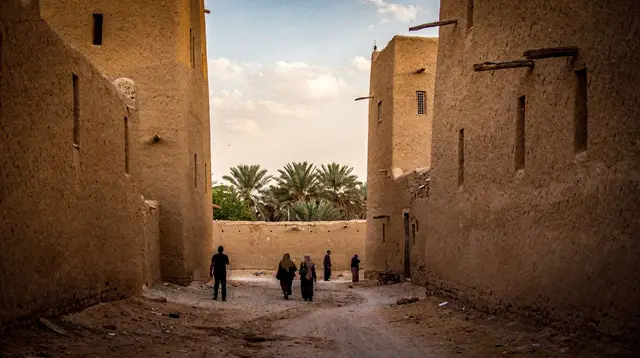
Walking through At-Turaif, what stands out is less any single building and more the scale and coherence of the whole district: narrow lanes, thick earthen walls, and a layout built for defence rather than display. Exhibits and restored spaces inside the citadel walk through the story of the first Saudi state, which gives the walk more weight than a purely scenic stroll would. If you already know the outline of Masmak Fortress’s role in 1902 and the kingdom’s 1932 founding from a Riyadh city visit, At-Turaif fills in the earlier chapter, the 18th-century roots that came generations before either of those events.
Access arrangements at At-Turaif have changed as the district has developed, with independent walk-in entry available at some points and more structured, ticketed or guided access at others. Rather than assume either applies when you arrive, check current entry conditions shortly before your visit, or let a booked tour remove the guesswork by handling tickets and timing for you.
A guided walk through At-Turaif’s citadel paired with Al Bujairi TerraceAl Bujairi Terrace: dinner with a view, not a heritage site
Across the Wadi Hanifa from At-Turaif sits Al Bujairi Terrace, and it’s worth being clear-eyed about what it is: a strip of restaurants and cafes with a strong sightline back to the citadel, rather than a historic site in its own right. That’s not a knock against it. The terrace is genuinely one of the better places in the Riyadh area to sit down for a meal with a view that actually earns the term, especially as the light drops and At-Turaif’s walls catch the evening colour.
Where Al Bujairi Terrace works less well is as a standalone destination. If someone tells you they’re “doing Al Bujairi Terrace” without also walking At-Turaif, they’re getting the easier half of the visit and missing the reason most people make the drive out. The pairing is the point: walk the citadel in the afternoon or early evening, then cross to the terrace for dinner as it gets dark. Several tours are built around exactly that sequence, and it’s the version we’d point most first-time visitors toward.
A Turaif and Al Bujairi visit that bundles admission tickets into one bookingHow far is it, honestly, from a Riyadh hotel
We’re not going to give you a single number here, because it would be a false precision. Diriyah sits on the northwest edge of Riyadh, so the honest range depends heavily on where you’re staying and when you leave. A hotel around Olaya or the KAFD area is a meaningfully shorter drive than one further south or east in the city, and Riyadh’s traffic can stretch any of these estimates during peak hours in either direction.
What we can say with confidence: this is a taxi, rideshare, or driver trip, not a walk or a casual stroll from central Riyadh. Uber and Careem both operate reliably for this route, and a private driver is the norm for visitors who want to combine Diriyah with other stops in one afternoon without managing pickups themselves. If you’re weighing whether the drive is worth it against staying in the city, our comparison of Diriyah versus old Riyadh and Masmak lays out what each side actually offers, and how to get to Diriyah goes into transport options in more depth.
A half-day Diriyah tour that covers the historic district at a relaxed paceCombining Diriyah with old Riyadh in one day
Because Diriyah’s story and Masmak Fortress’s story are chapters of the same larger history, the House of Saud’s rise from the 18th century through to the 1932 founding of the modern kingdom, some tours combine both in a single outing. This makes sense if your time in Riyadh is limited and you want the fuller historical arc rather than splitting it across two separate days and two separate drives.
The trade-off is pace. A combined day covers more ground but gives you less time to linger at either site, particularly if you also want the Al Bujairi Terrace dinner at the end. If At-Turaif and the citadel are your priority, a Diriyah-only half day lets you walk it properly and still make it to the terrace before sunset. If you’re more curious about the fuller sweep of Saudi history and have less time overall, a combined tour is the more efficient use of a single afternoon.
A combined tour linking Diriyah with Masmak Fortress and Al Murabba Palace in one itineraryWhat Diriyah tours don’t cover
Worth being upfront about scope. Diriyah tours are built around At-Turaif and Al Bujairi Terrace, plus in some cases a link over to old Riyadh’s heritage sites. They don’t reach into the desert: Edge of the World, the Red Sand Dunes, and the Najdi villages of Shaqra and Ushaiger are separate excursions in a different direction, covered in our desert excursions section and in guides like Edge of the World day trip from Riyadh. If a tour description promises both Diriyah and a desert stop in one day, check the schedule carefully; Riyadh’s traffic and the desert’s own driving distances make that a long day to do properly.
Diriyah tours also don’t usually include Riyadh’s modern skyline (Kingdom Centre, KAFD, Al Faisaliah Tower) or the Riyadh Camel Market, both of which sit on the opposite side of the city and belong to a different half-day out. If you want the fuller picture of what’s on offer around the capital, things to do in Riyadh is the better starting point before narrowing down to Diriyah specifically.
Practical planning for a Diriyah visit
A few things worth knowing before you book:
| Factor | What to expect |
|---|---|
| Distance from Riyadh | Northwest edge of the city; drive time varies by hotel location and traffic, no fixed figure |
| Best time of day | Late afternoon into evening, so the citadel walk ends near sunset before dinner at Al Bujairi Terrace |
| What’s on site | At-Turaif’s mud-brick citadel (UNESCO since 2010) and Al Bujairi Terrace’s restaurants and cafes across the wadi |
| Access | Independent and guided access have both applied at different points; confirm current entry rules or book a guided tour to avoid uncertainty |
| Dress | Modest dress for everyone in public applies here as anywhere else in Riyadh; an abaya isn’t required of foreign women |
| Combine with | Old Riyadh heritage sites on longer combined tours; not desert excursions, which run in a different direction |
Dress modestly, as you would anywhere in the Riyadh area: shoulders and knees covered for everyone. Nobody will hand you an abaya at the gate and nobody should be asking you to wear one; that requirement doesn’t exist for foreign women here, and the more persistent myth that it does tends to make people overpack for a heritage walk that doesn’t call for it. If you want the fuller picture of what to wear across your trip, what to wear in Riyadh covers it beyond just this one site.
For getting there and back, weigh a private driver against rideshare if you’re combining Diriyah with other stops; our Uber and Careem in Riyadh guide and renting a car in Riyadh guide both cover the options in more detail. If you’d rather not manage logistics at all, private tours in Riyadh is where several Diriyah-inclusive itineraries live alongside other private options.
a private transfer that links Diriyah with Souq Al Zal back in old Riyadh
Where Diriyah fits in a longer Riyadh itinerary
If you’re mapping out several days rather than one outing, Diriyah slots naturally into a broader stay. Our three days in Riyadh itinerary gives Diriyah its own half day without crowding it against the desert or the modern skyline, while five days in Riyadh has room to combine it with old Riyadh on one day and leave the desert entirely separate. If you’re touring with kids, note that Diriyah is a walking, history-focused visit rather than an activity park, so pace expectations accordingly; Riyadh with kids has more on balancing heritage sites with things that hold younger attention.
However you build the day, the core of it stays the same: At-Turaif for the history and the architecture, Al Bujairi Terrace for the meal and the view back across the wadi, and an honest allowance for the drive out from wherever you’re staying in the city.
Frequently asked questions about visiting Diriyah
Is Diriyah part of Riyadh?
No. Diriyah is a separate historic town on the Wadi Hanifa, northwest of the capital. It predates modern Riyadh and was the seat of the first Saudi state in the 18th century, so it has its own identity, gate and ticketing separate from anything inside Riyadh proper.
What is At-Turaif and why is it UNESCO listed?
At-Turaif is the mud-brick citadel built by the House of Saud as their original seat of power. UNESCO added it to the World Heritage List in 2010, recognising it as the ancestral home of the Saudi royal family and a rare surviving example of Najdi mud-brick architecture at this scale.
What is Al Bujairi Terrace?
Al Bujairi Terrace sits across the wadi from At-Turaif and functions mainly as a restaurant and cafe strip with a view back toward the citadel. It is not a heritage site in its own right; most visitors treat it as the place to eat before or after walking At-Turaif, especially at sunset.
How long does it take to get to Diriyah from a Riyadh hotel?
There is no single fixed figure worth quoting, since it depends on where in Riyadh you are staying and the time of day. It sits on the northwest edge of the city, so a hotel near Olaya or Al Malqa is a shorter drive than one further south, and Riyadh’s peak-hour traffic can stretch any of these journeys.
Can you visit At-Turaif without a guided tour?
Independent entry has existed alongside guided access, and rules have shifted as the district has developed, so it is worth checking current entry arrangements before you go rather than assuming either option. A guided tour removes that uncertainty and usually adds historical context that a self-guided walk through the citadel does not.
Does a Diriyah tour also cover Masmak Fortress or old Riyadh?
Some combined tours pair Diriyah with Masmak Fortress and other Riyadh heritage sites in a single day, since the House of Saud’s later history connects the two. If you are specifically after Masmak and Deera Square, our Riyadh city and heritage guide covers those on their own without Diriyah’s extra travel time.
Is Al Bujairi Terrace worth visiting without going to At-Turaif?
It is possible, but it is a restaurant destination rather than a heritage one, so most of what makes the trip worthwhile is the view across to the citadel. Combining both in one visit gets more from the same drive than treating Al Bujairi Terrace as a standalone outing.
Is Diriyah worth it if I only have one full day in Riyadh?
It depends on priorities. At-Turaif is the single site most guides point to as essential Saudi heritage, so it competes well against a full day spent only in modern Riyadh. If your day is very short, a combined tour that also touches old Riyadh makes better use of the drive out.
Diriyah and At-Turaif heritage tours on GetYourGuide
Verified deep-linked GetYourGuide tours. Book through these links and we earn a small commission at no cost to you.
GetYourGuide does not provide a product photo for this activity — the image shows the meeting point, photographed by us.