Things to do in Riyadh: how to plan your trip
What are the main things to do in and around Riyadh?
Riyadh is your base: the historic centre and modern skyline fill a city stay, Diriyah and its UNESCO district sit a short drive away, and the desert (Edge of the World, Red Sand Dunes, Shaqra and Ushaiger) fills a day trip. Al-Qassim and places like AlUla are further out and work as multi-day add-ons, not day trips.
Most guides to Saudi Arabia try to cover the whole country in one page. This one does not. You are staying in Riyadh — Olaya, Al Malqa, KAFD, or somewhere near Diriyah — and everything below is organised around that fact: what fills a city stay, what fills a day trip into the desert, and what only makes sense as part of a longer, multi-day itinerary.
How Riyadh, Diriyah and the desert fit together
Think of your trip in three rings. The first is Riyadh itself, where you sleep and where the historic centre, the modern skyline and the museums sit within a short drive of each other. The second is Diriyah, the town where the Saudi state began, a separate settlement on the Wadi Hanifa northwest of the city rather than a Riyadh neighbourhood. The third ring is the desert around Riyadh — the Edge of the World, the Red Sand Dunes, and the heritage villages of Shaqra and Ushaiger — all reachable and back in a single day.
Beyond that ring sits a fourth: Al-Qassim is a longer excursion, and places like AlUla, Jeddah, Mecca and Medina are genuinely far from Riyadh. AlUla is roughly a one hour 45 minute flight away. None of these belong on a day-trip itinerary from your Riyadh hotel — they are worth knowing about only if a specific multi-day tour departing from Riyadh puts them on the schedule. If you see one advertised as a day trip, that is a red flag, not a good deal.
Riyadh itself: historic centre, modern skyline, museums
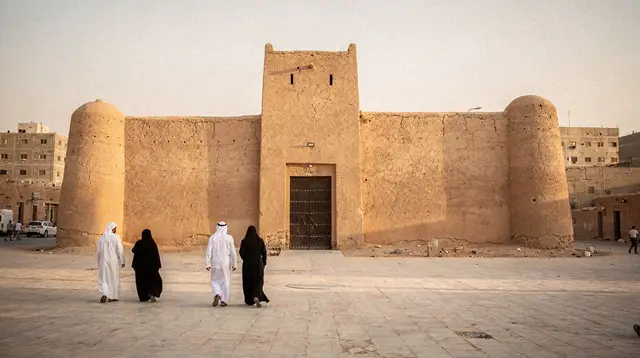
Start with the historic centre and heritage tours around Al Dirah and Deera. Masmak Fortress, taken in 1902 by Abdulaziz Ibn Saoud, is the small mud-brick fort that set off the chain of events leading to the kingdom’s founding in 1932 — two dates worth keeping straight, since guides and drivers sometimes blur them. Deera Square and Qasr Al Hukm sit nearby, and Souq Al Zal is a working traditional market for rugs, daggers, incense and antiques rather than a staged tourist stop.
For the modern city, the Kingdom Centre’s Sky Bridge (302 metres up) and Al Faisaliah Tower define the Olaya skyline, and the King Abdullah Financial District shows where Riyadh’s business district is headed. Wadi Hanifa cuts a green corridor through the west of the city with paths and parks, and Wadi Namar’s small reservoir lake sits further south — both are free, low-key ways to spend an afternoon outside without booking anything.
If you want a structured overview rather than picking sites yourself, a half-day guided tour of Riyadh’s main sights covers the historic centre and skyline in one go, which is useful on a short stay or a layover. Museum-minded travellers should budget separate time for the museum scene: the National Museum at the King Abdulaziz Historical Center is the country’s main history museum, paired with Murabba Palace, the fondateur’s former residence next door. A guided visit to the National Museum makes more sense of the exhibits than wandering through alone, particularly for the earlier periods of Saudi history that get little context abroad.
Riyadh Season, the city’s annual festival roughly from October to March, turns Boulevard City and Boulevard World into the busiest entertainment venues in town, with concerts, rides and pop-up events. If your dates overlap, expect heavier traffic near those venues in the evenings.
One more outing worth knowing about: the Riyadh Camel Market, about 30 kilometres east of the centre on the Khurais road, is one of the larger livestock markets in the region and a genuinely local scene rather than a set piece for visitors. A camel market tour is the easiest way to see it without navigating there yourself, since it is not on the metro and taxis rarely wait around.
Diriyah: a separate town, not a Riyadh district
Diriyah deserves its own section because it is one of the most common points of confusion for first-time visitors. It is not a Riyadh neighbourhood — it is the town where the first Saudi state was founded in the eighteenth century, sitting on the Wadi Hanifa northwest of the city. At-Turaif, its mud-brick citadel, was inscribed as a UNESCO World Heritage Site in 2010, and it is worth checking that date if anyone tells you otherwise. Across the wadi, Al Bujairi Terrace is where the restaurants and cafés are, with views back toward At-Turaif in the evening.
Diriyah tours typically combine a walk through the At-Turaif district with time at Al Bujairi Terrace, and it pairs naturally with a half day in Riyadh’s own historic centre since both cover the same period of Saudi history from different angles.
Desert day trips: what is actually a day trip
This is where a lot of Riyadh planning goes wrong, usually by underestimating drive times. The Edge of the World day trip — Jebel Fihrayn, an escarpment of the Tuwaiq range — sits 90 to 100 kilometres northwest of the city, which is two to two and a half hours of driving each way, with the last stretch on unpaved desert track that requires a 4x4. It is not a quick detour, and it is not a coastal view: there is no sea anywhere near it, despite the name. Access rules and opening periods shift, including closures during the hottest months, so book with an established operator and confirm current conditions before you go rather than relying on an old blog post. Sunset is the best time to visit, and there are no barriers at the cliff edge, so keep well back.
The Red Sand Dunes, about an hour west of the city along the Mecca road, are a shorter and easier outing — quad biking, sandboarding, dune bashing and sunset desert camps, all manageable in half a day if you skip a full overnight stay.
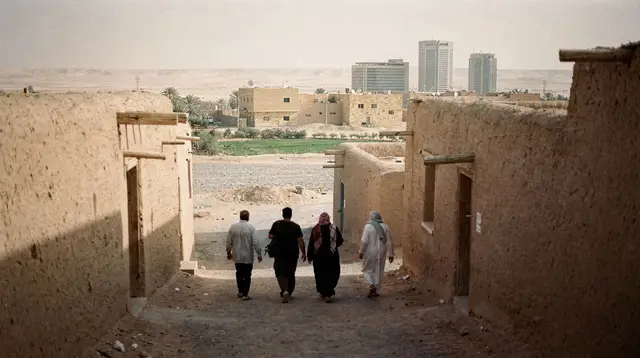
Further out, Shaqra and Ushaiger sit about two and a half hours northwest of Riyadh. Ushaiger Heritage Village is a restored mud-brick settlement with palm gardens, and Shaqra is an old Najdi town nearby — a longer but quieter alternative to the desert excursions closer to the city, better suited to a full day than a half day.
For something in between, a desert dinner and overnight camp is the closest most visitors get to a proper night under Saudi stars. A sunset dinner in the desert near Riyadh — commonly around Thumamah to the north or the Red Sand Dunes to the west — combines the scenery with dinner and stargazing without committing to a full overnight camp. If you want to try more than one desert activity in the same outing, look at the broader desert safari options, which range from a few hours to a full day depending on what is bundled in.
Al-Qassim and multi-day options: further afield, on purpose
Al-Qassim, centred on Buraydah, is a longer excursion than anything covered above — realistically most of a day just in driving, so treat it as a deliberate choice for a longer stay rather than something to squeeze in alongside a city visit. The Qassim day trip page has the practical detail if you want to add it.
AlUla sits in a different category altogether. It is roughly a one hour 45 minute flight from Riyadh, and the only sensible way to see it in connection with this trip is a multi-day tour that explicitly departs from Riyadh and includes the flight and accommodation. A full-day or multi-day tour booked as a package, such as a full-day VIP tour with private transport, is a reasonable way to cover ground efficiently if your schedule is tight — but check exactly what is included before assuming it reaches somewhere like AlUla, Jeddah, Mecca or Medina, none of which are within day-trip range of Riyadh.
Getting to and around Riyadh
You will land at King Khalid International Airport (RUH), about 35 kilometres north of the centre — figure 30 to 45 minutes to Olaya outside peak hours, and longer during the evening rush.
Riyadh is built for cars, and distances between attractions are longer than they look on a map. The Riyadh Metro is a genuinely useful addition: a six-line automated network that opened in stages between December 2024 and early 2025, connected to the airport, and worth using for city-centre trips where a station lines up with your route. For everything else — and for every desert excursion — Uber and Careem or a licensed taxi cover most needs, and a private driver is the norm for trips out to the desert rather than the exception. Driving is on the right, and women have been able to drive in Saudi Arabia since 2018, so a self-drive rental is a legitimate option if you prefer it.
Money, connectivity and everyday practicalities
The currency is the Saudi riyal (SAR), pegged to the US dollar. Cards and contactless payment work almost everywhere, including small shops, so carry only a modest amount of cash for souqs and for isolated desert stops where card readers are unreliable. See money, cards and payments in Riyadh for more detail.
Arabic is the local language, but English is widely used in hotels, malls and on organised tours, so language is rarely a practical barrier for visitors sticking to the areas covered in this guide.
Power sockets are Type G at 230V/60Hz — the same standard used in the UK — so bring the right adapter if you are travelling from elsewhere. Riyadh runs on Arabia Standard Time, UTC+3, all year round, with no seasonal clock change to account for.
What to wear and how strict the rules really are
This is worth stating plainly, because outdated advice circulates constantly: the abaya is not required for foreign women visiting Riyadh. What is expected, of everyone, is modest dress in public — shoulders and knees covered, nothing tight or sheer. A headscarf is only necessary inside mosques, not as a general rule around the city. See what to wear in Riyadh for a fuller breakdown by activity, since desert excursions and city sightseeing call for slightly different practical choices.
Alcohol is banned throughout Saudi Arabia, with no exception for international hotels — do not expect a bar or a wine list anywhere, and do not assume a hotel will make an exception. Public displays of affection are frowned upon, and photographing people (women especially) without asking, or photographing government, military or security buildings, is best avoided entirely.
The weekend runs Friday and Saturday, not Thursday and Friday, and Friday midday around the main prayer is the quietest stretch of the week, with some shops and restaurants pausing briefly around prayer times generally.
Visas and timing
Saudi Arabia opened to tourism in September 2019, and that recent opening is exactly why so many visitors assume, wrongly, that no visa is needed. Most Western nationalities — EU and Schengen countries, the UK, the US, Canada, Australia, Japan, South Korea and others — need an e-Visa applied for online through the official visa.visitsaudi.com portal, or a visa on arrival for eligible nationalities. Only citizens of Gulf Cooperation Council countries travel visa-free. Keep your passport valid for at least six months, and check the official e-Visa and entry rules page for current requirements rather than relying on a fixed fee quoted anywhere, since amounts change.
For timing your trip, the best time to visit is November to March, when days are mild — roughly 20 to 25°C from December to February — and desert nights turn cold. May through September runs consistently hot, often above 40°C, which pushes desert excursions to early morning or late afternoon. Rain is rare, and sandstorms are possible in spring and summer. If your visit overlaps with Ramadan, dates shift about 11 days earlier each year, eating, drinking and smoking in public during the day is not permitted, and many venues adjust their hours toward the evening — worth planning around rather than working against.
Booking tours: GetYourGuide and Viator in Riyadh
Riyadh’s tour catalogue on GetYourGuide has grown substantially — around 139 activities across 20 categories at last count, spanning city tours, desert safaris, camel and horse rides, and museum visits, with Viator as a second option worth checking for the same activity. Prices below are approximate and change with the season, so treat the ranges as a starting point and confirm the current rate on the booking page before you commit.
| Activity type | Typical duration | Rough price range |
|---|---|---|
| City and heritage tour | Half day | Check current listing |
| Diriyah / At-Turaif tour | Half day | Check current listing |
| Edge of the World day trip | Full day | Check current listing |
| Red Sand Dunes excursion | Half day | Check current listing |
| Desert dinner / overnight camp | Evening or overnight | Check current listing |
| Multi-day tour (incl. AlUla) | Multiple days | Check current listing |
Rather than repeat pricing that goes stale within weeks, each activity page above links through to the live GetYourGuide or Viator listing, where the date-specific price and availability are always current.
How many days do you actually need
For a first visit, three days covers the historic centre, the modern skyline, and Diriyah at a comfortable pace, with a half day left over for a museum or the camel market. Add a fourth day for one desert excursion, and a fifth if you want both the Edge of the World and the Red Sand Dunes rather than choosing between them — see how many days in Riyadh for a longer breakdown against different interests and paces.
Things to do in Riyadh: frequently asked questions
Is Riyadh worth visiting for a few days?
Yes. Two to three days cover the historic centre, Diriyah, and one desert day trip without rushing. A longer stay lets you add a museum, a second desert excursion, or a longer trip to Al-Qassim.
Do women have to wear an abaya in Riyadh?
No. Modest dress covering shoulders and knees is expected of everyone, but the abaya is not required for foreign women. A headscarf is only needed inside mosques.
Can you drink alcohol in Riyadh, even at a hotel?
No. Alcohol is banned across Saudi Arabia, including in international hotels, and there is no legal workaround for visitors.
Do I need a visa to visit Riyadh?
Most Western visitors need an e-Visa or visa on arrival, applied for through the official visa.visitsaudi.com portal. Only citizens of Gulf Cooperation Council countries travel visa-free.
Is there a metro in Riyadh?
Yes. The Riyadh Metro is a six-line automated network that opened in stages between December 2024 and early 2025, and it connects to the airport.
How far is the Edge of the World from Riyadh?
It is roughly 90 to 100 kilometres northwest of the city, which works out to about two to two and a half hours of driving each way, including an unpaved final stretch that needs a 4x4.
What is the weekend in Saudi Arabia?
Friday and Saturday. Friday midday, around the main prayer, is the quietest point of the week in Riyadh.
Can I do AlUla as a day trip from Riyadh?
No. AlUla is about a one hour 45 minute flight from Riyadh and belongs in a multi-day trip, not a day trip from your Riyadh hotel.
Planning tips for visiting Riyadh on GetYourGuide
Verified deep-linked GetYourGuide tours. Book through these links and we earn a small commission at no cost to you.
GetYourGuide does not provide a product photo for this activity — the image shows the meeting point, photographed by us.