How many days do you need in Riyadh?
How many days should I spend in Riyadh?
Two full days cover the city itself — the historic centre, Masmak Fortress, the King Abdulaziz Historical Center and the modern skyline. Add a third day for Diriyah and At-Turaif, and a fourth if you want a full day trip to Edge of the World or the Red Sand Dunes. Al-Qassim is a longer, optional add-on best kept for a fifth day or a return trip.
Two days covers the city; more time buys you the desert
The honest answer is that Riyadh splits cleanly into two kinds of time: time spent inside the city, where distances are manageable and traffic is the main variable, and time spent getting out to the desert, where the drive itself is a large share of the day. Deciding how many days you need really means deciding how many of those desert days you want, on top of a base of city time.
As a starting point: two days is enough to see Riyadh itself properly. Three days lets you add Diriyah and At-Turaif without feeling rushed. Four days makes room for one full desert excursion — Edge of the World or the Red Sand Dunes, not both. Five days or more is where Al-Qassim or a second desert day becomes realistic, and where the trip stops feeling like a checklist.
None of this is about ticking off sights against the clock. It is about being honest that Riyadh is a car city, that the desert sites are genuinely far, and that a good chauffeur-driven day in the desert is worth more than two rushed half-days.
Day one and two: what “the city” actually means
Riyadh’s city time splits into two halves that pair naturally into two days, or can be compressed into a long single day if that is all you have.
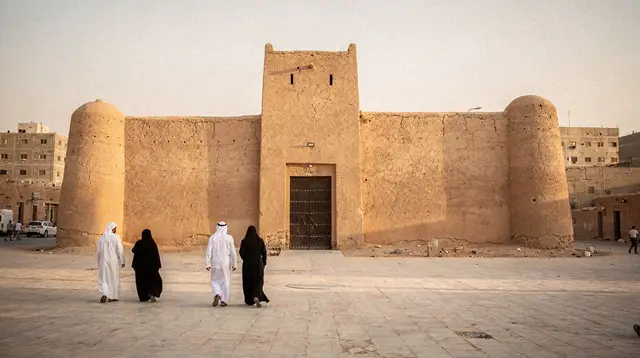
The first half is the historic centre, Al Dirah/Deera: Masmak Fortress, the modest brick citadel taken in 1902 by Abdulaziz Ibn Saud — the event that led to the founding of the modern kingdom three decades later, in 1932. Nearby, Deera Square and Qasr Al Hukm sit around the old government quarter, and Souq Al Zal is a genuine working market for rugs, daggers, incense and antiques rather than a staged tourist stop. A short drive away, the King Abdulaziz Historical Center at Al Murabba houses the National Museum of Saudi Arabia and the Murabba Palace, the founder’s former residence. Together, this half-day is unhurried but complete by early afternoon.
The second half is modern Riyadh: the Kingdom Centre, 302 metres tall with its Sky Bridge near the top, the Al Faisaliah Tower with its distinctive sphere, and the King Abdullah Financial District (KAFD). If your visit overlaps with Riyadh Season, roughly October to March, Boulevard City and Boulevard World are the festival’s main venues and worth an evening rather than a daytime visit. Wadi Hanifa, the green valley that cuts through the west of the city, and Wadi Namar’s reservoir lake to the south are good half-day options if you want a break from museums and towers, and the Riyadh Camel Market, about 30 km east on the Khurais road, is a genuine working market rather than a photo-op built for visitors.
Trying to cram the historic centre and the modern skyline into a single day is possible but tight, and it leaves no slack for Riyadh’s peak-hour traffic. Two unhurried days, or one long day if that is genuinely all you have, is the realistic range.
Day three: Diriyah and At-Turaif, a separate trip in all but name
Diriyah is not a Riyadh neighbourhood — it is a distinct town on the Wadi Hanifa, north-west of the city, and the birthplace of the first Saudi state in the eighteenth century. Treat it as its own outing rather than an add-on to a city-centre morning.
At-Turaif District, the mud-brick citadel of the Al Saud, has been a UNESCO World Heritage Site since 2010. Across the wadi, Al Bujairi Terrace is the restaurant and cafe district, and it is genuinely worth timing your visit for early evening, when the citadel is lit and the terrace fills up for dinner. A reasonable pattern is a late-afternoon visit to At-Turaif followed by dinner at Bujairi, which turns the outing into a half-day rather than a rushed hour.
Given the drive out, the site itself, and the drive back into evening traffic, treating Diriyah as its own half-day — or its own day if you also want time at the museum inside At-Turaif — is more realistic than bolting it onto the end of a city-centre morning.
Day four: one desert excursion, chosen deliberately
This is where trip length genuinely branches, because Riyadh’s two signature desert excursions pull in different directions and neither is a quick trip.
Edge of the World, known locally as Jebel Fihrayn, is an escarpment of the Tuwaiq desert roughly 90 to 100 km north-west of Riyadh — about two to two and a half hours of driving each way, with the final stretch on unpaved desert track that requires a 4x4. Access rules and seasonal closures change, so book through an established tour and confirm current conditions before you go rather than assuming it is always open. Sunset is the best time to visit, and there are no barriers at the cliff edge, so keeping a sensible distance matters.
The Red Sand Dunes sit about an hour west of Riyadh along the Mecca road — quad biking, sandboarding, dune bashing and sunset desert camps are the draw, and the shorter drive makes this the easier half-day of the two.
Because of the driving time involved, most visitors choose one of the two rather than attempting both in a single trip. A private driver is the norm for either excursion — self-driving on unmarked desert tracks is not something most visitors should plan around, and a driver who knows current road and access conditions is worth the arrangement.
Further out, Ushaiger Heritage Village, a restored mud-brick village with palm gardens near the older Najdi town of Shaqra, sits about two and a half hours north-west of Riyadh — roughly the same order of driving as Edge of the World, and best treated as an alternative to it rather than an addition, unless you have a fifth day to spare.
A full desert day trip that pairs dune driving with a Bedouin-style camp is a practical way to see this side of the desert without arranging your own 4x4 and driver.
Day five and beyond: Al-Qassim and second desert days
Al-Qassim, centred on Buraydah, is a genuinely longer excursion from Riyadh and a secondary destination on any itinerary — worth knowing about, not worth prioritising over the city and the closer desert sites. If you have five days or more and have already covered central Riyadh, Diriyah and one desert excursion, Al-Qassim becomes a reasonable way to use extra time rather than repeating a site you have already seen.
The same logic applies to a second desert day: once the city and Diriyah are done, adding both Edge of the World and the Red Sand Dunes across two separate days, rather than trying to combine them, is the more comfortable way to see both.
A bundled three-day Riyadh package that pairs accommodation with guided city and heritage visits is a reasonable frame for exactly this middle length of trip.
Why driving time matters more than distance here
Riyadh is a genuinely car-dependent city, and this shapes trip length more than raw kilometres do. King Khalid International Airport (RUH) sits about 35 km north of the centre, and the drive to Olaya takes roughly 30 to 45 minutes outside peak hours — longer when it is not. The Riyadh Metro, a six-line automated network that opened in stages between December 2024 and early 2025 and connects to the airport, is genuinely useful for fixed point-to-point trips within the city, and Uber and Careem cover most other city journeys. None of this changes the calculus for desert excursions, where a private driver remains the norm and the drive itself — not the metro, not a taxi app — is the main variable in how long the day takes.
The practical consequence: build slack into any day that includes both a city stop and a desert or Diriyah excursion, and schedule desert trips outside the worst of the afternoon traffic where you can. A day trip billed as “half-day” on paper can run long once transfer time in both directions is added on.
A desert dinner and sunset excursion is a good example of a trip designed around this reality — it starts in the late afternoon specifically to avoid the worst of the heat and the worst of the traffic.
A simple framework by trip length
| Days available | Reasonable plan |
|---|---|
| 1 day | Either the historic centre or the modern skyline — not both, and no desert excursion |
| 2 days | Full city: historic centre one day, modern Riyadh and Wadi Hanifa or Wadi Namar the next |
| 3 days | City (2 days) plus Diriyah and At-Turaif as a half- or full-day add-on |
| 4 days | City, Diriyah, and one desert excursion — Edge of the World or the Red Sand Dunes |
| 5+ days | Add a second desert day, Ushaiger and Shaqra, or Al-Qassim as a longer, secondary trip |
This is a starting framework, not a fixed rule — someone travelling with kids, on a tight budget, or without much tolerance for early starts will want to adjust it. See things to do in Riyadh with kids or Riyadh on a budget for those adjustments; this page only covers the length-of-stay decision itself.
If you are trying to decide between a shorter trip focused on the city alone or building in desert time, the two-day, three-day, and five-day itineraries walk through exactly this, day by day. For a trip built specifically around combining the city with one or two desert excursions, Riyadh and the desert in four days lays out a sequence that respects the driving-time constraints above rather than assuming everything is close together.
A private full-day city and heritage tour is worth considering if you are on the shorter end of this range and want a driver who can move efficiently between the historic centre and the modern skyline without you having to plan the route yourself. And for the historic centre specifically, a guided city tour of central Riyadh covers Masmak Fortress and the old town at a pace that fits comfortably into a single morning.
FAQ: how long to stay in Riyadh
Is one day enough in Riyadh?
One day is enough only if you pick a single focus, such as the historic centre and Masmak Fortress, or the modern skyline around KAFD and Kingdom Centre. Trying to combine the city centre with a desert excursion in one day usually means rushing both and sitting in traffic in between.
Do I need to visit Diriyah on a separate day from central Riyadh?
You do not strictly need a separate day, but it works better as one. Diriyah and At-Turaif sit north-west of the city, and combining them with a full morning in the old city centre the same day usually means cutting one of the two short.
How much time should I set aside for Edge of the World?
Plan on this taking most of a day, door to door, once you count the drive out, the time on-site and the drive back through Riyadh traffic on the return leg. It is not a half-day add-on.
Can I do Edge of the World and the Red Sand Dunes on the same day?
Not comfortably. Both are half- to full-day excursions in different directions from Riyadh, and combining them turns into a long day of driving with little time at either site. Most itineraries pick one per visit.
Is Al-Qassim worth adding to a Riyadh trip?
Only if you already have four or five days and have covered the city and the closer desert sites first. Al-Qassim is a longer excursion and a secondary destination on this itinerary, not a must-do.
What is the minimum for someone on a layover?
A single day lets you see either the old city centre or the modern skyline, but not both at a comfortable pace, and it rules out any desert excursion given the drive time involved.
Does traffic really change how many days I need?
Yes. Riyadh is a car-dependent city, and peak-hour traffic can meaningfully extend a cross-town transfer. Building in a buffer, or scheduling desert excursions outside peak hours, is more useful here than optimising the map distance.
Planning tips for visiting Riyadh on GetYourGuide
Verified deep-linked GetYourGuide tours. Book through these links and we earn a small commission at no cost to you.
GetYourGuide does not provide a product photo for this activity — the image shows the meeting point, photographed by us.