Uber and Careem in Riyadh
Are Uber and Careem good enough to get around Riyadh?
Yes, for city trips. Uber and Careem cover Olaya, Al Malqa, KAFD and the historic centre well and are the default way visitors move around Riyadh. For excursions into the surrounding desert, a private driver booked as a tour is the norm, not a one-off ride-hail trip.
Getting around Riyadh without renting a car
Riyadh is a driving city. Distances between neighbourhoods are longer than they look on a map, and traffic builds fast around Olaya, King Fahd Road and the approaches to King Abdullah Financial District (KAFD) during the morning and evening rush. Walking between sights, the way you might in a compact old-town destination, rarely works here. That leaves most visitors with three practical options: drive yourself, use the Riyadh Metro for structured routes, or let someone else drive. This page is about the third option — Uber, Careem and agreed taxis — and about being honest with yourself about when a ride-hail app is the right tool and when it isn’t.
Both apps work the way they do in most major cities: you set a pickup and drop-off, see an estimated fare before confirming, and pay through the card on file. Coverage across the city is good, cars are plentiful in central areas, and English works fine inside the app even where a driver’s spoken English is limited, since destinations are set by pin rather than by conversation.
Setting up both apps before arriving in Riyadh saves time at the airport curb: language, a payment card and a saved hotel address can all be confirmed in advance, so the first ride of the trip isn’t spent figuring out the interface. Pickup points at hotels, malls and King Khalid International Airport are generally well marked, and dropping a pin on the entrance you can actually see, rather than typing an address, tends to get a more accurate arrival than guessing at a building name.
Where Uber and Careem genuinely work well
For point-to-point trips inside the built-up parts of Riyadh, ride-hail is close to ideal. It covers the corridor most visitors actually live in: hotels around Olaya and Al Malqa in the north, business meetings or malls in KAFD, and the older streets of Al Dirah and Deera in the historic centre. A ride from an Olaya hotel to Masmak Fortress or Deera Square is a short, predictable trip with no ambiguity about where to park.
The same applies to restaurants, Boulevard World and Boulevard City during Riyadh Season, and evening trips where parking is scarce or valet queues are long. During the festival months, roughly October to March, both apps see heavier demand around the boulevard venues, so fares and wait times climb in the hour before major shows or fireworks. Building in extra time on those nights is worth more than trying to time the app perfectly.
Airport transfers are another strong use case. Both apps serve King Khalid International Airport (RUH), roughly 35 kilometres north of the centre, and the ride to Olaya typically runs 30 to 45 minutes outside peak hours. That window stretches noticeably during rush periods, so an airport pickup scheduled for a specific flight should assume the longer end of the estimate. The metro also reaches the airport now, and travellers weighing the two options can compare them directly in Metro vs Uber in Riyadh.
Trips to Diriyah sit in a middle zone. Diriyah is a distinct town northwest of Riyadh along Wadi Hanifa, not a city neighbourhood, so the drive takes longer than a typical in-city hop — often 30 to 45 minutes depending on traffic and exactly where in Diriyah you’re headed. A ride-hail trip there and back works fine for a half-day visit to At-Turaif or Al Bujairi Terrace, and demand is usually manageable outside weekend evenings. Details on the drive itself are in How to get to Diriyah.
Uber vs Careem: is there a real difference in Riyadh
Both apps cover the same ground in practice, so the choice mostly comes down to whichever shows a better fare or shorter wait at the moment of booking. Careem has deeper roots in the Gulf and slightly wider coverage in some residential pockets outside the main tourist corridor, while Uber’s interface and support are identical to what most international visitors already know from other cities. Neither app requires a local phone number to install, though a working payment card and a data connection are needed either way — see Staying connected in Saudi Arabia for getting a SIM or eSIM sorted on arrival. Checking both apps side by side for a couple of minutes before booking a longer trip, such as the airport run or a Diriyah visit, is a habit worth keeping for the whole stay, since the gap between the two can vary from one time of day to the next.
Where ride-hail stops being the right tool
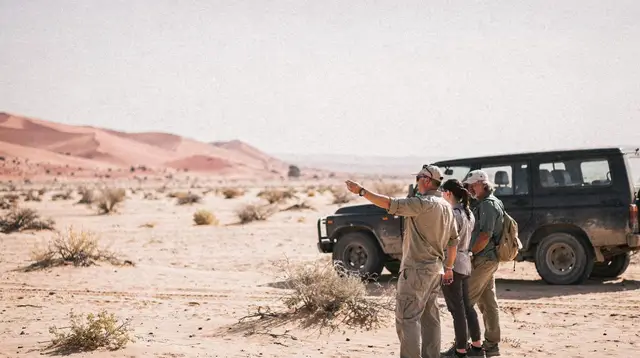
The honest limit of Uber and Careem in Riyadh is the desert. For a day trip to Edge of the World, the drive alone runs roughly 90 to 100 kilometres and 2 to 2.5 hours each way, and the last stretch is unpaved, requiring a 4x4 rather than a standard sedan. A ride-hail driver picked up spontaneously in Olaya is not equipped or, in most cases, willing to take that route, wait several hours at the site, and drive back after dark on unlit desert tracks. This is not a gap in app coverage; it’s a mismatch between what the product is built for and what the trip requires.
The same logic applies to the Red Sand Dunes and to Shaqra and Ushaiger, a heritage village trip that runs about 2.5 hours from Riyadh. These are excursions with a fixed itinerary, waiting time built in, and often quad biking, dune bashing or a sunset camp attached — not a single point-to-point ride. For these, a private driver hired for the day, either independently or through a booked tour, is the practical norm. It’s also generally cheaper in effect than trying to string together multiple ride-hail legs with long waits between them, and far more reliable than hoping a driver accepts a return fare from the middle of the desert.
A private tour in Riyadh or a dedicated desert safari solves this cleanly: the vehicle, driver and route are arranged in advance, and getting back to the hotel isn’t left to chance. If you’d rather stay in the city and let someone else handle the whole day, a guided option covers ground you’d otherwise struggle to reach on your own.
A full-day private VIP tour of Riyadh with a dedicated driver removes the guesswork around parking, route-finding and timing for a longer city day, and works well for anyone who wants the flexibility of a private car without renting one themselves.
City tour vs desert tour: two different transport problems
| City trips (Olaya, KAFD, Al Malqa, Deera) | Desert trips (Edge of the World, dunes, Shaqra/Ushaiger) | |
|---|---|---|
| Typical distance | A few kilometres to 15-20 km | 90-150+ km round trip |
| Road surface | Paved throughout | Paved then unpaved final stretch |
| Vehicle needed | Standard sedan | 4x4 for the last leg |
| Booking style | On-demand, minutes | Arranged ahead, full or half day |
| Best tool | Uber, Careem, agreed taxi | Private driver or booked tour |
A day that mixes both
A common pattern for a short Riyadh trip is to use ride-hail for everything inside the city — hotel to the National Museum, museum to lunch, lunch to Kingdom Centre — and then book a separate private-driver day for the desert excursion. Trying to do both with the same tool usually means either overpaying a ride-hail driver to wait for hours in the desert, or under-preparing for a route the car and driver weren’t set up for.
If a city day out with a guide appeals more than self-directed ride-hailing, a guided city tour covering Riyadh’s main sights bundles transport and commentary together, which is often simpler than coordinating several separate rides.
Booking a driver instead of a ride
For the desert side of a Riyadh trip, the practical options are a private driver booked through a hotel or tour operator, or a full desert excursion that includes transport as part of the package. a one-day desert trip that includes transport from Riyadh is a straightforward way to get the driving handled without negotiating separately. For an evening out rather than a full day, a sunset dinner experience in the desert with transport included covers the return trip after dark, which is exactly the scenario where an ad hoc ride-hail booking is least reliable.
The same logic scales up for the Qassim region. A trip out to Al-Qassim and Buraydah is a full day of driving each way, well beyond what a ride-hail app is built for, and it’s covered separately in Qassim day trip from Riyadh and, for a longer stay, Riyadh, Ushaiger and Qassim in four days. A private driver or an organised tour is the only realistic way to make that trip and still get a comfortable return to a Riyadh hotel the same night or the following day.
Current fares for any of these change with demand and season, so checking the booking page for the day’s price is the only reliable way to know what a trip costs.
Combining the metro with a ride-hail app
For visitors weighing the Riyadh Metro against Uber and Careem, the two aren’t mutually exclusive. A common pattern is to use the metro for the core of a trip — a station near the hotel to a station near KAFD or the historic centre — and a short ride-hail leg to cover the last stretch to a specific address, since the six metro lines don’t reach every hotel or attraction door to door. Is the Riyadh Metro worth using for tourists goes into more detail on when one beats the other; in practice, most short-stay visitors end up using both at different points in the same day rather than picking one for the whole trip.
Practical notes
Both apps show driver name, plate number and car model before pickup, which is worth checking against the vehicle that actually arrives, especially outside major hotels where drivers sometimes queue for pickups. Fares are shown upfront and charged to the card on file, so no cash is needed for a standard ride, though it’s sensible to carry some for agreed taxis outside the main tourist areas. Riyadh’s driving is on the right, and self-driving is a legal option for any visitor with a valid licence — women have been able to drive in Saudi Arabia since 2018 — but that’s a separate decision covered in Renting a car in Riyadh.
Traffic is genuinely the biggest variable in any Riyadh transport plan. A trip that takes 15 minutes at 10am can take 40 minutes at 6pm on the same road. Building slack into airport transfers, dinner reservations and any timed booking is more useful here than picking the “best” app.
Ride-hail pickup and drop-off points don’t come with a dress code beyond the general modesty expected in public across Riyadh — see What to wear in Riyadh for specifics — and drivers are used to picking up visitors in ordinary travel clothing. During Ramadan, both apps keep running normally, but journey times can shift: traffic often thins out in the afternoon and spikes sharply around the evening meal, so booking a ride right at that time is worth avoiding if the schedule allows it. Visiting Riyadh during Ramadan covers the wider effect on opening hours and daily rhythm during that month.
Questions about Uber and Careem in Riyadh
Can I use Uber or Careem to reach the airport in Riyadh?
Yes. Both apps serve King Khalid International Airport, and the ride to or from Olaya usually takes 30 to 45 minutes outside peak traffic. The Riyadh Metro also connects to the airport, so travellers with light luggage sometimes combine the two.
Which app is more popular in Riyadh, Uber or Careem?
Both operate widely in Riyadh and cover essentially the same areas. Careem started in the region and has strong local coverage; Uber is equally common. Comparing live prices and wait times in each app before booking is the practical approach.
Can I book Uber or Careem for a trip to Edge of the World?
You can request a ride, but drivers are not set up for the unpaved final stretch, the waiting time at the site, or the return leg after dark. A private driver or a booked desert tour is the standard way to reach Edge of the World, not a ride-hail app.
Do taxi drivers in Riyadh use meters?
Agreed taxis at hotels and malls typically run on a set or negotiated fare rather than a strict meter, so confirming the price before departure avoids confusion. Ride-hail apps show the fare upfront, which is one reason many visitors prefer them for everyday trips.
Is it normal to tip Uber and Careem drivers in Riyadh?
A small tip is appreciated but not required, and it is not built into the app the way it is in some other markets. Most visitors round up or add a modest amount in cash for longer or more complicated trips.
Do I need cash for taxis and ride-hail in Riyadh?
No. Uber and Careem charge the card on file, and most agreed taxis also accept cards or contactless payment now. It is still worth carrying some cash for smaller, unmetered taxis or informal arrangements outside the city centre.
Is it safe for a solo woman to use Uber or Careem in Riyadh?
Ride-hail apps are widely used by solo female travellers in Riyadh, since the driver, route and fare are all recorded in the app. The same general precautions that apply anywhere else, such as confirming the licence plate before getting in, apply here too.
Getting around Riyadh on GetYourGuide
Verified deep-linked GetYourGuide tours. Book through these links and we earn a small commission at no cost to you.
GetYourGuide does not provide a product photo for this activity — the image shows the meeting point, photographed by us.