Masmak Fortress guide: the 1902 event, not the 1932 founding
What is Masmak Fortress and why is it important?
Masmak Fortress is a mud-brick fort in Riyadh's old quarter, Al Dirah (also called Deera), taken by Abdulaziz Ibn Saoud in 1902 in a raid that set his family back on the path to power. That raid is not the founding of Saudi Arabia itself, which came three decades later in 1932. The fort is now a small museum next to Deera Square and Qasr Al Hukm.
Two dates that keep getting merged into one
Ask a handful of visitors what happened at Masmak Fortress and most will say some version of “this is where Saudi Arabia was founded.” It’s close, but it collapses two separate events into one, and the fort’s own signage doesn’t always do enough to pull them apart.
In 1902, Abdulaziz Ibn Saoud, then in his early twenties and living in exile with his family in Kuwait, led a small raiding party back into Riyadh at night and retook Masmak Fortress from the garrison of the rival Al Rashid family, who had been holding the city. That single, local event restarted Al Saoud rule over Riyadh and the surrounding Najd region. It did not create a country. The unified Kingdom of Saudi Arabia, bringing together Najd, the Hejaz (home to Jeddah, Mecca and Medina) and other regions under one crown, was proclaimed in 1932, three decades after the raid, once decades of further campaigns had run their course.
So: 1902 is the retaking of one fort in one city. 1932 is the founding of the modern state. Both dates matter, and neither should stand in for the other. This page exists mostly to hold that line, because it’s the single most common mix-up in how old Riyadh gets described to visitors.
Where the fort actually sits
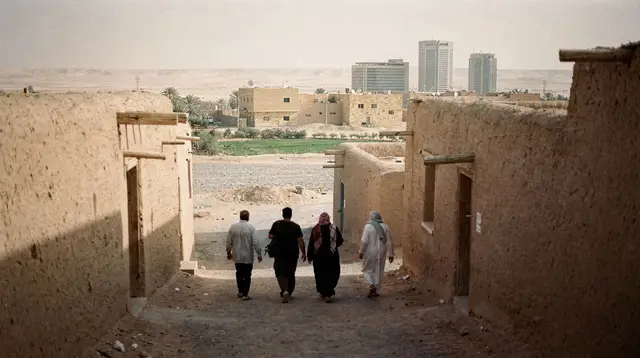
Masmak Fortress is in Al Dirah, also written Deera, Riyadh’s old administrative and market quarter, well inland from the glass towers of Olaya and King Abdullah Financial District (KAFD) that most visitors see first. This is the original heart of the city, and it still functions as one: government buildings, a working market and a historic fort sit within a few minutes’ walk of each other.
Deera Square, right in front of the fort, is a plain open plaza that has served as a public gathering space for generations. Qasr Al Hukm, the seat of the regional government and courts, stands next to it, a modern building on a historic site rather than a museum piece itself. Together the square, the courts building and the fort form the civic core of old Riyadh, distinct from the desert excursions and from Diriyah, the separate town northwest of the city where the Al Saoud story actually begins in the 18th century, a full century and a half before Masmak.
That distinction is worth holding onto: Diriyah and its At-Turaif district tell the earlier chapter of the same family’s history, from the founding of the first Saudi state in the 1700s through its fall in the early 1800s. Masmak tells a later, narrower chapter: one raid, one fort, one restart, in the city itself rather than in the countryside.
What the fort looks like and what’s inside
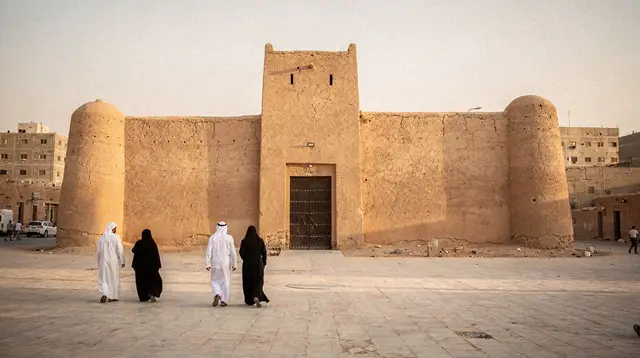
Masmak is a squat, thick-walled fort built from mud brick and clay, in the same construction style you’ll see at Diriyah’s At-Turaif, though on a smaller and more utilitarian scale. Corner towers, a heavy wooden gate studded with iron, and small window slits rather than large openings, all built for defense rather than display. It’s not a grand palace; it’s a functional garrison building, which is part of why the 1902 raid worked at all: a small, determined group could take it by surprise rather than by siege.
Inside, the fort now operates as a museum covering the retaking of Riyadh and the early Al Saoud period, with rooms arranged around a central courtyard. Exhibits include weapons, photographs, and some explanation of the raid itself, along with a look at traditional Najdi architecture and daily life of the period. It’s compact: a visit runs 45 minutes to a little over an hour for most people, closer to 30 minutes if you’re moving quickly.
One detail people often ask about: a wooden door reportedly still shows the mark left by a spear thrown during the 1902 raid. It’s a small thing, but it’s the kind of physical detail that makes the date easier to remember correctly, rather than folding it into the vaguer, later story of 1932.
Deera Square and Qasr Al Hukm, right outside
Deera Square itself is unremarkable to look at during the day, a large paved open space rather than a landscaped plaza. Its significance is civic rather than visual. Qasr Al Hukm, the government and justice complex bordering the square, is a working building rather than a historic relic, rebuilt in a style that nods to the older fort architecture without pretending to be original.
Neither site needs much time on its own, but both are worth the few minutes’ walk from Masmak, if only to see how the old administrative core of the city still functions as one connected space rather than a set of separate tourist stops.
Souq Al Zal, two minutes’ walk away
Souq Al Zal sits just beside this cluster, a traditional market selling rugs, daggers, incense, antiques and secondhand goods in a warren of narrow covered lanes. It’s a genuinely different register from Masmak: less about a specific historical event, more about browsing and haggling in a working market that has operated in some form for a long time. If Masmak is the history stop, Souq Al Zal is the atmosphere stop, and doing both back to back on foot is the natural way to spend a couple of hours in Al Dirah. A fuller look at the market, what’s actually worth buying and what’s mostly reproduction, is covered separately at Souq Al Zal.
What’s a short drive further: Murabba and the national museum
The King Abdulaziz Historical Center, in the Al Murabba area, is a longer walk or a short taxi ride from Masmak rather than a next-door stop. It houses the National Museum of Saudi Arabia, which covers the country’s history at far greater depth and scale than Masmak’s small exhibits, plus Al Murabba palace itself, Abdulaziz’s former residence built after Riyadh had already been secured. If Masmak covers the moment of 1902, the historical center covers everything that followed, including the eventual 1932 founding, in proper museum depth. The two sites complement each other rather than repeat each other, and the fuller comparison of what each place actually does well sits at Murabba Palace and King Abdulaziz Historical Center and at the national museum guide.
Visiting independently vs booking a tour
Masmak is straightforward to visit on your own. It’s centrally located, signage covers the basics in English and Arabic, and the layout is small enough that you won’t get lost. Independent visitors typically combine it with a walk to Deera Square, Qasr Al Hukm and Souq Al Zal, all within a few minutes on foot, which covers the old-town cluster in a morning or afternoon without needing transport between stops.
Where a guide adds real value is context and pacing across a longer route. A walking-focused option covering the fort itself in detail is the Walking Tour al Masmak Fortress in Old Riyadh, useful if you want the 1902 story told properly rather than pieced together from signage.
If you’d rather have someone connect Masmak with the market and Murabba palace in one outing, without working out the walking order or a driver between stops, the Riyadh: Masmak Fort Souq Alzal and Murabba Palace Tour covers that cluster as a single itinerary, which is efficient if your time in old Riyadh is limited to half a day.
For visitors who want the national museum’s deeper collection included alongside the fort, and don’t mind paying more for a smaller group and a vehicle, the VIP Riyadh Half Day Almasmak National Museum Kingdom Tower pairs the historic core with the modern skyline in one guided half-day, which suits visitors on a tighter overall Riyadh schedule who want both the old town and the Kingdom Centre view in the same booking. As with anything booked ahead, treat the price shown on the listing as the current figure rather than anything quoted here.
If your priority is covering as much of central Riyadh as possible in one guided day rather than focusing narrowly on the old town, the Riyadh: Full Day City Tour Guided with Transport typically works Masmak and the old-town cluster into a wider loop that also takes in the modern skyline, which suits visitors who’d rather not stitch together separate bookings for the historic core and the rest of the city.
Getting there and timing your visit
Al Dirah sits well inland from the airport and from most business hotels in Olaya and Al Malqa. Coming from King Khalid International Airport (RUH), figure on a longer drive than the 30 to 45 minutes to Olaya, since Al Dirah is further into the older part of the city; traffic timing matters more than raw distance here, and Riyadh’s rush hours can stretch any trip across town. Uber and Careem cover the route reliably, and the Riyadh Metro’s newer lines have started bringing parts of the old city within reach, though checking current station coverage before relying on it for this specific trip is worth doing, since the network opened in stages between December 2024 and early 2025 and coverage has kept expanding.
Riyadh drives on the right, and self-driving is a normal option for this trip, not just a fallback: women have been permitted to drive in the Kingdom since 2018, so a rental car works as well for couples or families as it does for a solo visitor, and it removes any dependence on ride-hailing availability at odd hours. If you’d rather not drive yourself in city traffic, Careem and Uber remain the simplest point-to-point option for a hop to Al Dirah, and the renting a car in Riyadh guide and the Riyadh Metro guide both go into more detail than fits here on choosing between the two for a trip built mostly around old-town and city stops rather than the desert.
Morning is the more comfortable time to walk Deera Square and Souq Al Zal, before the midday heat sets in for most of the year; the fort’s museum interior is air-conditioned regardless. More broadly, November through March is the most comfortable stretch for walking any part of old Riyadh at length, with daytime temperatures typically in the 20s Celsius, while May through September regularly pushes past 40°C, at which point a morning visit to Masmak followed by an air-conditioned stop nearby is the more realistic plan rather than a long walking loop through Deera Square and the souq.
The best time to visit Riyadh guide and Riyadh in summer cover that seasonal trade-off in more depth. Friday’s midday prayer period is the quietest stretch of the week citywide, including here, and some shops in the adjoining souq may pause briefly around prayer times generally. None of that should require much planning around; it’s a matter of not being surprised by a short lull rather than a scheduling obstacle.
Dress the way you would anywhere else in central Riyadh: modest clothing covering shoulders and knees for everyone is the expectation in public, but there’s no requirement for women to wear an abaya, and no headscarf requirement outside of mosque interiors. Old Riyadh isn’t more conservative on this point than the rest of the city, whatever the fort’s historic setting might suggest. The what to wear in Riyadh guide covers this in more general detail if you’re packing for the whole trip rather than just this stop.
Money, dress and timing basics for this stop
A few basics apply here the same way they apply everywhere else in the city. The riyal (SAR) is pegged to the US dollar, and cards are accepted almost everywhere, including small shops in and around Souq Al Zal, though it’s worth carrying a little cash for the souq’s smaller stalls; the money, cards and payments in Riyadh guide covers this fully. Alcohol isn’t available anywhere in Riyadh, Masmak included, a rule that surprises some first-time visitors more than the dress code does.
The local weekend runs Friday and Saturday rather than Saturday and Sunday, which matters if you’re timing a visit around when Deera Square and the surrounding streets are busiest or quietest; see the Saudi weekend: Friday and Saturday for how that plays out across the city. If your trip falls during Ramadan, expect shifted hours around the old town generally and no eating, drinking or smoking in public during daylight, which affects the souq and nearby cafés more than the fort’s interior itself; the visiting Riyadh during Ramadan guide has the fuller picture. Riyadh runs on Arabia Standard Time, UTC+3, year-round, with no seasonal clock change to account for when you’re timing a visit against opening hours back home.
Where Masmak fits in a wider Riyadh visit
For a first stay, Masmak works best as part of a half-day covering old Riyadh rather than as a stop on its own; the things to do in Riyadh overview and a structured one-day Riyadh itinerary both fold it into a broader plan alongside the modern skyline and, time permitting, Diriyah. If you’re deciding between spending your limited old-town time here versus at Diriyah, the direct comparison at Diriyah vs old Riyadh: Masmak lays out what each place actually adds, since they cover different centuries and different kinds of sites rather than overlapping ground.
For general orientation before you go, Riyadh’s city and heritage tours and, for anyone weighing a private option instead of a group tour, private tours in Riyadh are the wider references worth checking before booking anything specific. And if history isn’t the day’s main draw, the general Riyadh Metro guide and Uber and Careem in Riyadh cover how to get around the rest of the city without a hitch.
The short version to keep straight: Masmak, 1902, one fort, one raid, one restart of Al Saoud rule in Riyadh. The founding of the Kingdom of Saudi Arabia itself, 1932, thirty years and a much longer campaign later. Everything else at this stop, Deera Square, Qasr Al Hukm, Souq Al Zal, is context around that one narrow, well-documented event.
Riyadh city and heritage tours on GetYourGuide
Verified deep-linked GetYourGuide tours. Book through these links and we earn a small commission at no cost to you.
GetYourGuide does not provide a product photo for this activity — the image shows the meeting point, photographed by us.