Murabba Palace and King Abdulaziz Historical Center
What is the King Abdulaziz Historical Center in Riyadh?
It is a museum complex in the Al Murabba district that combines the National Museum of Saudi Arabia, open since 1999, with Murabba Palace, the former residence of the kingdom's founder. It tells the national story through exhibits and period rooms, unlike Masmak Fortress, which sits on the actual 1902 event site with no museum collection.
Two ways to tell the same founding story
Riyadh keeps its founding story in two places, and they are not the same place. Masmak Fortress in Al Dirah is the physical site of the 1902 raid led by Abdulaziz Ibn Saud, the event that set the modern kingdom in motion three decades before its formal founding in 1932. Walk through Masmak and you are standing where it happened, but the building itself carries almost no explanatory material — a few doors, a courtyard, and the famous spear mark in the main gate.
The King Abdulaziz Historical Center, in the Al Murabba district, is the other half of that story: the museum version. It groups the National Museum of Saudi Arabia, open since 1999, with Murabba Palace, the former residence King Abdulaziz built as his household and administrative base. Together they turn the same national narrative into curated galleries, period rooms, and a sense of how the founder actually lived, rather than the single dramatic moment Masmak preserves.
Neither site replaces the other. If you only have time for one, decide based on what you want: the unfiltered site of the event, or the fuller narrative arc with context, artefacts, and a lived-in palace. Many visitors do both, on the same day or across a short three-day Riyadh itinerary, and the pairing works better than either alone.
Where Al Murabba sits, and why it is not Al Dirah
This is the point that trips up a lot of first-time visitors: Al Murabba and Al Dirah/Deera are two different districts. Al Dirah is old Riyadh, the historic core where Masmak Fortress, Deera Square, Qasr Al Hukm, and Souq Al Zal cluster within a short walk of each other. Al Murabba lies a short drive away, further into what was, a century ago, the edge of the city and is now well inside it.
The confusion is understandable because both districts get folded into “Riyadh’s historic centre” in casual conversation, and some tour itineraries do visit both in a single loop. But if you’re planning your own route rather than joining an organised things to do in Riyadh tour, treat them as two stops with a transfer between them, not two buildings on the same street. Budget the drive time; traffic between the districts varies with the hour, and Riyadh’s road network rewards a little slack in any plan.
What the National Museum actually covers
The National Museum of Saudi Arabia opened in 1999 as the centrepiece of the King Abdulaziz Historical Center, and its galleries move chronologically from the earliest human presence on the Arabian Peninsula through pre-Islamic kingdoms, the arrival of Islam, and the political fragmentation that preceded unification, ending with the story of Abdulaziz Ibn Saud and the founding of the modern state.
What sets it apart from Masmak is density of material. Where Masmak gives you a building and a plaque, the museum gives you scaled dioramas, calligraphy and manuscript displays, weapons and everyday objects from different periods, and multimedia rooms that walk through the unification campaigns in sequence. If your interest in Saudi history goes beyond “this is where the raid happened” and toward “how did the country actually come together,” the museum is where that gets answered in depth.
It is also, practically, an air-conditioned option — useful context if your visit falls in the hotter months, when an afternoon indoors is a reasonable trade against the heat outside. For a broader sense of how museum time fits into a wider Riyadh trip, see Riyadh museum tours, which also covers the Black Gold Museum if the oil-industry side of the country’s modern history interests you.
Murabba Palace: the founder’s household, not a throne room
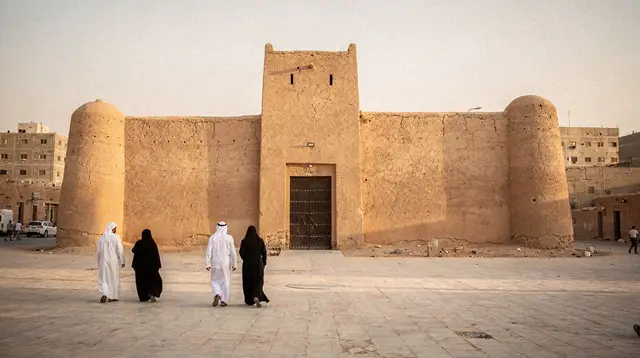
Murabba Palace is the residential half of the complex, and it reads differently from the museum next door. Built for King Abdulaziz in the early twentieth century, it was originally positioned outside the old city walls — a deliberate expansion beyond Al Dirah as the ruler’s household and administrative needs grew. Modern Riyadh has since grown around it entirely, so today it sits inside a dense urban district rather than on any kind of periphery.
Inside, the palace is furnished and arranged to reflect how the royal household actually functioned: reception rooms, private quarters, and working spaces rather than ceremonial staging. It is a modest building by the standards of later Gulf palace architecture, and that modesty is arguably the point — this was the seat of power during the kingdom’s founding decades, built in the same mud-brick and palm-wood construction as the rest of Najdi Riyadh at the time, not a showcase of later oil wealth.
If you’ve already seen or plan to see Diriyah’s At-Turaif district, the UNESCO-listed mud-brick citadel of the Al Saud family that predates the modern kingdom by roughly two centuries, Murabba Palace makes a useful comparison point: same building tradition, different century, and a direct line from one to the other in the story the two sites tell together. Diriyah tours cover that earlier chapter in more depth, and how to get to Diriyah is worth a look if you’re combining both districts on one trip.
Planning time and pace
There’s no fixed opening-hours figure worth printing here — check the current schedule before you go, since museum hours shift periodically and closures around public holidays are common. What’s more useful is pacing.
| Stop | Realistic time |
|---|---|
| National Museum galleries | 60–90 minutes |
| Murabba Palace | 30–45 minutes |
| Combined visit, unhurried | 1.5–2.5 hours |
That’s without a guide. A guided visit tends to run longer because guides slow the pace deliberately to add context the wall text doesn’t cover — which is often worth it here, since some of the unification narrative benefits from someone filling in names, dates, and regional detail that a first-time visitor won’t have background for.
If your day also includes Masmak Fortress and Souq Al Zal in Al Dirah, treat the two districts as separate blocks of your itinerary rather than a single continuous walk. A private guide in Riyadh or a set city-heritage tour handles the transfer for you, which removes the main friction point of doing both districts in one day.
A guided day that links Masmak Fortress, Souq Al Zal, and Murabba Palace in one route, handling the transfer between Al Dirah and Al Murabba for youMasmak versus the Historical Center: which to prioritise
This is the honest comparison a lot of guides skip. Masmak Fortress is free-standing, quick to visit — most people are through in 30 to 45 minutes — and its value is entirely in standing on the actual site. There is very little to read or look at beyond the architecture itself and the marked gate. Some visitors leave feeling it’s overhyped for what is, physically, a small fort with a big backstory told mostly through the backstory itself rather than the building.
The King Abdulaziz Historical Center is the opposite trade: more time investment, more to actually look at, and a narrative arc rather than a single moment. If you have to choose only one because of time, choose based on what you’re after — the site of the event, or the fuller story with material to back it up. If you have the time for both, seeing the museum first tends to make the fifteen minutes at Masmak land harder, because you’ll already know exactly what the fort represents rather than reading it off a small plaque on arrival.
A broader historical-landmarks route through old Riyadh that covers the founding-era sites alongside the traditional souq experienceNeither site connects meaningfully to Riyadh’s desert excursions or to Diriyah beyond the shared historical thread — this is city heritage, not a day trip, and it doesn’t require a driver beyond the short hop between Al Murabba and Al Dirah.
Getting there and combining it with the rest of old Riyadh
Both Al Murabba and Al Dirah sit well within central Riyadh, reachable by taxi, Uber, or Careem in a matter of minutes from the Olaya area on a normal traffic day. If you’re using Riyadh Metro as part of your trip, check current station coverage for both districts before relying on it exclusively — a short taxi leg to close the final distance is common and inexpensive.
For a fuller day around the founding-era sites, a reasonable sequence looks like: Murabba Palace and the National Museum in the morning while the city and the museum are quieter, then a short transfer to Al Dirah for Masmak Fortress, Deera Square, Qasr Al Hukm, and Souq Al Zal in the early afternoon. That leaves the rest of the day free for modern Riyadh — the Kingdom Centre and its Sky Bridge, or KAFD — for a contrast between the two eras of the same city. See one day in Riyadh or two days in Riyadh for how this fits alongside everything else worth covering.
A walking tour focused specifically on Masmak Fortress and the old town, if you’d rather split the two districts across separate outingsWhat this page deliberately leaves out
This page stays on the museum and palace content of the King Abdulaziz Historical Center — it isn’t a shopping guide to Souq Al Zal, a transport primer, or a Diriyah itinerary, all of which are covered elsewhere. If you’re after the Wadi Hanifah green corridor that runs through western Riyadh, or the newer skyline sights like the Kingdom Centre Sky Bridge, those sit outside this district entirely and are treated in their own guides.
Frequently asked questions about the King Abdulaziz Historical Center
Is the King Abdulaziz Historical Center the same as Masmak Fortress?
No. Masmak Fortress in Al Dirah is the mud-brick fort where Abdulaziz Ibn Saud’s 1902 raid took place; it is a preserved building on the original site with minimal labelling. The King Abdulaziz Historical Center in Al Murabba is a purpose-built museum and palace complex that narrates the wider founding story with curated exhibits.
What is inside the National Museum of Saudi Arabia?
Chronological galleries covering the Arabian Peninsula from early civilisations through Islamic history to the unification of the kingdom under Abdulaziz Ibn Saud, with artefacts, models and multimedia rooms rather than open courtyards.
What is Murabba Palace and who lived there?
Murabba Palace was built as a residence for King Abdulaziz in the early twentieth century, once on the outskirts of Riyadh and now enclosed by the modern city. Rooms are furnished to reflect how the royal household lived and worked at the time.
Where is Al Murabba compared to Masmak and Souq Al Zal?
Al Murabba is a separate district from Al Dirah, the old town where Masmak Fortress and Souq Al Zal stand. The two areas are a short drive apart, not walking distance, so a visit to both in one day means budgeting time for the transfer.
How long should I plan for the King Abdulaziz Historical Center?
Most visitors need one and a half to two and a half hours to cover the National Museum galleries and Murabba Palace at an unhurried pace, more if you read the exhibit text in full.
Should I visit this museum before or after Masmak Fortress?
Visiting the National Museum first gives useful context for the 1902 event that Masmak represents, since the museum lays out the broader unification story. Some travellers prefer the reverse order, seeing the raw site first and the fuller narrative afterward; either sequence works.
Is the King Abdulaziz Historical Center included in city tours from Riyadh hotels?
Some Riyadh heritage tours pair it with Masmak Fortress and Souq Al Zal in a single itinerary, since all three sit on the historical circuit. Check the specific tour listing for which sites are included before booking.
Riyadh city and heritage tours on GetYourGuide
Verified deep-linked GetYourGuide tours. Book through these links and we earn a small commission at no cost to you.
GetYourGuide does not provide a product photo for this activity — the image shows the meeting point, photographed by us.