Diriyah is not a Riyadh neighbourhood
If you’ve been told Diriyah is “the historic part of Riyadh,” that’s close enough to be misleading. Diriyah is a separate town, sitting on the Wadi Hanifa northwest of the capital, with its own history that predates modern Riyadh by two centuries. It was here, in the 1700s, that the first Saudi state was founded — the political and religious alliance that eventually grew into the kingdom you’re visiting today. Riyadh’s own historic quarter, Al Dirah, tells a later chapter: the 1902 retaking of Masmak Fortress and the 1932 founding of the modern state. Those are covered on the Riyadh destination page — this page is about the earlier story, and about the town where it happened.
The confusion is understandable. Diriyah has absorbed enough of Riyadh’s northward sprawl that the drive between them can feel like crossing a city district rather than travelling to another town. But the distinction matters for how you plan the visit: Diriyah has its own opening hours, its own site rules, and its own rhythm, separate from anything in central Riyadh.
Two sides of a wadi: At-Turaif and Al Bujairi Terrace
Diriyah’s visitor experience splits cleanly into two zones, facing each other across the Wadi Hanifa.
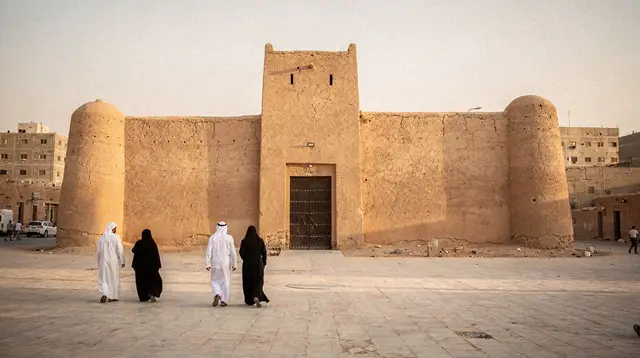
At-Turaif District is the historic citadel — a cluster of mud-brick palaces, mosques and defensive walls built by the House of Saud when Diriyah was their capital. The site was inscribed as a UNESCO World Heritage Site in 2010, recognised for its Najdi architectural style (thick earthen walls, geometric window patterns, triangular battlements) and for its role as the birthplace of the first Saudi state. Restoration has been extensive, so much of what you walk through today is rebuilt rather than original ruin, but the layout and materials follow the historic pattern closely. This is the site to visit if you want the actual history: exhibits, walking routes through the old palace complex, and views over the wadi.
Al Bujairi Terrace sits on the opposite ridge, looking back at At-Turaif. It is not a heritage site in the same sense — it’s a purpose-built district of restaurants, cafes and some retail, arranged to take advantage of the view across the valley to the citadel walls. Come here to eat, not to learn history. The terrace gets busy in the evening, when At-Turaif is often lit and the temperature has dropped, and that evening version — dinner with the citadel glowing across the wadi — is arguably the better experience than a midday walk-through. Treating Bujairi Terrace as a heritage stop and skipping the dining is a common way visitors undersell it.
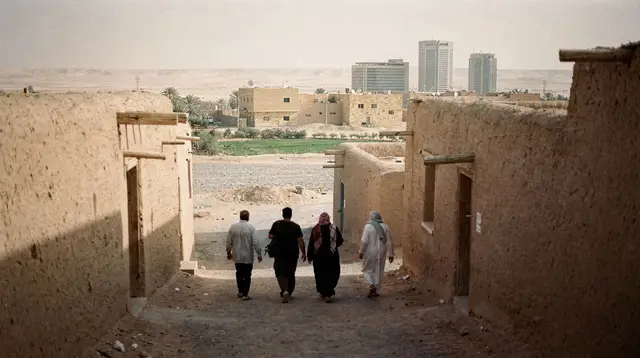
Between the two, at the base of the wadi, there are pedestrian paths and green space, part of the wider Wadi Hanifa rehabilitation that has turned what was once a neglected drainage valley into a landscaped corridor.
Getting there from Riyadh
Diriyah sits northwest of the city, and travel time depends heavily on which part of Riyadh you’re staying in and what time of day you leave.
| From (Riyadh) | Typical drive time | Rush-hour drive time |
|---|---|---|
| Olaya | 30-40 minutes | 50-70 minutes |
| Al Malqa / north Riyadh | 15-25 minutes | 25-40 minutes |
| KAFD | 25-35 minutes | 45-60 minutes |
These are rough bands, not fixed figures — Riyadh’s traffic is genuinely unpredictable at peak times, and a 25-minute trip can stretch well past 40 if you leave during the evening rush. Uber and Careem cover the route reliably and are the simplest option for most visitors; a private driver is worth arranging if you’re combining Diriyah with other stops in one day, since waiting for a return ride can eat into your visit. Full details on rideshare apps and fares are on the Uber and Careem in Riyadh guide, and if you’re arriving straight from the airport rather than a hotel, see the Riyadh airport arrival guide. Riyadh Metro does not currently reach Diriyah directly, so budget for a road transfer regardless of how you’re getting around the city centre — see the Riyadh Metro guide for what the network does cover.
If you’re driving yourself, parking near At-Turaif and Bujairi Terrace is generally manageable outside of Riyadh Season’s peak weekends, when both districts draw large crowds.
How to spend a half-day (or an evening)
A straightforward plan: arrive at At-Turaif in the mid-to-late afternoon, allow one and a half to two hours to walk the restored district and take in the exhibits, then cross to Al Bujairi Terrace as the light drops for dinner with the citadel view. This sequencing avoids the worst of the midday heat for the outdoor walking portion and puts you at Bujairi Terrace for its best moment.
If you only have an evening — say, you’re doing a single overnight-plus-day trip through Riyadh — Al Bujairi Terrace alone, with a distant look at the lit citadel, is a reasonable substitute for the full At-Turaif walk-through, though you’ll miss the historical detail.
Don’t try to stack Diriyah onto the same day as the desert excursions covered elsewhere on this site. Edge of the World and the Red Sand Dunes both sit in the opposite direction from the city and require several hours of round-trip driving on their own; combining either with Diriyah turns a comfortable day into a rushed one. The same goes for the longer Shaqra and Ushaiger trip. Diriyah pairs more naturally with other in-city plans — a morning at Riyadh’s modern skyline or the Riyadh Camel Market — than with a full desert day.
For a structured route through both zones, the heritage tour covering At-Turaif and finishing at Bujairi Terrace is built around exactly this pairing, with a guide handling the history at At-Turaif rather than leaving you to piece it together from signage.
Booking a tour vs. going independently
Independent visits work fine if you’re comfortable arranging your own transport and don’t need a guide to narrate At-Turaif’s history. The tradeoff is that you’ll need to organise a driver for the round trip (or a rideshare you’re confident will be available for the return leg), and you’ll rely on on-site signage for context.
A booked tour removes both frictions and typically bundles transport with entry. Options worth knowing about:
- A half-day tour focused specifically on Diriyah’s historic district suits visitors who want the At-Turaif story in depth without adding other stops.
- A combined itinerary linking Diriyah’s old town with Riyadh’s modern skyline works well if you want the historical and contemporary sides of the city in one outing.
- A private half-day option pairing Diriyah with the Shamlat Art Center and KAFD suits travellers who prefer a smaller group and a mixed heritage-plus-contemporary itinerary.
Whichever you choose, confirm what’s included at booking — entry tickets to At-Turaif, transport both ways, and whether a meal at Bujairi Terrace is part of the plan or left for you to arrange separately.
Weather, seasons and Ramadan
Diriyah’s outdoor walking sections make seasonal timing more important here than for an air-conditioned museum stop elsewhere in Riyadh. November through March brings the most comfortable conditions for the At-Turaif walk-through, with daytime temperatures typically in the 20-25°C range and cool desert-adjacent evenings — good for lingering at Bujairi Terrace after dark. From May to September, Riyadh regularly climbs past 40°C, and a midday walk through At-Turaif’s open courtyards is genuinely unpleasant; visiting in that window works better if you shift the At-Turaif portion to the first hour after opening or the last before closing, and treat the Bujairi Terrace evening as the main event rather than an add-on. Rain is rare, but sandstorms are an occasional possibility in spring and can shorten or reshuffle a visit with little warning.
During Ramadan, opening hours at both At-Turaif and Bujairi Terrace shift, and eating, drinking or smoking in public during daylight hours isn’t permitted — which changes the terrace’s usual daytime dining rhythm, since most restaurants there operate around iftar instead for the month. The guide to visiting Riyadh during Ramadan covers how this reshapes a typical day, and the Riyadh weather by month guide is worth checking if you’re weighing exact travel dates against comfort. Riyadh Season, mentioned above, runs roughly October through March and overlaps with the cooler months, which is part of why that stretch books up and gets busiest at both zones.
Diriyah for different kinds of trips
Diriyah’s manageable half-day format and low-key evening option suit a range of travel styles. Families often find At-Turaif easier going than a full desert excursion — flat paths, some shaded stretches through the restored district, and an early finish before anyone gets overtired — followed by a calmer evening at Bujairi Terrace rather than a long drive back from the dunes; the Riyadh with kids guide has more on pacing a family day around the city generally.
Solo travellers, including solo women, generally find both zones straightforward and well-populated with other visitors, especially in the evening; the solo female travellers guide has wider context on getting around Riyadh alone. Travellers with a bit more budget to spend sometimes treat Bujairi Terrace’s better restaurants as a standalone splurge evening rather than pairing it with At-Turaif at all — the luxury Riyadh guide covers that end of the dining scene in more detail.
Entry requirements before you book
Nothing about visiting Diriyah itself requires paperwork beyond what any Saudi Arabia trip already needs. Saudi Arabia opened to leisure tourism in September 2019, and most Western passport holders — including EU/Schengen, UK, US, Canadian, Australian, Japanese and South Korean nationals — can apply for an e-Visa online through the official visa.visitsaudi.com portal, or in some cases get a visa on arrival; GCC nationals need no visa at all. A passport valid for at least six months is required. Fees and processing times change, so check the official portal directly rather than relying on a fixed figure — the Saudi e-Visa and entry rules guide covers the current process in more depth. Settle this before booking a Diriyah tour tied to a fixed date, since a tour booked around an unconfirmed visa timeline is the easiest way to lose a deposit.
Money and connectivity
Diriyah runs on the same riyal (SAR) and card-first payment culture as the rest of Riyadh — At-Turaif’s ticket counters and Bujairi Terrace’s restaurants both take cards and contactless payment without issue, and you’re unlikely to need cash for a standard visit. It’s still worth carrying a little, mainly for the odd smaller vendor near the terrace who may prefer it. If you’re arriving with questions about a SIM, eSIM or data coverage out here versus central Riyadh, the staying connected in Saudi Arabia guide covers setup before you land; connectivity at both At-Turaif and Bujairi Terrace is solid, being close to the city rather than out in the desert.
What Diriyah is not
It’s worth being direct about what a Diriyah visit doesn’t include, since marketing photography sometimes blurs this. This is not the site of Masmak Fortress or the 1902 retaking of Riyadh — that’s a separate historic core in central Riyadh, covered on the Riyadh destination page and the Diriyah versus old Riyadh comparison guide if you’re deciding which to prioritise on a short trip. It’s also not a desert excursion: there are no dunes, no 4x4 tracks and no overnight desert camps here, despite Diriyah sometimes appearing bundled into “Riyadh desert” marketing. For that, see the dedicated desert excursions pages.
And Al Bujairi Terrace, again, is a restaurant district first. If your priority is heritage content rather than a meal with a view, spend the bulk of your time at At-Turaif and treat the terrace as a stop for coffee or dinner rather than the main event.
Practical notes
Dress modestly, as you would anywhere in public in Riyadh — shoulders and knees covered is the standard expectation, and there’s no requirement for foreign women to wear an abaya here or anywhere else outside a mosque interior. Alcohol is not served at Bujairi Terrace’s restaurants, in keeping with the nationwide rule. Cards and contactless payment are accepted at both At-Turaif’s ticketed areas and the Bujairi Terrace restaurants, though carrying some cash is sensible if you plan to buy from any smaller stalls. Friday midday is the quietest time to visit, ahead of the weekly prayer; expect the terrace to be busiest on Thursday and Friday evenings, the start of the Saudi weekend.
If your trip falls during Riyadh Season, roughly October through March, expect both At-Turaif and Bujairi Terrace to be noticeably busier, and to see extended evening hours and additional programming tied to the festival. Outside that window, evenings are calmer and easier to plan around.
Where Diriyah fits in a wider Riyadh trip
For most itineraries, Diriyah earns a half-day slot within a broader Riyadh stay rather than a standalone day. It fits naturally into a two-day Riyadh itinerary as an afternoon-into-evening block, and it’s one of the more efficient uses of limited time if you’re only in the city for one day and want a heritage stop that doesn’t require a long drive out of the city. If you want the deeper context on why Diriyah matters before you go, the story of the first Saudi state and a primer on Najdi mud-brick architecture are both worth a few minutes before you visit — they make the At-Turaif walk-through considerably more legible than going in cold.