Why Diriyah is the birthplace of the Saudi state
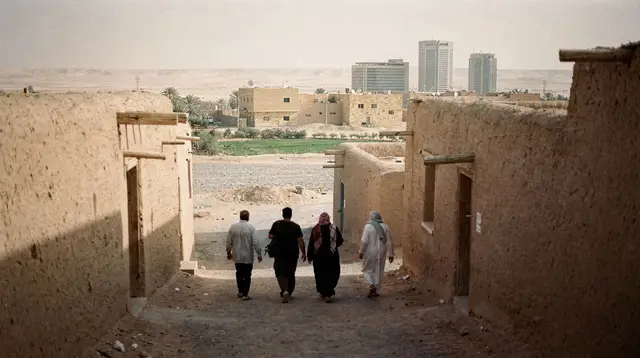
The first time someone told me Diriyah wasn’t part of Riyadh, I assumed they were being pedantic. I’d been staying in Olaya for three days, and every map I’d looked at showed Diriyah as a blob at the edge of the same grey urban sprawl. Same city, surely, just a further-out neighbourhood. It took a slow drive along the Wadi Hanifa, watching the modern towers thin out and then disappear entirely behind a ridge, before I understood the distinction actually mattered.
Diriyah is not a suburb. It’s a separate town, on its own patch of the wadi, and it existed for centuries before the Riyadh most visitors picture — the one with the Kingdom Centre and King Abdullah Financial District (KAFD) — was anything more than a walled town on the other side of the valley. Getting that order of events right changes how the whole visit reads.
Two founding stories, and they are not the same one
If you spend any time in Riyadh’s old quarter, you’ll hear about Masmak Fortress and the raid of 1902, when Abdulaziz Ibn Saud retook the fort and set in motion the events that led to the founding of the modern Kingdom of Saudi Arabia in 1932. That is a real, important story, and I’ve written about it separately in the guide to Masmak Fortress.
But it is a different story from Diriyah’s, and conflating the two flattens both. Diriyah’s history starts nearly two centuries earlier. In 1727, the Al Saud family established their emirate at Diriyah, on the banks of the Wadi Hanifa, and over the following decades this became the capital of what historians call the first Saudi state — a political and religious project centred on this one town, long before Riyadh had any comparable weight. That state was eventually destroyed in 1818, and its capital abandoned as a seat of power. The 1902 Masmak episode and the 1932 unification are about the third Saudi state, the one that still governs today. Diriyah’s story is about the first one. Same family, same region, but a full century and a different town apart.
I mention this partly because it’s easy to visit Diriyah and Masmak on the same day — plenty of tours do exactly that — and come away with the dates blurred together in your head. Keep them separate and the whole site makes more sense.
Standing inside At-Turaif
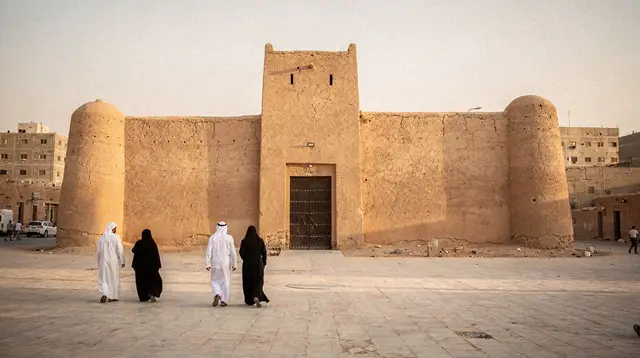
At-Turaif is the reason to come. It’s the old citadel district of Diriyah, built almost entirely from mud brick in the distinctive Najdi style — thick walls, small windows, geometric detailing picked out in relief rather than paint. UNESCO inscribed At-Turaif as a World Heritage Site in 2010, and walking through it, that recognition doesn’t feel like a formality. The scale is what struck me: this wasn’t a single palace but a whole administrative and residential complex, with the Salwa Palace at its centre, perched above the wadi.
What I appreciated most was that the restoration hasn’t tried to disguise itself as something ancient and untouched. The walls are clearly rebuilt and consolidated, and the site is upfront about that rather than pretending otherwise. It reads less like a museum piece and more like a place that’s been carefully brought back into use, which somehow makes the eighteenth-century layout easier to take seriously rather than harder.
Go in the late afternoon if you can arrange it. The mud brick takes on a warm colour as the light drops, and the crowds — modest to begin with, this isn’t a site that draws Masmak-level numbers — thin out further. I’d allow two to three hours to walk the district properly, more if a guide is talking you through the layout room by room, which I’d genuinely recommend rather than wandering alone with a phone. A private tour in Riyadh that includes Diriyah as a stop will usually build in that context.
Bujairi Terrace is the reward, not the history
Across the wadi from At-Turaif sits Al Bujairi Terrace, and I want to be clear about what it is and isn’t. It is not a historic site. It’s a modern development of restaurants and cafés, built with clean sightlines back across the valley to the citadel, and it functions as the place you go once you’ve done the walking. Good coffee, a decent range of food from casual to fairly upscale, and a view of At-Turaif lit up after dark that’s genuinely worth timing your visit around.
I’d resist the temptation to treat Bujairi Terrace as the main event. Some visitors spend an hour in At-Turaif and three at Bujairi, which is a reasonable way to spend an evening but not really a fair way to weigh the two. If your time is limited, give the citadel the longer half.
A guided heritage tour that covers both At-Turaif and Bujairi Terrace in one trip is the simplest way to see them together without working out logistics yourself, and it typically includes the admission arrangements for At-Turaif, which change periodically.
Getting there, and what to skip
Diriyah sits northwest of central Riyadh, and depending on traffic and exactly where you’re staying, the drive can run anywhere from twenty minutes to closer to an hour. There’s no dedicated metro line running directly to the site as of this writing, so most visitors arrive by taxi, Uber, Careem, or as part of an organised tour — see the Riyadh Metro guide and the Uber and Careem guide if you’re weighing options.
One thing I’d skip: trying to combine Diriyah with a desert excursion like the Edge of the World in a single day. They’re in roughly opposite directions from central Riyadh, and rushing either one undersells it. Diriyah deserves its own half-day or full day, ideally the kind covered by a dedicated Diriyah tour.
If you’re building out a longer stay, the three days in Riyadh itinerary or the Riyadh weekend itinerary both slot Diriyah in without forcing it against a desert day. And if you’re trying to decide how Diriyah compares to the old city centre around Masmak, I’ve laid that out directly in Diriyah versus Old Riyadh and Masmak.
A ticketed tour that handles At-Turaif entry directly is worth booking ahead during Riyadh Season, when visitor numbers at Diriyah climb noticeably; outside that window, availability tends to be looser.
For a sense of what else sits nearby if you have extra time, the things to do in Diriyah category page and the Diriyah destination guide both cover the wider area, and how to get to Diriyah walks through the transport options in more detail than I have space for here.
Diriyah versus Masmak, side by side
| Diriyah / At-Turaif | Masmak Fortress | |
|---|---|---|
| Story | First Saudi state, founded 1727 | Raid of 1902, path to the 1932 kingdom |
| Location | Separate town, northwest of Riyadh | Central Riyadh, Al Dirah district |
| UNESCO status | Inscribed 2010 | Not a UNESCO site |
| What’s there now | Restored mud-brick citadel district | Fortress museum in the old town |
| Pair it with | Al Bujairi Terrace (food, cafés) | Souq Al Zal, Deera Square |
Frequently asked questions about Diriyah and At-Turaif
Is Diriyah part of Riyadh?
No. Diriyah is a separate town on the Wadi Hanifa, northwest of Riyadh, not a district of the capital. It has its own municipal identity and a history that predates modern Riyadh’s growth by roughly two centuries.
When was At-Turaif made a UNESCO World Heritage Site?
At-Turaif was inscribed by UNESCO in 2010, recognising it as an outstanding example of Najdi mud-brick architecture and as the seat of the first Saudi state.
Is Al Bujairi Terrace a historic site too?
No. Bujairi Terrace is a modern dining and café district built across the wadi from At-Turaif. It’s a place to eat and take in the view of the citadel, not a heritage site in its own right.
How is Diriyah’s history different from Masmak Fortress?
Diriyah’s At-Turaif marks the founding of the first Saudi state in 1727. Masmak Fortress, in central Riyadh, is tied to the 1902 raid that led to the modern kingdom’s founding in 1932 — a later, separate chapter involving a different town.
How much time should I plan for a Diriyah visit?
I’d budget two to three hours for At-Turaif itself, plus extra time at Bujairi Terrace for food. A half-day covers it comfortably; a full day allows for a slower pace and an evening meal once the citadel is lit up.
Can I get to Diriyah without a tour?
Yes, by taxi, Uber, or Careem from central Riyadh. A guided tour isn’t required, but I’d still recommend one for At-Turaif specifically, since the historical layout is easy to miss without context.
Is Diriyah worth visiting if I’ve already seen Masmak Fortress?
Yes. They tell different, non-overlapping stories from different centuries and different towns. Seeing one doesn’t cover the other.
tours.Culture
Verified deep-linked GetYourGuide tours. Book through these links and we earn a small commission at no cost to you.
GetYourGuide does not provide a product photo for this activity — the image shows the meeting point, photographed by us.