Al Bujairi Terrace: what to do after visiting At-Turaif
What is Al Bujairi Terrace and how does it relate to At-Turaif?
Al Bujairi Terrace is a restaurant and cafe district in Diriyah, built on the ridge facing At-Turaif across the Wadi Hanifa valley. It has no historical exhibits of its own; it is where visitors eat, sit outdoors and look at the UNESCO-listed mud-brick citadel, especially after dark when At-Turaif is lit.
The view, not the history
If you already know the story of Diriyah and At-Turaif — the mud-brick citadel where the first Saudi state took shape in the eighteenth century, listed by UNESCO in 2010 — this page is not about that again. It is about what to do once you have walked the citadel and want somewhere to sit down, eat, and look back at it. That place is Al Bujairi Terrace, a modern dining and cafe district built on the ridge directly across the Wadi Hanifa valley from At-Turaif.
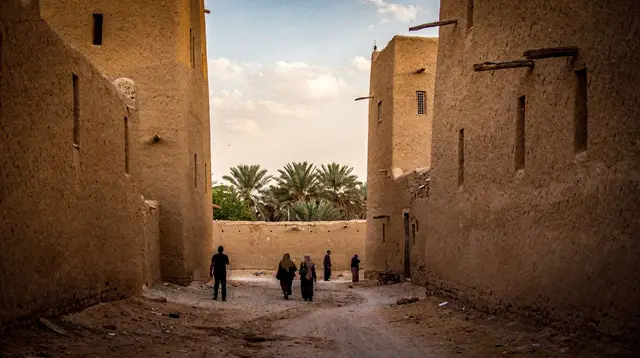
The two sites are physically separate but designed to be seen together. At-Turaif occupies one side of the valley; Al Bujairi Terrace occupies the other. Between them runs the valley floor, landscaped with paths and, depending on the season, some greenery. The short walk across gives you the postcard shot: the citadel’s earthen walls rising above the palm groves, with the terrace’s restaurant lights in the foreground once the sun goes down.
For a guide focused on that older history, see the At-Turaif UNESCO district guide. This page assumes you have read it, or plan to visit both, and covers only what happens on the Bujairi side.
What Al Bujairi Terrace actually is
Al Bujairi Terrace is not a historical site with exhibits, ticket gates, or a curated narrative. It is a purpose-built commercial strip of restaurants, cafes, and some retail, arranged in tiers along the ridge so that outdoor seating faces the valley and the citadel. The architecture uses the same low, earth-toned palette as the historic district across the way, which keeps the whole visual composition consistent rather than jarring — a deliberate choice, since the entire point of the location is the sightline to At-Turaif.
Because it is a dining district rather than a monument, there is no single admission ticket for Al Bujairi Terrace itself. You walk in, choose where to eat or sit, and pay for what you order. At-Turaif, across the valley, is the ticketed side. Several bookable products bundle the two, combining admission to the historic district with time at the terrace and round-trip transport from a Riyadh hotel — useful if you would rather not work out getting to Diriyah and back on your own.
A guided half-day that pairs the At-Turaif district with time at Al Bujairi Terrace covers both halves of the outing in one booking, which suits a first visit to Diriyah where you want the history and the evening view without planning two separate stops.
Diriyah is not a Riyadh neighbourhood
It is worth repeating, because the confusion is common: Diriyah is a distinct locality northwest of Riyadh, sitting along the Wadi Hanifa, not a district inside the city. If you are staying in Olaya, Al Malqa, or near KAFD, getting to Al Bujairi Terrace means a drive out of central Riyadh, not a short hop across town. Budget for that when you plan an evening visit, since traffic on the way out during the late afternoon can add to the drive.
This matters for timing as much as for logistics. A Diriyah half-day is its own outing, planned around a departure window from Riyadh, not something to squeeze in between two other city stops on the same afternoon. Most visitors treat At-Turaif and Al Bujairi Terrace as one combined trip from a Riyadh base — see how to get to Diriyah for the transport options — rather than trying to fold Diriyah into a broader day of Riyadh sightseeing.
Planning the visit: order and timing
The sensible order is At-Turaif first, Al Bujairi Terrace second. The historic district is more comfortable to walk before the day’s heat peaks or after it has eased in late afternoon, and it has no shade to speak of once the sun is high. Al Bujairi Terrace, by contrast, is built around evening use — restaurant terraces, outdoor seating, and a view that only becomes dramatic once At-Turaif is lit at night.
A workable half-day sequence looks like this:
| Time block | What to do |
|---|---|
| Mid to late afternoon | Walk the At-Turaif district while daylight is still good for the mud-brick architecture |
| Early evening | Cross to Al Bujairi Terrace, walk the tiers, watch the light change over the valley |
| After sunset | Dinner or coffee at the terrace, with At-Turaif illuminated across the wadi |
Reverse this if you would rather see the citadel lit from a terrace table before the crowds build, then walk the district itself the next morning on a separate trip — workable if you are staying in Diriyah or nearby rather than commuting from central Riyadh.
The heat matters more than the calendar. From May to September, midday temperatures regularly clear 40°C, which makes the walk between the two sides of the valley unpleasant outside the early morning or evening. November through March is milder and the more comfortable season for spending real time outdoors on both sides. Riyadh Season, which runs roughly October to March, also brings extra programming and crowds to the wider Diriyah area, Al Bujairi Terrace included, so evenings during that window are busier and better booked ahead. See best time to visit for the seasonal detail.
What to expect at the terrace itself
Al Bujairi Terrace is arranged in stepped levels connected by walkways, with restaurants and cafes occupying most of the frontage. The mix runs from casual coffee stops to sit-down dining, generally at mid-range to upscale prices by Riyadh standards, and the appeal for almost everyone is the outdoor seating oriented toward the valley and the citadel. Menus and specific venues change over time — this page will not list restaurants by name, since a static list goes stale fast; check current options through your booking platform or on arrival.
Photography is straightforward and welcomed in the public seating areas; the usual courtesy about not photographing other diners without asking still applies, as it does anywhere in Saudi Arabia. Dress codes at the terrace follow the same general modesty expectations as the rest of Riyadh and Diriyah — covered shoulders and knees for everyone — nothing stricter is enforced specifically here, and there is no abaya requirement for foreign women, contrary to what some older write-ups suggest.
Alcohol is not served anywhere on the terrace, or anywhere else in Saudi Arabia, including hotels. If a menu or a review implies otherwise, it is wrong; plan on soft drinks, coffee, or juice with dinner.
For visitors who want a broader look at the district’s cafes and evening atmosphere beyond this page’s scope, how Riyadh looks at night more generally covers the modern skyline side of that question, separate from Diriyah.
Getting there and back
Diriyah sits far enough from central Riyadh that a private driver, Uber, or Careem is the practical choice for most visitors rather than attempting public transport for an evening round trip. A private driver has the added advantage of waiting through dinner rather than requiring you to arrange a return ride from a quieter suburban area after dark. Group tours that include Al Bujairi Terrace generally build return transport into the booking, which removes the question entirely.
A ticketed tour of the At-Turaif district that also stops at Al Bujairi Terrace is worth comparing against the combined heritage tour above if you specifically want admission handled for you but a lighter touch on guiding.
If you are visiting Diriyah as part of a longer look at Riyadh’s older architecture and heritage sites, the At-Turaif versus old Riyadh comparison lays out how Diriyah’s mud-brick district differs from the Masmak Fortress area in central Riyadh, which some visitors otherwise conflate.
Combining it with the rest of a Riyadh trip
Al Bujairi Terrace on its own is a half-day stop at most, so most itineraries fold it into a broader Diriyah half-day or a longer multi-stop day. A four-day Riyadh and desert itinerary typically places Diriyah, At-Turaif, and Al Bujairi Terrace on one afternoon-into-evening slot, leaving other days for the city centre and a desert excursion further out.
During Riyadh Season, the wider Diriyah area including Al Bujairi Terrace sees additional programming and higher footfall than the rest of the year; a Riyadh Season-specific itinerary accounts for that. If your dates fall outside the season window, expect a quieter, more straightforward visit with shorter waits for a table.
For background on why Diriyah holds this position at all — why a dining district was built specifically to face a historic citadel — the story of why Diriyah is the birthplace of the Saudi state and Najdi mud-brick architecture explained both cover ground this page deliberately leaves out, since the terrace itself carries none of that history directly.
A guided day covering Diriyah alongside other historic Riyadh-area attractions suits visitors who want Al Bujairi Terrace as one stop among several rather than the main event, and a full-day guided city tour with transport included is a reasonable option if you would rather have Diriyah folded into a wider look at Riyadh with a driver handling all the logistics.
Is it worth the trip on its own?
Honestly, Al Bujairi Terrace by itself — without At-Turaif — is a pleasant but ordinary outdoor dining district; the setting is what elevates it. If you are short on time and have to choose one side of the valley, At-Turaif is the more substantial visit, since it is the UNESCO-listed site with the actual historical content. Al Bujairi Terrace earns its place as the second half of that visit, not as a standalone destination, and skipping it to save time is a reasonable call if your schedule is tight and dinner in Riyadh proper is more convenient.
Where it clearly earns the extra time is the evening lighting of At-Turaif, which is genuinely the best angle on the citadel available anywhere, and something you cannot get from inside the historic district itself during the day. If your visit allows for it, staying through sunset for that view is the single best reason to build the terrace into your plans at all.
Al Bujairi Terrace: questions worth asking before you go
Is Al Bujairi Terrace part of the At-Turaif UNESCO site?
No. At-Turaif, the mud-brick citadel listed by UNESCO in 2010, sits on one side of the Wadi Hanifa valley. Al Bujairi Terrace is the dining and cafe district built on the opposite ridge, facing it. They are two separate areas connected by a short walk across the valley floor, and most visitors treat them as one outing.
Do I need a ticket to visit Al Bujairi Terrace?
Walking around Al Bujairi Terrace itself is generally open access, since it is a commercial dining district rather than a ticketed monument. At-Turaif, across the valley, does require admission, which is where tour products with entry included become useful for skipping a queue or bundling transport from Riyadh.
What is the best time of day to go to Al Bujairi Terrace?
Late afternoon into evening works best. Riyadh’s desert heat makes the terraces uncomfortable at midday for much of the year, and the main reason to come here is the view of At-Turaif once its facade is lit after sunset. Arriving an hour or so before sunset lets you see the citadel in daylight first, then watch the lighting change.
Can I combine Al Bujairi Terrace and At-Turaif in one visit?
Yes, and most people do. A typical half-day covers the At-Turaif district first, while it is easier to walk in the heat, followed by a meal or coffee at Al Bujairi Terrace in the evening with the citadel visible across the valley. Several tour products bundle both stops with return transport from Riyadh.
Is Al Bujairi Terrace in Riyadh?
No. Diriyah, where both At-Turaif and Al Bujairi Terrace sit, is a separate locality northwest of Riyadh, on the Wadi Hanifa. It is close enough to visit on a half-day trip from a Riyadh hotel, but it is not a Riyadh neighbourhood, and treating it as one leads to confusion when planning transport.
What kind of restaurants are at Al Bujairi Terrace?
The district holds a mix of international and regional restaurants and cafes, generally positioned toward the mid-range and upscale end, with outdoor seating oriented toward the At-Turaif view. Exact venues and price levels change over time, so check current listings rather than relying on a fixed list.
Does Al Bujairi Terrace get crowded?
Evenings, weekends, and the Riyadh Season period from roughly October to March draw the largest crowds, since cooler air and event programming pull people outdoors. A weekday visit or an early evening arrival before the dinner rush is calmer if you mainly want photos and a quiet walk.
Diriyah and At-Turaif heritage tours on GetYourGuide
Verified deep-linked GetYourGuide tours. Book through these links and we earn a small commission at no cost to you.
GetYourGuide does not provide a product photo for this activity — the image shows the meeting point, photographed by us.