At-Turaif: the UNESCO mud-brick district in Diriyah
What is At-Turaif and is it in Riyadh?
At-Turaif is a mud-brick citadel district in Diriyah, a separate town on the Wadi Hanifa north-west of Riyadh, not a Riyadh neighbourhood. It was the seat of the first Saudi state in the 18th century and has been a UNESCO World Heritage Site since 2010.
Ask a first-time visitor where At-Turaif is and most guess “somewhere in Riyadh.” It isn’t. At-Turaif is a walled district in Diriyah, a town of its own on the banks of the Wadi Hanifa, north-west of Riyadh’s city limits. That distinction matters for planning, because Diriyah isn’t a five-minute taxi hop from Olaya the way a Riyadh neighbourhood would be — it’s a separate trip, with its own drive time and its own logistics.
This page is about the historic site itself: what At-Turaif is, how old it actually is, what’s original versus rebuilt, and how to get there and back from a Riyadh hotel. For the restaurants and terraces facing the site, see Al Bujairi Terrace — that’s a separate development, not part of the historic district. For the other founding moment in Saudi history, the 1902 taking of Masmak Fortress in central Riyadh, see the Masmak Fortress guide; the two sites are often confused and they shouldn’t be.
Diriyah is a town, not a Riyadh neighbourhood
Diriyah predates Riyadh as a seat of power. It sits on the Wadi Hanifa, the green valley that cuts through the west side of greater Riyadh, and it grew as an oasis settlement long before it became politically significant. In the mid-18th century, the Al Saud family based their emerging state here, and Diriyah served as its capital until the town was destroyed in 1818. What survived, and what has since been excavated and partly reconstructed, is At-Turaif: the citadel quarter, built on a raised ridge above the wadi for defence and visibility.
Riyadh grew later, a few kilometres to the south-east, and the two settlements have since sprawled toward each other with development, roads, and the wider Wadi Hanifa corridor connecting them. But administratively and historically they’re distinct. If you’re staying in Olaya, Al Malqa, or KAFD and someone tells you At-Turaif is “just up the road,” treat that loosely — it’s a real drive, not a stroll.
What At-Turaif actually is
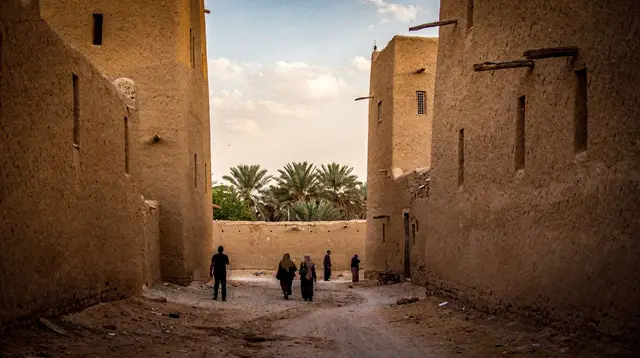
At-Turaif is built almost entirely from mud brick — locally called labn — packed and dried in the traditional Najdi style rather than fired or reinforced with modern materials. This is the same building method used across the historic Najd region, and it’s worth understanding before you visit, because it explains both the architecture’s appeal and its fragility. Mud brick doesn’t survive centuries of exposure to wind, rare but real rain, and abandonment. Most of what stood in the 18th and early 19th centuries had eroded into low mounds by the time serious conservation work began.
What you see today is a mix of three things: excavated foundations and wall sections that are genuinely original, reconstructed walls and towers built on those original footprints using the same mud-brick technique, and a handful of fully restored buildings — including a former palace complex — furnished and opened as exhibition spaces. A good guide will point out which is which as you walk through; without that context, it’s easy to assume everything is either “ancient” or “fake,” when the reality is a careful layering of both.
The district includes several distinct areas: main squares that would once have functioned as gathering and market spaces, a cluster of palace buildings associated with early Al Saud rulers, watchtowers along the perimeter walls that took advantage of the ridge’s height over the wadi, and narrow lanes between compounds that give a sense of how dense the original settlement was. None of it is large by the standards of a major archaeological site elsewhere in the region, but it doesn’t need to be — the value here is legibility. You can walk the whole district and come away with an actual sense of how an 18th-century Najdi capital was laid out.
Why the 2010 UNESCO listing matters
At-Turaif District in Diriyah was inscribed as a UNESCO World Heritage Site in 2010. The listing recognises the site specifically for its architecture and its historical role — as the centre of the first Saudi state — rather than for scale or antiquity in the way some UNESCO sites are chosen. It’s the reason serious conservation funding followed, and it’s the reason the site now has proper walkways, signage, and controlled access instead of being an open ruin.
It’s worth being precise about the date, because it gets mixed up with other Saudi milestones fairly often: 2010 is the UNESCO listing for At-Turaif. It has nothing to do with 1902, when Masmak Fortress in Riyadh was taken by Abdulaziz Ibn Saud, or 1932, when the modern Kingdom of Saudi Arabia was founded. Three different dates, three different sites and events, and conflating them is the single most common factual slip in casual write-ups of Riyadh’s history.
Getting to At-Turaif from a Riyadh hotel
There’s no metro line to Diriyah, so plan on a car regardless of where you’re staying. From Olaya, Al Malqa, or KAFD, a private driver, Uber, or Careem will get you there in roughly 25 to 40 minutes outside peak traffic — longer during the morning or evening rush that affects most of greater Riyadh. If you’re driving yourself, renting a car in Riyadh is straightforward and Diriyah has proper parking areas near the site entrance, but budget extra time on Thursday and Friday evenings when Al Bujairi Terrace draws crowds and traffic backs up on the approach roads.
A ride-hailing app works fine for the outbound leg. Getting a return ride from Diriyah in the evening, especially after dark or during a busy period, can take longer than you’d expect simply because of demand in one small area — build in a buffer rather than assuming a car will appear the moment you request one. For a longer visit that also stops at Al Bujairi Terrace for lunch or dinner, see our dedicated Diriyah tours guide and the practical how to get to Diriyah breakdown, which covers parking, drop-off points, and timing in more detail than fits here.
How much time to give the site
Two to three hours is a reasonable estimate for walking through At-Turaif itself at an unhurried pace, including the restored palace buildings that are open to visitors and the main squares. That’s separate from time at Al Bujairi Terrace — if you plan to combine the historic district with a meal across the wadi, add at least another hour, more if you’re going in the evening when the terrace is at its busiest.
Morning visits avoid both the heat and the crowds; by mid-afternoon in the hotter months, the mud-brick walls offer little shade and walking the open squares is uncomfortable. If your trip falls in the hot season rather than the cooler November-to-March window, an early start matters more here than at most other Riyadh sites, since much of the district is outdoors with limited cover.
If you’re building a wider Riyadh trip around this, our one-day Riyadh itinerary and two-day Riyadh itinerary both slot At-Turaif and Diriyah into a realistic schedule alongside the city’s other landmarks, rather than trying to force it into a rushed half-day alongside central Riyadh.
Visiting independently versus booking a tour
You can visit At-Turaif on your own — buy entry, walk the district, read the signage — and plenty of visitors do exactly that, particularly if they’ve already read up on the site’s history. Where a guided visit earns its cost is in the detail: what’s original mud brick versus reconstruction, which building served which function under which ruler, and how the 18th-century layout related to the wadi below. Without that narration, the district can feel like an attractive but somewhat opaque cluster of restored walls.
A tour that pairs At-Turaif with the rest of old Riyadh gives useful context too, since the story of Diriyah’s fall in 1818 connects directly to the later rise of Riyadh under the Al Saud family in the 20th century.
A guided tour that covers At-Turaif alongside Riyadh’s historic coreIf you’d rather focus the whole outing on Diriyah itself, including guaranteed entry to At-Turaif’s ticketed areas, a more targeted option is a Diriyah-focused tour that includes At-Turaif admission and a stop at Bujairi Terrace.
For a broader look at Riyadh’s heritage sites in one guided day — useful if At-Turaif is one stop among several rather than the whole plan — there’s also a historic-sites tour covering several of Riyadh’s older districts in a single day. And travellers building a heritage-and-museums day that pairs At-Turaif with the capital’s national collection sometimes add a guided visit to the Saudi National Museum with tickets included to the same trip, since the museum’s early galleries cover the same first-Saudi-state period that At-Turaif represents on the ground.
What’s next door, and what this page leaves out
Al Bujairi Terrace sits directly across the Wadi Hanifa from At-Turaif and offers the best photographed views of the citadel walls, along with a dense strip of restaurants and cafés. It’s genuinely worth a stop, but it’s a modern dining and viewing district, not part of the historic site, so it gets its own page rather than crowding this one: see Al Bujairi Terrace for what’s there and when it’s busiest.
Likewise, if you’re trying to keep Riyadh’s two founding-era sites straight, the short version is: Masmak Fortress (1902, central Riyadh, Abdulaziz Ibn Saud’s retaking of the city) and At-Turaif (18th century, Diriyah, the first Saudi state, UNESCO-listed in 2010) are different places from different periods. Our Diriyah versus old Riyadh and Masmak comparison lays the two out side by side if you only have time for one and want to pick the right fit for your trip. For the deeper backstory on why Diriyah holds this status at all, see why Diriyah is the birthplace of the Saudi state, and for more on the building method itself, Najdi mud-brick architecture explained goes into the construction technique in more detail than fits into a single visitor guide.
If Diriyah is your main draw and you want to see the full range of what the area offers beyond At-Turaif, the Riyadh city and heritage tours guide rounds up how it fits alongside the rest of the capital’s historic sites.
FAQs about visiting At-Turaif in Diriyah
Is At-Turaif the same place as Diriyah?
No. Diriyah is the wider historic town on the Wadi Hanifa; At-Turaif is the walled citadel district inside it, built on a low ridge above the wadi. Al Bujairi Terrace, the restaurant and viewing area facing At-Turaif, is a separate development across the valley, not part of the historic site itself.
When did At-Turaif become a UNESCO World Heritage Site?
At-Turaif District in Diriyah was inscribed on the UNESCO World Heritage List in 2010, recognised for its Najdi mud-brick architecture and its role as the birthplace of the first Saudi state in the 18th century.
Is At-Turaif the same as Masmak Fortress?
No, and this is the most common mix-up. Masmak Fortress is in central Riyadh (Al Dirah), taken in 1902 by Abdulaziz Ibn Saud, an event that led to the kingdom’s founding in 1932. At-Turaif in Diriyah is a different site, from a different century, tied to the first Saudi state rather than its 20th-century refounding.
How far is At-Turaif from central Riyadh?
Diriyah sits north-west of Riyadh on the Wadi Hanifa. From Olaya or Al Malqa, allow roughly 25 to 40 minutes by car depending on traffic and which part of the city you’re starting from; there’s no metro connection to Diriyah itself.
Do I need a guide to visit At-Turaif?
A licensed guide isn’t strictly required to enter, but a guided walk through At-Turaif adds real value here: the mud-brick ruins and reconstructed buildings read very differently once someone explains what’s original, what’s rebuilt, and which structure was which.
How much time should I set aside for At-Turaif?
Two to three hours covers a proper walk through the district at a reasonable pace, including the main squares and restored buildings. Add more time if you plan to cross to Al Bujairi Terrace afterwards for a meal.
Is At-Turaif open every day?
Opening days and hours have changed as the site has developed, so check the current schedule before you go rather than assume it matches an older guide. This page deliberately doesn’t quote fixed hours for that reason.
Diriyah and At-Turaif heritage tours on GetYourGuide
Verified deep-linked GetYourGuide tours. Book through these links and we earn a small commission at no cost to you.
GetYourGuide does not provide a product photo for this activity — the image shows the meeting point, photographed by us.