Najdi mud-brick architecture explained
Why Riyadh’s oldest buildings are made of earth
I kept noticing the same thing on every trip out of the city: the further I got from the glass towers of Olaya, the more the buildings seemed to grow out of the ground itself, literally the same colour as the desert around them. That is Najdi mud brick, and once you know what to look for, it changes how you read Diriyah, Ushaiger, and Shaqra rather than just checking them off a list.
This isn’t a how-to-get-there piece. The destination page for Diriyah and the Shaqra and Ushaiger destination guide cover distances and access. What I want to explain here is the building technique itself: why it looks the way it does, why it worked so well in this climate for centuries, and why it more or less vanished from the city where it was invented.
The material: sun-dried earth, not fired brick
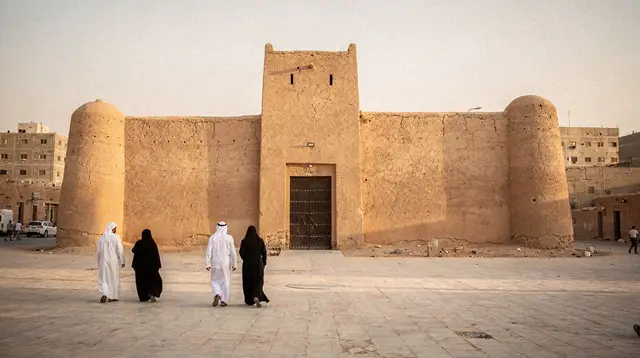
Najdi mud brick, sometimes called adobe in English, is unfired earth. Builders mixed clay-heavy soil with sand, water, and often chopped straw, packed it into wooden moulds, and left the blocks to dry in the sun rather than baking them in a kiln. That single choice explains almost everything else about the style. Sun-dried brick is cheap and local, since the raw material is quite literally the ground under the building site, but it is also soft compared to fired brick or stone, which is why walls have to be thick and why surfaces need regular re-plastering.
You can see the rawness of the material up close on a heritage tour of At-Turaif and Al Bujairi Terrace, where restored sections sit next to older, weathered walls. The contrast is the point: this was never meant to be permanent in the way a stone fortress is permanent. It was meant to be renewable, rebuilt by the same community that used it.
Thick walls as a climate strategy, not a defect
The walls at At-Turaif and in Ushaiger’s old core are often 40 to 60 centimetres thick. That is not decoration and it is not a structural weakness being compensated for. Earth is a slow conductor of heat, so a thick mass of it acts as a buffer: the sun’s heat takes most of the day to work its way through the wall, and by the time it would reach the inside, the outside temperature has already started dropping toward evening. The reverse happens overnight, when desert temperatures fall sharply. The wall releases the heat it absorbed during the day back into the room.
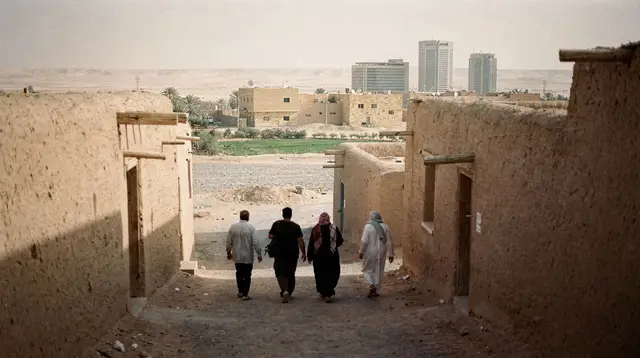
This is why Najdi houses tend to have small, high windows rather than large glazed openings, and why interior courtyards were so common: the goal was always to minimise direct sun exposure while still allowing airflow. It’s a passive cooling system centuries older than the compressors now humming on every rooftop in modern Riyadh’s KAFD district.
Reading the surface: patterns, plaster, and palm
The geometric motifs you’ll notice on facades around Diriyah and Ushaiger, usually triangles, diamonds, and stepped zigzags, are pressed or painted into the final plaster coat, often picked out around doorways and window frames. They vary from town to town within the Najd, which is part of why a trained eye can sometimes tell which village a building came from just by its decoration. There’s no single agreed meaning behind the shapes; they read more as regional taste and craftsmanship than as a fixed symbolic code, and I’d be sceptical of any guide who tells you otherwise with total confidence.
Roofs are their own separate technique: palm trunks laid as beams, topped with palm fronds and then a layer of packed earth. It’s a lightweight system suited to a place with abundant date palms and little timber, and it needed the same kind of periodic maintenance as the walls. On an evening walk around Wadi Hanifah near Diriyah you can still spot palm groves that would once have supplied exactly this kind of roofing material.
Maintenance after the rain
The honest, slightly less romantic part of mud-brick architecture is upkeep. Rain, when it comes, is the real enemy of unfired earth. After a wet spell, exposed mud-brick surfaces need fresh render, essentially a new skin of the same clay-and-straw mix, worked back onto the wall before erosion sets in. Historically this was communal, seasonal labour. At the restored sites today, conservation teams do the same job on a maintenance schedule, which is why At-Turaif and Ushaiger look consistently cared-for rather than crumbling, without that upkeep becoming an event you’d notice as a visitor.
Why the style disappeared from Riyadh itself
If Najdi mud brick worked so well, why does almost none of central Riyadh look like this anymore? The short answer is money and speed. From the mid-20th century onward, oil revenue funded concrete, steel, and imported construction methods that could scale to a fast-growing capital far quicker than earth building ever could, and that didn’t need re-plastering after every rain. The skyline that resulted, towers like the Kingdom Centre with its Sky Bridge, is built almost entirely in that newer material vocabulary. It’s a legitimate architectural choice for a modern capital, but it also means the building tradition that founded the Saudi state at Diriyah in the 18th century survives today mainly at the edges of the city and beyond it, in places that were deliberately conserved rather than redeveloped.
That’s really the throughline connecting At-Turaif, Ushaiger, and the older quarter around Masmak Fortress: three places that, for different reasons, kept the old material and the old technique instead of replacing them. UNESCO’s 2010 listing for At-Turaif recognised precisely this, an intact example of Najdi construction tied to the founding of the state, not just an old-looking building.
Where to actually see it well
If you only have time for one comparison, pair a walk through At-Turaif and Al Bujairi Terrace with a stop in Shaqra and Ushaiger; the first shows the technique at monumental, state-founding scale, the second at the scale of an ordinary Najdi household. For context on why Diriyah matters historically before you go, the piece on why Diriyah is the birthplace of the Saudi state is worth reading first. A Turaif and Bujairi Terrace tour with admission included or a guided heritage walk through the UNESCO site and terrace both put a local guide next to the walls, which is genuinely useful here since so much of what makes this architecture interesting isn’t visible without someone pointing it out.
For a longer trip that adds the villages, the four-day Riyadh, Ushaiger, and Qassim itinerary is built around exactly this contrast between the modern capital and its mud-brick roots. And if you’re curious whether the detour to Ushaiger earns its drive time, I’d point you to is Ushaiger worth a day trip for a more direct answer.
A guided walk through At-Turaif’s mud-brick citadel with admission included gets you a local guide who can point out the plaster patterns most visitors walk straight past. If you’d rather combine the UNESCO site with dinner across the wadi, a heritage tour covering both Turaif and Al Bujairi Terrace does that in one booking. For the modern counterpoint, a city tour through Riyadh’s contemporary districts makes the contrast with concrete-and-glass Riyadh obvious within a single afternoon.
tours.Culture
Verified deep-linked GetYourGuide tours. Book through these links and we earn a small commission at no cost to you.
GetYourGuide does not provide a product photo for this activity — the image shows the meeting point, photographed by us.