Shaqra and Ushaiger day trip from Riyadh
Is Shaqra and Ushaiger worth a day trip from Riyadh?
It is worth it if you care about traditional Najdi architecture, but it is not a quick outing. Ushaiger and Shaqra sit about 2.5 hours' drive northwest of Riyadh, so the round trip takes up most of a day. Book an organised tour or hire a private driver rather than attempting it as a casual self-drive detour.
What you’re actually signing up for
Ushaiger and Shaqra get pitched online as a charming half-day detour from Riyadh. They are charming, but “half-day detour” undersells the commitment. Ushaiger sits roughly 2.5 hours’ drive northwest of the city, close to the older Najdi town of Shaqra. That means a round trip of five hours on the road before you count any time spent walking the village itself. If your Riyadh stay is two nights and packed with a Diriyah evening and a desert sunset, squeezing this in on top is the kind of plan that sounds fine on a spreadsheet and feels exhausting by the third hour in the car.
Compare it honestly to the other excursions this site covers. The red sand dunes are about an hour west of Riyad — genuinely a half-day outing. Edge of the World is a similar drive time to Ushaiger, 2 to 2.5 hours each way, but it heads northwest toward the Tuwaiq escarpment for a landscape payoff — cliffs, a horizon, a sunset. Ushaiger heads a similar distance in a related direction for something completely different: mud-brick houses, palm gardens, and a lived-in sense of what Najdi village life looked like before oil money rebuilt the region’s cities. Neither trip is better. They answer different questions about why you’d leave Riyadh for a day.
Ushaiger: what’s actually there
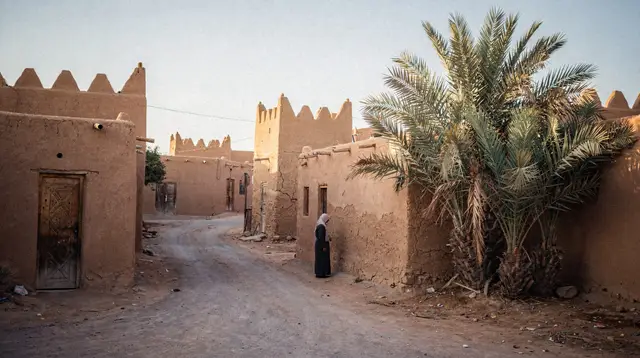
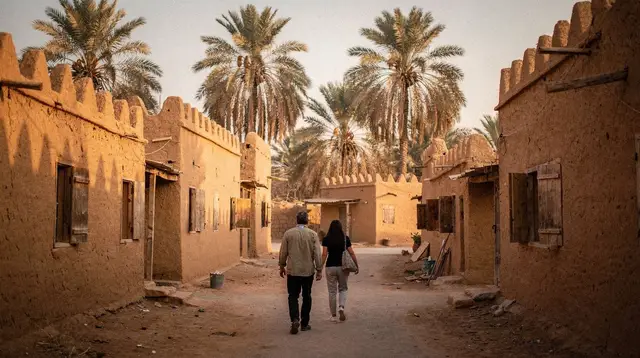
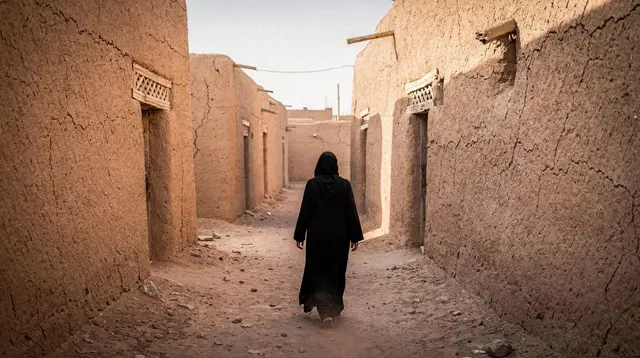
Ushaiger’s old quarter is a genuine restored village, not a themed reconstruction. Narrow lanes wind between mud-brick and clay houses, some centuries old, with wooden doors carved in geometric patterns that were once specific to individual families. Palm gardens line parts of the village, watered by a system of wells that predates any modern infrastructure nearby. A small local museum sits inside the old quarter, showing household objects, tools and photographs that put the architecture in context — worth the fifteen minutes it takes to walk through, mainly because the building itself is more interesting than most of what’s displayed in it.
Some houses in Ushaiger are still privately owned and lived in, so this isn’t an open-air museum in the strict sense — a few doors are closed to visitors, and that’s worth respecting rather than treating as an oversight. The most photographed corners are the alleyways with their layered mud-brick walls and the doors with carved patterns, and a guide who knows the village can point out which houses belonged to which families and why certain architectural details mattered locally. Without that context, an hour of walking covers the ground; with it, ninety minutes to two hours feels better spent.
Shaqra: the town, not just the stop before Ushaiger
Shaqra itself is an old Najdi town rather than a single attraction, and it’s easy to treat it purely as a waypoint on the road to Ushaiger. That undersells it slightly — Shaqra has its own older buildings and a longer history as a trading and agricultural centre in the region, and tours that include both towns usually build in a stop here rather than driving straight past. It won’t take the bulk of your day, but it rounds out the picture of what Najdi towns outside Riyadh actually looked like before the highway network connected everything to the capital.
How to actually do this trip
Self-driving is possible if you’re comfortable with several hours on Saudi highways and don’t mind navigating without much English signage once you’re off the main routes. Most visitors who don’t already have a rental car in Riyadh find it easier to book a private driver or an organised tour, both because the distance makes a wrong turn costly in time and because a guide who has done the route knows where to stop, what to point out, and roughly how the day should be paced.
A day tour that covers both Shaqra and Ushaiger from a Riyadh hotel pickup is the straightforward option if you want the two towns handled as one outing without renting a car. For something more flexible with your own pace and group, a private day trip to Ushaiger swaps the fixed group schedule for your own timing, which matters more here than on shorter excursions simply because of how much of the day is spent travelling. If you’d rather combine the heritage angle with Riyadh’s own museums before heading out, a tour pairing the National Museum with Souq Ushaiger builds a fuller narrative around Najdi history rather than treating Ushaiger as an isolated stop. There’s also a more standard day trip focused on Ushaiger alone if you’d rather skip Shaqra and keep the day shorter.
Check current departure times and duration on the tour listing before booking — some run as early starts to beat the midday heat and traffic leaving Riyadh, others leave mid-morning. Given the total drive time, an early departure generally leaves more daylight for the walk through the old quarter rather than arriving with the light already fading.
If you do decide to self-drive, the practical questions are less about the road itself — Saudi highways are generally well-surfaced and signposted on the main routes — and more about logistics: renting a car in Riyadh covers what to expect at pickup, and remember that driving here is on the right, a detail that trips up visitors used to left-hand traffic more than the road conditions do. For a trip this long, most visitors who’d rather not navigate themselves look at hiring a private guide in Riyadh, which covers what a dedicated driver-guide adds over a group tour when the destination is this far out — namely, the flexibility to linger in Ushaiger’s old quarter for as long as the light and your interest hold up, rather than working to a fixed group schedule.
When to go
November to March is the easier season for this trip: daytime temperatures in the low-to-mid 20s°C make walking the village’s narrow lanes comfortable for as long as you want. From May to September, Riyadh and the surrounding desert regularly exceed 40°C, and Ushaiger’s mud-brick lanes offer only partial shade between buildings. If you’re travelling in summer, treat this as a morning trip — leaving Riyadh early enough to walk the village before the heat peaks — rather than a midday outing. Sandstorms are occasionally possible in spring, which can affect visibility on the highway drive; check conditions before setting out if the season and forecast suggest it.
Friday and Saturday are the Saudi weekend, and Friday midday prayer is typically the quietest window on the roads if you’re travelling that day. Outside of that, weekday and weekend traffic out of Riyadh toward Shaqra is generally lighter than the city’s internal rush-hour congestion, since you’re heading away from the dense central districts rather than across them.
How this fits into a longer Riyadh trip
Given the time commitment, Shaqra and Ushaiger work best on a trip of four days or more, where a full day can be given over to the drive without crowding out Riyadh’s own sights or a separate desert excursion. If you’re building an itinerary, see Riyadh, Ushaiger and Qassim in four days for one way to sequence a longer heritage-and-desert route, or five days in Riyadh if you want to fit this alongside the city’s other regions without rushing any of them.
If your time in Riyadh is shorter — two or three days — it’s worth being honest that Diriyah is the better use of a limited heritage slot. Diriyah tours cover At-Turaif, the UNESCO-listed eighteenth-century citadel that was the birthplace of the first Saudi state, and it sits close enough to Riyadh that the whole visit, including dinner at Al Bujairi Terrace, fits into an afternoon and evening. Shaqra and Ushaiger are for travellers who have already seen Diriyah, or who specifically want the more rural, further-out version of Najdi heritage rather than the restored urban district closest to the capital.
For the desert side of a Riyadh trip that isn’t about architecture at all, Riyadh desert safaris and the red sand dunes cover quad biking, dune bashing and sunset camps — a different day entirely from the one described here, and one that doesn’t require the same drive time.
Shaqra and Ushaiger versus a Qassim day trip
Shaqra and Ushaiger aren’t the only longer excursion this site covers. The Qassim region, centred on Buraydah, is a further-out trip again — a genuinely long day rather than a half-day-plus-drive, and it’s worth being clear-eyed about which of the two actually suits your itinerary before booking either. Qassim day trip from Riyadh lays out what that route involves, and is Qassim worth the drive from Riyadh? is a useful gut check if you’re weighing the two against each other with limited days to spend outside the capital.
As a rough rule, Shaqra and Ushaiger reward people specifically drawn to restored Najdi village architecture at a manageable distance, while Qassim is for travellers who have more time in Saudi Arabia generally and want to go further off the well-worn Riyadh–Diriyah–desert circuit. Doing both on a single trip is possible, but it means committing two separate full days to driving, which only makes sense on a longer stay — see Riyadh, Ushaiger and Qassim in four days for how that pairing is usually sequenced.
Practical notes before you book
Bring water and sun protection regardless of season; there are limited amenities once you’re off the main highway between Riyadh and Shaqra. Cash is worth carrying in small amounts for any roadside stops, though cards are increasingly accepted even in smaller towns — money, cards and payments in Riyadh covers what to expect more broadly, and the same habits apply once you’re out of the city. Mobile signal along the route is generally reliable but can drop in patches, so download offline maps or confirm your tour operator’s contact details before setting out; staying connected in Saudi Arabia covers local SIM and data options if you haven’t sorted one yet. Wear closed, flat shoes — the uneven ground inside Ushaiger’s old quarter is not sandal-friendly, especially after any rain, however rare that is here.
If you haven’t sorted entry yet, this trip doesn’t add anything extra to plan for — the same e-Visa or visa-on-arrival rules that cover the rest of your Saudi Arabia trip apply here too, since Shaqra and Ushaiger sit within the same province as Riyadh rather than requiring any separate permit or permission. The bigger practical difference from a Riyadh city day is simply that once you’re on the highway northwest of the capital, there’s no metro line or ride-hailing coverage to fall back on if plans change, so confirm pickup times and a contact number with your driver or tour operator before you leave the hotel.
Shaqra and Ushaiger day trip: frequently asked questions
How far is Ushaiger from Riyadh?
Ushaiger is roughly 2.5 hours’ drive northwest of Riyadh, close to the town of Shaqra. That is a similar drive time to Edge of the World, though in a different direction and for a different reason to go.
Is Ushaiger a real village or a museum?
Ushaiger is a restored heritage village with genuine mud-brick houses, alleyways and palm gardens dating back generations. Some houses are still family-owned, others are open for visitors, and a small museum sits inside the old quarter.
Can I visit Shaqra and Ushaiger without a tour?
Yes, with a rental car or private driver, but the appeal of an organised tour is a guide who can unlock context around the mud-brick architecture and Najdi history that is not signposted on site. Given the distance, most visitors prefer not to self-navigate.
Is Shaqra and Ushaiger better than Diriyah?
They cover different ground. Diriyah is close to Riyadh and centred on At-Turaif, an eighteenth-century UNESCO citadel with restaurants nearby at Al Bujairi Terrace. Shaqra and Ushaiger are further out, more rural, and about village architecture rather than a single restored palace district.
How much time do you need at Ushaiger itself?
Most visitors spend one to two hours walking the old village on foot. Combined with the drive there and back and a stop in Shaqra, the whole outing runs a half day to a full day from a Riyadh hotel.
What should I wear to Ushaiger?
Modest dress that covers shoulders and knees works for everyone, and flat, closed shoes are more useful than sandals on the uneven mud-brick lanes. There is no dress requirement beyond the general modesty expected across Saudi Arabia.
Is there shade or shelter at Ushaiger in summer?
Parts of the old village offer some shade between buildings, but there is little formal shelter. From May to September, an early morning or late afternoon visit is more comfortable than midday, when temperatures often exceed 40°C.
Is Ushaiger worth a day trip from Riyadh?
For most travellers who enjoy walking a genuine old village rather than a curated attraction, yes, but it depends on how much of your trip you can give to a single excursion. Given the drive time involved, it suits a Riyadh stay of four days or more better than a short two-night visit.
Is Qassim worth the drive from Riyadh?
Qassim is a longer excursion again than Shaqra and Ushaiger, and it appeals more to travellers with extra time in Saudi Arabia who want to go further off the standard Riyadh circuit than to anyone trying to fit a single extra day trip into a short stay.
Shaqra and Ushaiger village tours on GetYourGuide
Verified deep-linked GetYourGuide tours. Book through these links and we earn a small commission at no cost to you.
GetYourGuide does not provide a product photo for this activity — the image shows the meeting point, photographed by us.