Desert safaris from Riyadh: dune bashing, quads and bedouin-style camps
What is a Riyadh desert safari, exactly?
It is a format, not a single destination: a half-day or evening trip in a 4x4 or on a quad bike, usually into the desert near Thumamah north of Riyadh or the dunes west of the city, often ending at a bedouin-style camp for dinner. It is different from a named day trip to Edge of the World or the Red Sand Dunes, which are specific places with their own pages.
What “desert safari” actually means around Riyadh
Search “Riyadh desert safari” and the results blur together fast, because the term covers a format rather than one place. A desert safari is a half-day or evening trip that puts you in a 4x4, on a quad bike, or on a camel, usually followed by tea, coffee and a Najdi-style dinner at a bedouin-style camp. What it is not, by default, is a trip to a single named landmark. If you want the cliff-edge views at Edge of the World or the orange dunes of the Red Sand Dunes, those have their own guides and their own drive times, and this page will point you to them where relevant. This one covers the more generic activity: vehicles on sand, a camp, a sunset, closer to the city.
Most safari packages sold from Riyadh operate in one of two general areas rather than at a landmark: Thumamah, a stretch of desert and gravel plain north of the city, and the dune belt to the west, along the road toward Mecca, where the sand is soft enough for dune bashing and sandboarding. Some operators mix in a stop near the Red Sand Dunes without naming it as the main event. The exact patch of desert matters less than what you’re actually paying for: the vehicle, the driver, the camp, and the sunset.
The activities behind the label
“Desert safari” bundles together several distinct things, and most listings combine two or three of them into one outing.
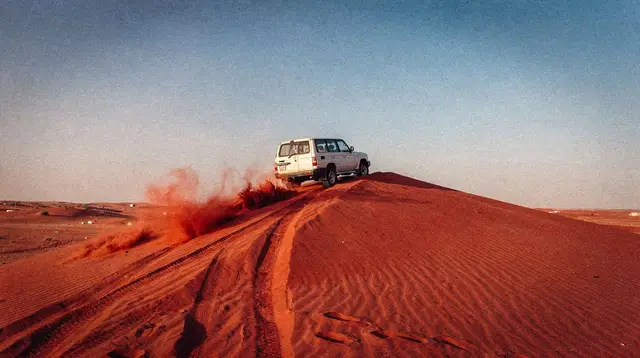
Dune bashing is the core of most half-day trips: a 4x4 with an experienced local driver navigating soft sand dunes at speed, climbing and dropping in a way that feels closer to a fairground ride than a scenic drive. You stay belted in as a passenger. It is not something to attempt in a rented car — see renting a car in Riyadh for why self-drive desert tracks are a bad idea for visitors.
Quad biking and ATVs put you in the driver’s seat instead, usually after a short briefing on a flatter patch of sand. Sessions run anywhere from 20 minutes to an hour and are sold both standalone and bundled with a camel ride or dinner.
Camel and horse rides are the slower, calmer counterpart — a short loop rather than a workout — and are often tacked onto a sunset package as a photo stop rather than the main activity.
Sandboarding rides the same dunes used for bashing, on foot with a board strapped to your feet; it’s a minor add-on rather than a full activity on its own.
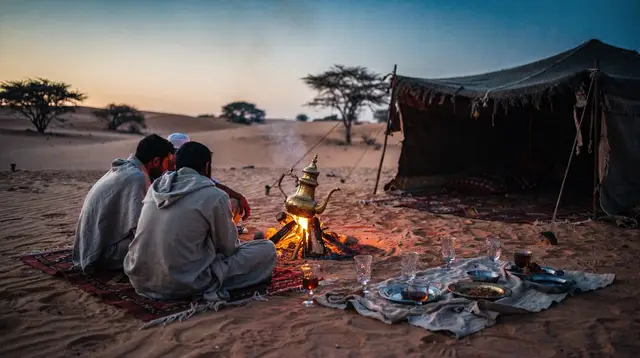
Bedouin-style camp dinners are the common ending point for almost every package: rugs, low seating, tea and coffee, and a dinner of grilled meats, rice and kabsa, sometimes with live music. None of these camps serve alcohol — it is prohibited everywhere in Saudi Arabia, hotels included, and no legitimate operator offers it.
Desert paragliding is a smaller niche activity, weather-dependent and usually offered as its own short session rather than folded into a longer safari.
For a side-by-side comparison of these formats, see camel vs quad vs 4x4 in the Riyadh desert and desert dinner and kashta near Riyadh.
| Activity | Typical length | Physical intensity | Good for |
|---|---|---|---|
| Dune bashing (4x4) | 45–90 min | Low effort, jolting ride | Anyone who enjoys a rough ride; skip if prone to motion sickness |
| Quad/ATV riding | 20–60 min | Moderate, some upper-body effort | First-time riders with a short briefing |
| Camel or horse ride | 15–30 min | Low | Families, photos, a calmer add-on |
| Sandboarding | 15–30 min | Moderate | Groups wanting an active break between rides |
| Camp dinner | 1–2 hours | None | Everyone; the usual finish to a sunset trip |
Where and when: not one fixed spot, and not midday in summer
Because the activity is the point rather than the destination, the exact patch of desert an operator uses can shift with sand conditions, closures or the season, and listings rarely pin it down beyond “near Riyadh.” That’s normal. What matters more is timing.
From roughly May to September, daytime desert temperatures routinely climb past 40 degrees Celsius, and a midday dune-bashing session in that heat is neither comfortable nor safe. Every operator running trips in these months schedules them at sunrise or in the late afternoon into evening, when the sand has cooled and the light is better for photos anyway. Expect a pickup a couple of hours before sunset, an hour or so of dune bashing or quad riding while there’s still daylight, and dinner as the temperature drops.
November to March is the easier season for this activity: daytime highs around 20–25 degrees make a mid-afternoon start comfortable, though desert nights get properly cold once the sun is down, so a dinner package after dark calls for a jacket even if you were fine in a T-shirt at 3pm. For the fuller seasonal picture across Riyadh, see best time to visit Riyadh; for what a heatwave outing actually feels like, see Riyadh heat survival tips. Sandstorms are occasional rather than routine, mostly in spring, and worth a quick check before booking — sandstorms in Riyadh: what to know covers what that means for an outdoor trip. (If that link doesn’t resolve for you, treat it as background reading rather than a booking blocker.)
Why a driver, not a rental car
Desert tracks in this region are unmarked, shift with the sand, and are easy to misjudge without local knowledge — a soft patch that looks solid can bog a vehicle down fast, and cell signal thins out well before you reach the interesting dunes. Every package listed on this page comes with an experienced driver or guide included, which is the actual point of paying for a safari rather than driving yourself: the vehicle and the person who knows the terrain, not just the destination.
If you’re weighing whether to rent a car for your whole Riyadh trip and add the desert separately, the short answer is that a rental makes sense for city driving but not for the desert leg — see renting a car in Riyadh and Uber and Careem in Riyadh for how most visitors actually get around day to day. For the desert stretch itself, book the safari with its own driver.
Booking: group vs private, and what actually varies
Group safaris run on a fixed schedule with a set pickup window, usually collecting several hotels before heading out together. They’re cheaper per person and easy to book with a day or two of notice, but you share the vehicle and the pace with strangers, and the group typically won’t skip an activity for you.
A private desert safari with dinner removes the group entirely: your own vehicle, your own start time, and the ability to time the pickup for a specific sunset rather than whatever slot a shared tour assigns you. It costs more, but for families, couples on a short trip, or anyone who wants to swap out one activity (skip the quad ride, add more time at the camp), private is the more flexible option.
For a straight dune-bashing-and-sandboarding outing without the extra add-ons, a dune bashing and sandboarding tour is the more focused, usually cheaper booking. If quad riding is the main draw, a desert ATV and quad bike tour paired with a short camel ride covers both without a full dinner package attached, which suits a shorter afternoon rather than a full evening out. And for a lighter, dinner-first evening built around the sunset itself rather than the vehicles, a sunset dinner in the desert is the calmer version of the same trip.
None of these listings fix a price on this page — check the booking page for the day’s rate, since it varies by group size, season and whether hotel pickup is included.
What to actually expect on the day
Pickup is almost always from your Riyadh hotel, whether you’re staying around Olaya, Al Malqa, KAFD or near Diriyah — see where to stay in Riyadh if you haven’t picked a base yet. The drive out to Thumamah or the western dunes is shorter than the trip to a named landmark like Edge of the World, generally well under an hour each way, which is part of why this format works as a half-day or evening outing rather than a full-day commitment.
Dress the same way you would anywhere else in public in Riyadh: shoulders and knees covered, nothing especially tight or sheer. There’s no extra dress rule specific to the desert, and no headscarf requirement outside a mosque — that misconception shows up often enough that it’s worth repeating here directly. What you do need that you might not for a city day is closed shoes if you plan to walk on sand, a light scarf or buff for dust during dune bashing, and a layer for the temperature drop after sunset, even in summer.
Photography is generally fine at a commercial camp site, but ask before photographing staff or other guests directly, and never photograph government, military or security installations you might pass on the drive — a rule that applies everywhere in the country, not just here.
Pairing it with the rest of a Riyadh trip
A desert safari slots naturally into a short Riyadh itinerary as an evening activity, leaving daytime hours free for the city and Diriyah. If you’re building out a longer trip, see Riyadh and the desert in four days for how this fits alongside a day at Diriyah and a separate day trip to a named desert destination.
If stargazing rather than dune bashing is the actual draw, note that some camp packages lean into that angle more than others — a night under the stars near Riyadh is worth a read before booking if a clear night sky matters more to you than the vehicle time. And if you’re specifically comparing this generic safari format against a named-destination day trip, what to expect from a Riyadh desert safari and quad biking near Riyadh go deeper on logistics than this overview does.
For groups who want a fully custom day — a specific mix of quad time, camel photos and a late dinner with no fixed group schedule — a combined camel ride, ATV tour and snacks outing is built for exactly that kind of mix-and-match afternoon, and can usually be adjusted with the operator before the day itself.
Desert safari FAQ for Riyadh
What is the difference between a desert safari and a trip to Edge of the World?
A desert safari is a booking category built around an activity — dune bashing, a quad ride, a camel ride, a camp dinner — usually somewhere reasonably close to Riyadh, such as Thumamah to the north or the dunes to the west. Edge of the World is one specific escarpment 90-100 km northwest of the city, with its own drive time and rules, covered on its own page.
Do I need a 4x4 licence or off-road experience?
No. Almost every safari booked from Riyadh is driven or guided by a local operator; you sit as a passenger for dune bashing and get a short briefing before a supervised quad ride. Self-driving on desert tracks without local knowledge is not something a first-time visitor should attempt.
Is it too hot for a desert safari in summer?
From May to September, midday heat in the desert regularly passes 40 degrees Celsius, so operators run these trips at sunrise or in the late afternoon into evening instead. Between November and March, days are milder, around 20-25 degrees, though desert nights turn cold, so bring a layer even for a sunset dinner.
Can women join a desert safari alone or in a mixed group?
Yes. Group and private desert safaris from Riyadh are routinely booked by solo women and mixed groups; modest clothing (shoulders and knees covered) is expected, but there is no dress rule specific to this activity beyond general public modesty.
Is alcohol served at desert camp dinners?
No. Alcohol is prohibited throughout Saudi Arabia, including at hotels and at desert camps, so no dinner package sold from Riyadh includes it. Meals are typically Najdi-style dishes such as kabsa, plus tea and coffee.
Should I book a shared group tour or a private safari?
A shared tour is cheaper and easier to book on short notice, with a fixed pickup window and a set group pace. A private safari costs more but lets you choose your own start time — useful for chasing a specific sunset — and works better for families or anyone who wants to skip a specific activity like dune bashing.
What should I bring on a desert safari?
A scarf or light layer for wind and evening cold, sunglasses, sun protection for a morning or late-afternoon trip, closed shoes if you plan to walk on sand, and a phone or camera with a case — dust gets everywhere during dune bashing.
Desert safaris and dune bashing on GetYourGuide
Verified deep-linked GetYourGuide tours. Book through these links and we earn a small commission at no cost to you.
GetYourGuide does not provide a product photo for this activity — the image shows the meeting point, photographed by us.