Hiking and nature reserves in Riyadh
Where can you hike or walk in nature close to Riyadh?
Wadi Hanifa runs through western Riyadh with paved and gravel paths, Wadi Namar has a dam lake and walking trails south of the city, and King Khalid Royal Reserve to the north has marked hiking trails and a cave. All three are short outings from a Riyadh hotel, unlike the desert of Edge of the World or the Red Sand Dunes, which need a longer drive and often a 4x4.
Nature you can reach without leaving Riyadh
Riyadh is not only skyline and souq. The city sits in a shallow basin cut by wadis, dry riverbeds that fill briefly after rain and stay green year-round where they are maintained. Two of them, Wadi Hanifa and Wadi Namar, give visitors staying in Riyadh a way to walk outdoors without booking a desert excursion. A third option, King Khalid Royal Reserve, sits further out but is still a manageable outing rather than a full desert trip.
This page is deliberately narrow. It covers walking and light hiking inside or at the immediate edge of the city. It does not cover Edge of the World, the Red Sand Dunes, or the villages of Shaqra and Ushaiger, all of which belong to genuine desert excursions with longer drives, unpaved tracks, and 4x4 vehicles. Confusing the two leads to bad planning: someone expecting a desert adventure at Wadi Hanifa will find a landscaped urban valley, and someone expecting an easy afternoon stroll at Edge of the World will find themselves on a two-hour-plus drive with a rough final stretch.
Wadi Hanifa: the green spine of western Riyadh
Wadi Hanifa is a valley that runs along the western side of Riyadh, restored over the past two decades from what had become a dumping and drainage problem into a chain of parks, lakes, and walking paths. It is the closest thing Riyadh has to a continuous green corridor, and it is the same wadi that continues north-west to Diriyah, where it borders the historic At-Turaif district.
For a visitor based in a hotel in Olaya or Al Malqa, sections of Wadi Hanifa are a short drive away, not a day trip. The experience is closer to walking a well-kept riverside park than hiking: paved and gravel paths, some shade, occasional water features, and families and joggers using the same spaces in the early morning and evening. It is a place to stretch your legs and see greenery, not to expect dramatic desert scenery.
Because Wadi Hanifa is long and its parks are spread out, picking one access point matters more than trying to cover the whole valley. A driver or Uber can drop you at a specific park section and collect you later; there is no single continuous trail that a visitor without local knowledge should expect to walk end to end in one visit.
Wadi Namar: the dam lake south of the city
South of central Riyadh, Wadi Namar holds a dam and the lake it creates, one of the more visually distinct green spots in the city precisely because open water is unusual here. Around it are walking paths and viewpoints used mostly by residents, with the lake itself the main draw rather than a hiking trail network.
Wadi Namar works well as a short, unhurried outing, especially in the cooler months when a slow walk along the water in the late afternoon is genuinely pleasant. It is not a wilderness experience, and there is no pretending otherwise: it is a managed public space with a dam structure, car parking, and the kind of light infrastructure you would expect around a city reservoir.
King Khalid Royal Reserve: closer to real hiking
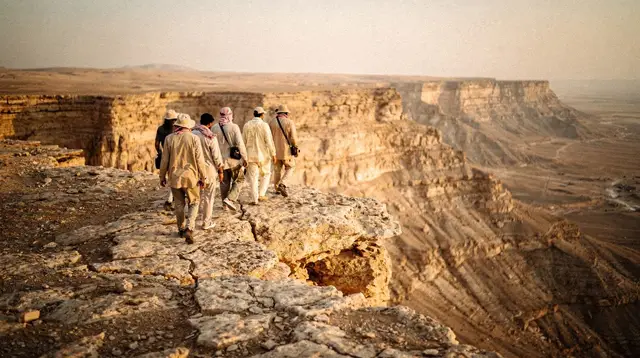
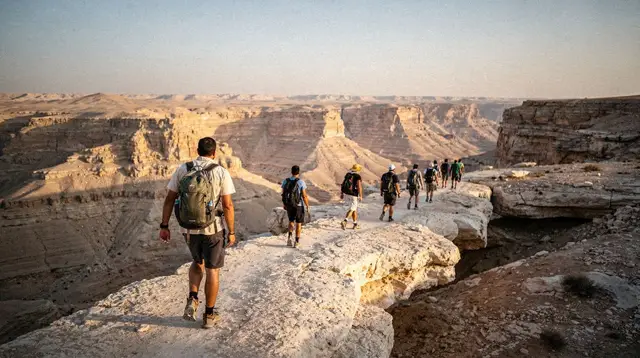
North of Riyadh, King Khalid Royal Reserve is a step up in scale from the two wadis above. It has marked hiking routes, varied terrain, and a known feature that draws hikers specifically: a cave associated with owls, which several tour operators build a themed hike around. This is where “hiking near Riyadh” starts to mean an actual trail with elevation change and rock, rather than a paved park path.
The reserve sits far enough from central Riyadh that most visitors do better joining an organised hike than trying to find trailheads and navigate on their own, particularly for a first visit or an evening or night hike.
An owl cave hiking route at King Khalid Royal Reserve covers the reserve’s best-known trail feature with a guide who knows the current path conditions, which matters more here than at the city wadis because routes and access can change with the season.
If you would rather hike after dark, when temperatures drop and the reserve feels different, a night hike at King Khalid Reserve with food and drinks included turns the same terrain into an evening outing rather than a daytime one, useful in the hotter months when a midday hike is simply not comfortable.
There is also a separate trail at the same reserve, sometimes marketed under the Thumama Falaq name, covered by a guided hike on the Thumama Falaq trail at King Khalid Royal Reserve, which spreads visitor traffic across more than one route inside the reserve rather than concentrating everyone on the same path.
Getting to King Khalid Royal Reserve on your own is possible with a rented car, but most visitors find a private driver or a booked tour simpler: the reserve sits far enough from central Riyadh that a waiting taxi is not guaranteed, and arranging a return trip from a trailhead with patchy phone signal is an avoidable hassle. An early departure also helps beat both the heat and the traffic that tends to build on the roads out of the city later in the day.
Why this is not a desert excursion
It is worth being explicit about the difference, because the names can sound similar to a first-time visitor skimming a list of Riyadh activities. Wadi Hanifa, Wadi Namar, and King Khalid Royal Reserve are inside or at the edge of the greater Riyadh area, reachable by ordinary car or Uber, on maintained or at least accessible paths, in landscapes that are green, rocky, or managed rather than open sand.
Edge of the World, by contrast, is an escarpment of the Tuwaiq range roughly 90 to 100 kilometres north-west of Riyadh, around two to two and a half hours’ drive each way once you count the unpaved final stretch, which needs a 4x4. The Red Sand Dunes and the villages near Shaqra and Ushaiger sit at similar or greater distances and belong to the same category: a planned day out with a driver or tour, not an afternoon add-on.
If your hotel concierge or a tour listing groups “hiking” and “desert safari” together, ask specifically which one you are booking. A trail at King Khalid Royal Reserve and a 4x4 run to Edge of the World share the word “adventure” in marketing copy and very little else in practice.
Comparing the options at a glance
| Place | Distance from central Riyadh | Terrain | Getting there |
|---|---|---|---|
| Wadi Hanifa | Inside the city, western districts | Paved and gravel paths, parks, some water | Car, Uber, Careem |
| Wadi Namar | South of the city | Dam lake, walking paths, viewpoints | Car, Uber, Careem |
| King Khalid Royal Reserve | North of the city, further out than the wadis | Marked hiking trails, rock, a cave feature | Private driver or booked tour recommended |
| Edge of the World (for contrast) | 90 to 100 km north-west | Desert escarpment, unpaved final stretch | 4x4, organised tour |
Getting there without renting a car
None of these three spots require a rental car. Uber, Careem, and licensed taxis operate across Riyadh and cover Wadi Hanifa and Wadi Namar without difficulty, since both sit close to city roads with normal traffic. For King Khalid Royal Reserve, a private driver arranged for the return trip is more practical than hailing a car from the trailhead itself, which is part of why most operators bundle transport into the hiking tours above.
The Riyadh Metro is useful for getting around central districts and to the airport, but it does not reach any of these three sites directly, so treat it as a way to get to your hotel or to Diriyah rather than a way to reach a trailhead. If you would rather compare the metro against Uber and Careem for the rest of your stay, or you are weighing renting a car in Riyadh against relying on ride-hailing throughout, both are worth reading before you settle on a plan for the whole trip.
Cards and contactless payment are accepted almost everywhere in Riyadh, including cafes near Wadi Hanifa and Wadi Namar, but King Khalid Royal Reserve and its trailheads are exactly the kind of isolated stop where a little cash is worth carrying, in case a kiosk or a parking attendant cannot take a card. See money, cards, and payments in Riyadh for more on that.
Honest notes on heat, timing, and expectations
Riyadh’s climate does not pause for hiking plans. From November to March, daytime conditions are comfortable, with December to February typically around 20 to 25 degrees Celsius and cool desert nights, making this the easiest window for any of the walks above, at any hour. From May to September, temperatures routinely climb past 40 degrees Celsius, and a midday walk at any of these sites, wadi or reserve, is a bad idea rather than an inconvenience. In that stretch, plan for sunrise or the last couple of hours before sunset, and carry more water than you think you need. Rain is rare across the year, and dust or sandstorms are an occasional spring and summer risk even in the city’s green spaces, not only in the open desert.
None of these outings require special clothing beyond ordinary modest dress and good walking shoes. An abaya is not required for foreign women at any of these locations; a headscarf is not required outside a mosque. What matters more here is sun protection: a hat, sunglasses, and, in summer, timing your walk for the cooler hours rather than worrying about formality.
Distances and trail lengths at King Khalid Royal Reserve are not fixed figures worth quoting precisely, since routes and open sections can change; a booked hike with a current guide is the more reliable way to know what a given day’s trail actually involves, rather than relying on a distance printed somewhere online.
Riyadh’s weekend falls on Friday and Saturday, and Wadi Hanifa and Wadi Namar are noticeably busier with local families and joggers during those two days, especially in the cooler months, than on a weekday morning. That is not a reason to avoid them, but it is worth knowing if you are picturing a quiet walk: a weekday visit, where your itinerary allows it, tends to be calmer at all three locations.
Fitting a walk into a Riyadh stay
For most visitors, a wadi walk or a reserve hike is a half-day slot rather than the centrepiece of a trip. A common pattern is to pair a morning or late-afternoon walk at Wadi Hanifa or Wadi Namar with sightseeing in central Riyadh or a visit to Diriyah on the same day, since driving times between them stay short. King Khalid Royal Reserve, being further out, tends to work better as its own half-day or evening slot, especially if you book the night hike.
If you are building a longer stay and want to see how a hike fits alongside heritage sites, museums, and a desert day, the Riyadh and the desert in four days itinerary structures that mix without cramming a hike and a desert excursion into the same day. For a shorter visit, one day in Riyadh is a useful reference for how much realistically fits before or after a walk.
If your main interest is genuinely the desert rather than city-adjacent nature, it is worth reading about Riyadh desert safaris or quad biking near Riyadh separately, since those trips are planned, timed, and equipped differently from anything on this page. Checking Riyadh’s weather by month or the best time to visit Riyadh before booking either kind of outing avoids arriving in the hottest stretch of the year expecting a comfortable walk.
For visitors who want a broader look at what else falls under this category, the hiking and nature reserves section groups all of Riyadh’s walking-related activities in one place, separate from the desert-specific listings.
Riyadh’s airport, King Khalid International, sits roughly 35 kilometres north of the centre, about 30 to 45 minutes to Olaya outside peak traffic. That timing matters if you are on a long layover or arriving late in the day: a short Wadi Hanifa walk near Olaya is realistic on an afternoon that also includes airport transfers, while King Khalid Royal Reserve or Wadi Namar need more of the day set aside. If you are specifically working with a layover, the Riyadh layover guide and the Riyadh layover itinerary go into that timing in more detail.
A full-day private VIP tour of Riyadh is worth considering if you would rather have a driver structure a day that includes a wadi stop alongside heritage and city sights, rather than arranging each leg separately.
The bottom line
If you want to walk somewhere green without leaving the Riyadh area, Wadi Hanifa and Wadi Namar deliver that on short notice with no special equipment. If you want an actual hiking trail with some challenge to it, King Khalid Royal Reserve is the honest next step up, best done with a guide who knows current conditions. None of it substitutes for a desert excursion, and none of it needs to: keep Edge of the World, the Red Sand Dunes, and the Shaqra-Ushaiger villages as separate, properly planned days, and treat this page’s three locations as what they are, easy nature breaks from a Riyadh hotel.
Hiking and nature reserve tours on GetYourGuide
Verified deep-linked GetYourGuide tours. Book through these links and we earn a small commission at no cost to you.
GetYourGuide does not provide a product photo for this activity — the image shows the meeting point, photographed by us.