Riyadh for first-time visitors: what to know before you go
What should a first-time visitor know about Riyadh before arriving?
Riyadh is a spread-out, car-dependent city where you sleep in town and take day trips into the surrounding desert. The abaya is not required for foreign women, alcohol is banned everywhere including hotels, and the weekend runs Friday-Saturday, not Thursday-Friday.
Riyadh does not work like most capital cities people plan a first trip to. It is not a compact old town you wander on foot for a week. It is a base: somewhere you sleep, eat, and organize logistics from, while the things worth seeing are split between the city itself and the desert around it. Get that framing right before you land and the rest of the trip falls into place faster than trying to figure it out on arrival.
Riyadh is a base, not a single destination
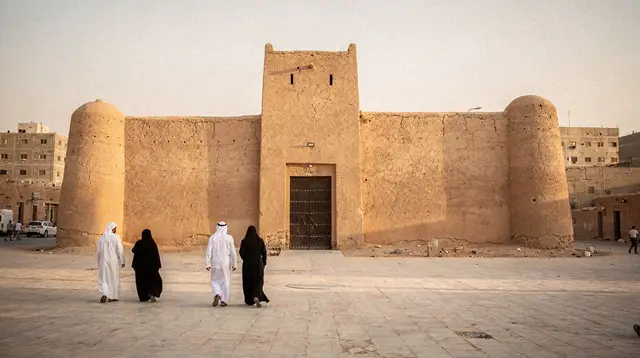
Treat Riyadh the way you would treat a gateway city near a national park. You stay in one of the central districts — Olaya, Al Malqa in the north, or near KAFD — and from there you either explore the city’s own sights or drive out for the day. The city side covers the modern skyline, the historic core around Masmak, and neighboring Diriyah, the mud-brick town where the first Saudi state began. The desert side covers the escarpment at Edge of the World and the wider desert excursions region, including the red dunes and the heritage villages further out.
What is not part of a normal Riyadh trip: AlUla, Jeddah, Mecca, and Medina. AlUla is roughly a 1h45 flight away, and the others are hundreds of kilometers in the other direction. None of them are day trips from Riyadh, and a tour or guide that frames them that way is being loose with the geography. The one exception is a multi-day tour explicitly sold as departing from Riyadh and covering one of those places over several days — that is a different product from a day excursion, and it should say so clearly in the listing.
Knowing how many days to allow for the city-versus-desert split matters more than picking a neighborhood, so if you have not settled that yet, work through how many days in Riyadh before booking anything, and pair it with where to stay in Riyadh for the practical side of picking a base.
A city built around the car, not the sidewalk
Riyadh is flat, gridded, and genuinely large. Distances that look short on a map routinely take 30-45 minutes by road, and that is outside peak traffic. Rush hour in the late afternoon and early evening can stretch any crossing of the city considerably, so build slack into a same-day plan rather than stacking appointments back to back.
The Riyadh Metro is real and useful for some trips: an automated six-line network that opened in stages between December 2024 and early 2025, with a connection to the airport and stops through several central districts. It is a genuine option for city-to-city hops within Riyadh, but it will not get you to the desert. For that, and for most cross-town trips outside the metro’s reach, Uber and Careem are heavily used and reliable, and licensed taxis cover the gaps.
For desert excursions specifically, a private driver or a booked tour is the norm rather than the exception. Edge of the World sits 90-100 km northwest of the city — call it two to two-and-a-half hours each way once you count the final unpaved stretch, which needs a 4x4. That is not a trip to improvise in a rental sedan, and it is not a 30-minute jaunt no matter how a listing photo makes it look. Traffic rules are straightforward if you are driving yourself: you drive on the right, and Saudi women have been legally permitted to drive since 2018, so a self-drive rental is a normal option for the city itself, if not for the desert tracks.
Arriving by air, King Khalid International Airport sits about 35 km north of the center, with a 30-45 minute drive into Olaya outside peak hours — plan on more if your flight lands during the evening crush.
Money, connectivity, and the practical basics
The currency is the Saudi riyal (SAR), pegged to the US dollar, and cards work almost everywhere — hotels, malls, restaurants, and most small shops take contactless payment without issue. Keep some cash for the older souqs and for isolated stops during desert excursions, where a card machine is not always on hand. This page is a general orientation rather than a budget breakdown; for actual cost planning, money, cards, and payments in Riyadh goes into the detail this page skips on purpose.
Arabic is the everyday language, but English is widely spoken in hotels, malls, and on organized tours, so a lack of Arabic is rarely a barrier for a first visit.
Riyadh runs on Arabia Standard Time, UTC+3, all year round — there is no daylight saving adjustment to account for, which simplifies scheduling calls home or coordinating flight connections. Power sockets are the UK-style Type G plug at 230V/60Hz, so pack the right adapter if you are coming from a country that uses a different standard.
Two small practical questions come up on almost every first trip: how to stay online, and how much to tip. Neither is complicated, but both are easy to get wrong by guessing instead of checking. Staying connected in Saudi Arabia covers SIM and eSIM options for arriving travelers, and tipping in Saudi Arabia sets out what is actually expected for drivers, guides, and restaurant staff rather than what a generic Gulf-travel article assumes.
The three etiquette points visitors get wrong
A short list of what actually changed, and what did not, saves more stress than any packing list.
The abaya is not required for foreign women. Modest dress — shoulders and knees covered, nothing sheer or overly tight — is the expectation for everyone in public, men included, but the full black abaya is a personal or cultural choice, not a legal requirement for visitors. A headscarf is only needed inside a mosque, not in a mall, a hotel lobby, or on a desert tour. If you want the fuller rundown, what to wear in Riyadh covers specific situations in more depth than makes sense here.
Alcohol is illegal everywhere, including hotels. This one has no exceptions and no quiet workaround: no licensed sale, no bar, no room service pour, in any hotel chain in the country. If a listing or a blog post claims otherwise, it is wrong.
The weekend is Friday-Saturday, not Thursday-Friday. Government offices and many businesses close then, and Friday midday prayer is the quietest window of the week across the city — a good time to expect a short pause at some shops and restaurants near prayer times generally, not just on Fridays.
None of these three are edge cases. They come up in almost every first-timer’s questions, and getting them backwards is the fastest way to either overpack or misjudge what a day in Riyadh will actually feel like.
The three areas this site covers
Riyadh’s own city fabric splits into the modern side — the Kingdom Centre and its Sky Bridge, Al Faisaliah Tower, and the King Abdullah Financial District — and the historic core around Masmak Fortress, Deera Square, and Souq Al Zal, plus the National Museum. Just outside the city, Diriyah adds the At-Turaif district and Al Bujairi Terrace on the opposite bank of Wadi Hanifa.
Beyond the city limits, the desert region groups Edge of the World, the Red Sand Dunes, and the heritage villages of Shaqra and Ushaiger — each a distinct half-day or full-day trip rather than a single combined outing. Further out again, Al-Qassim province around Buraydah is a longer excursion that most visitors skip on a first trip, worth considering only if you already have extra days and want to go deeper into the Najd region.
A private full-day option that combines several of the city’s landmarks in one outing is a common way to cover the ground without juggling separate bookings — a full-day private tour of Riyadh’s main sights is one way to see the skyline, the historic quarter, and a desert stop without renting a car yourself. For a more compact city-only introduction, a half-day city tour of Riyadh covers the essentials without the desert leg.
Traditional desert experiences beyond the sunset dinner
Alongside the scenery-focused trips, a handful of experiences lean more into local tradition than landscape. A camel market on the edge of the city is one of the few places where the trading and auction routines that predate the modern skyline are still visible, largely unchanged, and camel and horse rides are an easy add-on to a desert afternoon rather than a separate outing. A guided camel market tour handles the timing and the etiquette of visiting a working market, which is not something to improvise on a first trip without a guide who knows the site.
Heritage villages and the longer drive to Qassim
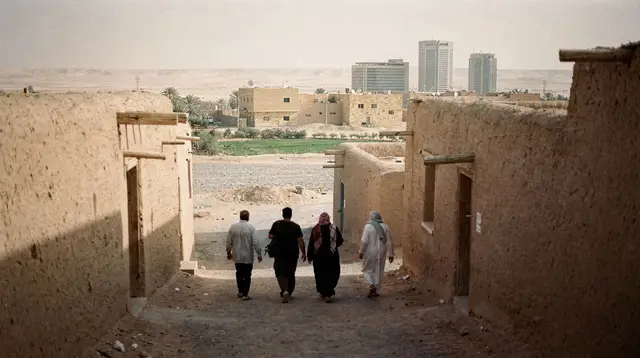
Past Edge of the World and the red dunes, Shaqra and Ushaiger sit further out and reward the extra driving with a different kind of sight: mud-brick heritage villages rather than desert scenery. Ushaiger heritage village in particular is walkable in a couple of hours, and a full Shaqra-and-Ushaiger day trip is the practical way to see both without doubling back to Riyadh in between.
Further still, Al-Qassim province around Buraydah is a genuinely longer excursion — closer to a day given over entirely to the drive than a half-day add-on — and it is worth reading whether Qassim is worth the drive from Riyadh before committing a full day of a short trip to it. A dedicated Qassim day trip lays out what the province actually offers once you are there.
Packing for the climate you will actually get
What belongs in the suitcase depends heavily on the season, since a December visit and a July one call for almost opposite kit. What to pack for Riyadh goes through this properly, but the short version is: layers for cold desert nights in winter, sun protection and light fabrics for the summer heat, modest clothing covering shoulders and knees year-round, and closed shoes for anything involving the escarpment trail or a heritage village’s uneven ground. Riyadh weather by month is the page to check if a specific travel date is already fixed and the packing list needs to match it exactly.
When to come
November through March is the comfortable stretch: daytime temperatures in the low-to-mid 20s Celsius from December to February, with cold desert nights that catch people out if they only packed for daytime heat. May through September runs consistently above 40°C, and desert excursions during those months are scheduled around sunrise or late afternoon rather than midday. Rain is rare year-round, and the occasional sandstorm is more likely in spring and summer than in winter. If timing is the one thing you have not locked down yet, best time to visit Riyadh breaks the year down month by month.
Ramadan is worth flagging on its own: dates shift roughly 11 days earlier each year, eating, drinking, and smoking in public during daylight hours is not permitted, and much of city life — including some tour schedules — shifts toward the evening. If your trip lands during that period, read visiting Riyadh during Ramadan before finalizing an itinerary, since opening hours at several sights change without much notice.
For the entry paperwork itself, the country opened to tourism in September 2019, and most Western nationalities now apply for an e-Visa or arrange a visa on arrival through the official visa.visitsaudi.com portal — only GCC citizens skip the visa step entirely. Passports need at least six months of validity. This page will not quote a fee, since amounts and eligibility change; Saudi Arabia e-Visa and entry rules is the page to check for the current process.
A first evening in the desert
If there is one experience worth building the first or second evening around, it is getting out of the city into the desert while the light is low. A sunset dinner out in the desert gives a low-effort introduction to that landscape without needing a full-day commitment, and it pairs naturally with an early city day beforehand. Save the longer desert drives — Edge of the World, the red dunes, or a trip toward Shaqra and Ushaiger — for a day with no other plans, since travel time there eats a meaningful chunk of daylight on both ends.
For a fuller first-timer’s route through the city and one desert day, three days in Riyadh lays out a sequence that matches the pacing described here.
Riyadh first-time visitor questions, answered
Do female visitors have to wear an abaya in Riyadh?
No. Modest dress covering shoulders and knees is expected of everyone in public, but the abaya itself is not required for foreign women. A headscarf is only needed inside mosques, not in malls, hotels, or on the street.
Can you get a drink in a Riyadh hotel?
No. Alcohol is illegal throughout Saudi Arabia, including in international hotel chains and their restaurants. There is no licensed sale or service anywhere in Riyadh.
Is the weekend in Riyadh Friday-Saturday or Thursday-Friday?
It is Friday-Saturday. Government offices, many businesses, and some tour schedules follow this rhythm, and Friday midday prayer is the quietest stretch of the week.
Does Riyadh have a metro?
Yes. The Riyadh Metro is an automated six-line network that opened in stages between December 2024 and early 2025, with a link to the airport, though most desert day trips still rely on a car or a private driver.
What currency is used in Riyadh?
The Saudi riyal (SAR), pegged to the US dollar. Cards and contactless payment are accepted almost everywhere, including small shops, though it helps to carry some cash for souqs and desert stops.
How easy is it to get around Riyadh without a car?
Uber, Careem, and licensed taxis cover the city well, and the metro now reaches several central districts and the airport. For desert excursions outside the city, a private driver or a booked tour is the practical option, not a taxi.
Do you need a visa to visit Riyadh?
Most Western visitors, including from the EU, UK, US, Canada, and Australia, need an e-Visa or a visa on arrival; only GCC citizens travel visa-free. Apply through the official visa.visitsaudi.com portal rather than a third-party site.
Planning tips for visiting Riyadh on GetYourGuide
Verified deep-linked GetYourGuide tours. Book through these links and we earn a small commission at no cost to you.
GetYourGuide does not provide a product photo for this activity — the image shows the meeting point, photographed by us.