Is Riyadh safe for tourists?
Is Riyadh safe for tourists?
Yes, by the numbers Riyadh has very low street crime, and violent crime against tourists is rare. The genuine risks are dense rush-hour traffic, extreme heat from May to September, and rules around photography that visitors don't expect, more than personal safety in the usual sense of the question.
What “safe” actually means in a city new to tourism
Saudi Arabia only opened to international tourism in September 2019, which means Riyadh’s tourist-facing infrastructure, from visa systems to hotel front desks used to answering foreign travellers’ questions, is younger than in most capital cities people compare it to. That is worth saying plainly, because it explains some of the friction visitors report: a hotel concierge who is still learning what tourists typically ask, a tour operator whose English-language materials feel newly printed, a metro system that only opened in stages between December 2024 and early 2025. None of that is a safety problem. It is a maturity gap, and it is closing fast.
The confusion around Riyadh’s safety usually comes from importing assumptions about the wrong kind of risk. Visitors arriving with worries about street crime, scams or being targeted as a foreigner are asking the wrong question. Riyadh’s crime rate against visitors is low, and violent crime is rare. The risks that actually deserve attention are duller and more practical: traffic, heat, and a short list of rules around photography and behaviour that are easy to break without meaning to. This guide covers those, and only those. Visa requirements and neighbourhood choice are covered elsewhere on this site; here the focus stays on personal safety and the things a consumer-protection mindset would actually flag.
The real risk is traffic, not crime
Ask residents what they worry about day to day in Riyadh and traffic comes up long before crime does. Riyadh is a car-first city built on a grid of wide arterial roads, and during rush hour, roughly 7 to 9am and 4 to 7pm, those roads fill with dense, fast-moving traffic that does not always follow lane discipline strictly. For a visitor this matters in two ways.
As a pedestrian, some intersections in older and commercial districts lack marked crossings or working signals, and drivers are not always attentive to people crossing outside a crosswalk. Around Olaya, Al Malqa and the newer KAFD district, infrastructure is better, with proper sidewalks and crossings, but it is still a city designed around the car rather than the pedestrian. The practical habit is the same one that works everywhere: cross at marked points, make eye contact with drivers where possible, and do not assume a stopped car will stay stopped.
As a passenger, whether in your own rental, an Uber, a Careem, or a private driver hired for a desert excursion, the risk is less about drivers’ skill and more about sheer traffic density turning short distances into long waits. A trip that should take 20 minutes at midday can take 45 during rush hour. This is a planning issue as much as a safety one: build in real time margins around airport transfers and any tour departure, because Riyadh’s roads punish tight schedules more than they punish careless driving.
Riyadh’s automatic metro network, opened in stages between December 2024 and early 2025 across six lines and now linked to the airport, has started to pull some of that pressure off the roads, and using it for point-to-point trips inside the city is one of the more reliable ways to sidestep rush-hour uncertainty altogether.
Heat is the other real risk, and it is seasonal
From May to September, daytime temperatures in Riyadh routinely climb past 40°C, and this is the safety issue most visitors underestimate, because it does not feel dramatic until it is. Heat exhaustion and dehydration are the realistic hazards on a midday desert excursion in summer, not wildlife, terrain or crime. The fix is scheduling, not gear: desert trips to places like the Red Sand Dunes or a heritage stop near Shaqra and Ushaiger should be planned for early morning or late afternoon and evening in the hot months, when temperatures drop enough to make walking, quad biking or camel riding comfortable rather than risky.
November through March is the more forgiving season, with daytime highs around 20 to 25°C from December to February and cold desert nights, which is why most tour operators push their desert programming toward that window and why it is worth matching your own trip to it if your dates are flexible. A 4x4 outing to Edge of the World in July, timed for sunset, is genuinely fine. The same trip attempted at 1pm in August is where heat becomes the actual danger, not the escarpment’s unguarded edges (though those deserve their own caution too: there are no barriers at the cliff line, and staying well back from the drop matters regardless of season).
Carry more water than feels necessary, and treat any organised desert trip’s stated departure time as a safety decision, not just a scheduling one.
Photography rules that catch visitors out
This is the safety-adjacent issue that trips up more first-time visitors than almost anything else, because it is legal rather than physical, and because the instinct to photograph an interesting street scene is hard to override. Two rules matter. First, photographing people, and especially women, without asking permission first is not acceptable, socially or legally, and can escalate into a confrontation or a police matter faster than a visitor expects. Ask first, or photograph landscapes, architecture and food instead. Second, photographing government buildings, military installations, airports and security checkpoints is against the law, and enforcement is not lenient about “I didn’t realise.” If a building looks official, official-looking, or has visible security presence, put the phone down.
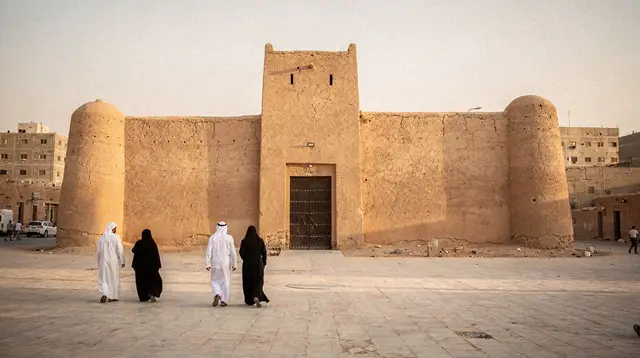
Everything else, from the Kingdom Centre’s 302-metre Sky Bridge to the mud-brick walls of At-Turaif in Diriyah, is fair game and photographed constantly by tourists and Saudis alike.
Driving, ride-hailing and getting around safely
Uber and Careem both operate widely in Riyadh and are the default choice for most visitors moving between neighbourhoods, with licensed taxis as a secondary option. For excursions outside the city, hiring a private driver or booking an organised tour is the norm rather than the exception, partly because the last stretch to somewhere like Edge of the World runs on unpaved desert track and genuinely needs a 4x4 and local route knowledge, not because self-driving in the city itself is unsafe.
If you do rent a car, driving is on the right, and Saudi women have held the legal right to drive since 2018, so a woman renting a car and driving herself around Riyadh is unremarkable, not a workaround. The road rules that matter for safety are the ordinary ones: speed limits are enforced with cameras more than by traffic police, seatbelts are mandatory, and using a phone while driving carries real penalties.
| Getting around | Best for | What to know |
|---|---|---|
| Riyadh Metro | Point-to-point city trips, avoiding rush-hour roads | Six-line automatic network, phased opening Dec 2024–early 2025, connects to the airport |
| Uber / Careem | Most in-city trips | Widely used, generally reliable, straightforward pricing shown upfront |
| Licensed taxi | Short hops, hotel pickups | Fine, though app-based rides are usually easier for a first-time visitor |
| Private driver | Desert excursions, multi-stop days | The norm for trips beyond the city; often bundled into a tour booking |
| Rental car | Independent city driving | Drive on the right; women have driven legally since 2018 |
Women travelling in Riyadh
The question of whether Riyadh is safe for women, and specifically for women travelling alone, deserves a straight answer rather than either reassurance or alarm. Foreign women are not legally required to wear an abaya; the actual requirement is modest dress for everyone in public, meaning shoulders and knees covered and nothing tight-fitting or sheer. A headscarf is only required inside mosques, not generally in public, which surprises visitors who arrive expecting otherwise based on outdated information or on rules that apply elsewhere in the region. Many women visit and move around Riyadh independently, use the metro and ride-hailing apps solo, and eat alone in restaurants without particular difficulty.
That said, public displays of affection are frowned upon for everyone, and unsolicited photography of women specifically is one of the more common sources of tension between visitors and locals, which loops back to the photography rule above. The practical experience for most solo female visitors is closer to “unremarkable, with occasional stares” than to anything more serious.
What tends to be overblown
A few worries that circulate online do not hold up well against how Riyadh actually functions in 2026. Alcohol is genuinely, fully prohibited, including in hotels, with no exceptions for tourists, and that is worth knowing before you book a room expecting a minibar to include anything more than soft drinks. But that is a dry-city fact, not a danger. Ramadan changes daily rhythms substantially, moving business hours later and prohibiting eating, drinking or smoking in public during daylight, but it is a scheduling adjustment, not a safety issue, and enforcement toward polite, discreet visitors is generally relaxed. The weekend runs Friday and Saturday, and Friday midday prayers are the quietest window of the week citywide, with some shops pausing briefly, which trips up itinerary planning more than anything else.
None of these are the “is it dangerous” question visitors actually mean to ask, and treating them as safety issues distracts from the two that genuinely are: traffic and heat.
Building it into a booking
Several of the ways visitors reduce their own risk in Riyadh are baked into how a trip is booked rather than something to manage solo. A Riyadh city tour with a licensed guide, such as the Riyadh city tour, moves you between the historic centre, Diriyah and the modern skyline with a driver who already knows which routes avoid the worst of rush-hour backups. For a longer day that folds in heritage sites and modern Riyadh without you managing logistics, the full-day VIP tour of Riyadh keeps timing and transport in someone else’s hands.
For desert excursions, where heat management is the main safety variable, a booked evening programme such as the sunset dinner in the desert is scheduled deliberately around the cooler part of the day rather than left to chance, which matters more than any piece of gear you could pack. Similarly, a desert horse ride booked as the desert horse ride tour runs at times chosen by an operator who deals with the heat daily, not by a first-time visitor guessing.
Planning around the real risks
The single most useful adjustment for a first Riyadh trip is timing: build airport transfers and any tour departure with real slack around rush-hour traffic, and push desert time toward early morning or evening between May and September. Pair that with the two legal rules that actually matter, permission before photographing people and no photographing official buildings, and Riyadh’s safety profile looks close to what the crime statistics already say: a low-crime capital city where the practical hazards are logistical, not personal.
For first-time visitors weighing how much to plan versus improvise, it is worth reading alongside a guide to what to wear in Riyadh and one on Saudi laws and etiquette, since dress and conduct expectations are the other half of the “how do I not stand out for the wrong reasons” question that safety worries are often really about. If your trip lands during the hottest months, the dedicated guide to Riyadh in summer goes further into heat-specific scheduling than this page does, and solo female travellers will find more detail on day-to-day experience there too. Anyone visiting during the holy month should also check the separate guide on visiting Riyadh during Ramadan before finalising an itinerary, since it affects timing far more than safety.
Frequently asked questions about safety in Riyadh
Is Riyadh safe for tourists?
Yes. Street crime and violent crime against visitors are both rare, and Saudi Arabia has invested heavily in tourist-facing infrastructure since opening to international visitors in September 2019. The practical risks are traffic and heat, not personal security.
Is it safe to walk around Riyadh at night?
Central and northern neighbourhoods such as Olaya and Al Malqa are generally fine to walk at night, with cafes and malls open late. The main hazard is the same as during the day: wide roads built for cars, with limited pedestrian crossings in places.
Do I need to worry about being pickpocketed in Riyadh?
It is not a common problem in Riyadh’s malls, souqs or hotel districts, but ordinary travel sense still applies: keep valuables out of sight in crowded markets like Souq Al Zal, the same as anywhere else.
Can I take photos in Riyadh?
Photographing places is fine almost everywhere, but photographing people, especially women, without asking first is not acceptable, and photographing government, military or security buildings is against the law.
Is Riyadh safe for women travelling alone?
Many women travel independently in Riyadh without incident. Saudi women have been legally allowed to drive since 2018, and foreign women are not legally required to wear an abaya, only to dress modestly, which changes how the city is often imagined versus how it actually runs.
What is the biggest safety risk in Riyadh?
For most visitors it is road traffic, both as a pedestrian crossing wide multi-lane roads and as a passenger in dense rush-hour congestion, followed by heat exposure during desert excursions between May and September.
Is the tap water in Riyadh safe to drink?
Riyadh’s municipal water is desalinated and treated, but most residents and hotels serve bottled water anyway, more from habit and taste than a safety issue.
Planning tips for visiting Riyadh on GetYourGuide
Verified deep-linked GetYourGuide tours. Book through these links and we earn a small commission at no cost to you.
GetYourGuide does not provide a product photo for this activity — the image shows the meeting point, photographed by us.