Saudi laws and etiquette for visitors
What are the main laws and etiquette rules visitors to Riyadh need to know?
Alcohol is illegal everywhere in Saudi Arabia, including hotels, with no exceptions. Public displays of affection are frowned on, and photographing people or government and security buildings without permission is against the rules. Most Western visitors need an e-Visa or visa on arrival, except GCC citizens, and a passport valid for at least six months.
What actually catches visitors out in Riyadh
Saudi Arabia has been open to leisure tourism since September 2019, and Riyadh has changed fast since then: a metro, international hotel brands, a packed festival calendar. What has not changed is the legal and social framework underneath it. Dress code is covered separately in what to wear in Riyadh, and Ramadan-specific timing gets its own page at visiting Riyadh during Ramadan. This page is about everything else: the rules around alcohol, public conduct, photography, and the paperwork you need before you land at King Khalid International Airport.
Most of this is straightforward once you know it. The friction usually comes from visitors who have been to Dubai or Abu Dhabi and assume Gulf cities are interchangeable. Riyadh runs on a different set of rules than those cities, and the gap catches people who did not expect it.
Alcohol: the rule most visitors get wrong
Alcohol is illegal in Saudi Arabia. Not restricted, not available with a license, not sold quietly in a hotel bar for foreigners. It is prohibited nationally, and Riyadh is no exception. This surprises visitors who have stayed in Dubai or Abu Dhabi, where international hotels routinely hold liquor licenses and serve alcohol to non-Muslim guests. Saudi Arabia has never operated that system. There is no tourist carve-out, no discreet minibar, no members-only lounge serving drinks behind a closed door.
International hotel chains in Olaya, Al Malqa, and around KAFD operate exactly like every other hotel in the country on this point: no alcohol on the premises, full stop. Bringing alcohol into the country in luggage is a customs offense, not a minor infraction, and it is treated accordingly. If a trip built around wine with dinner or a drink at the end of a long day in the desert is part of your expectations, adjust those expectations before you land, not after.
What you will find instead is a genuinely strong non-alcoholic drinks culture: Saudi coffee, dates, fresh juice bars, and an expanding café scene in places like Al Bujairi Terrace. It is not a replacement in the way some visitors want, but it is not a consolation prize either — the café culture in Riyadh has grown into something worth experiencing on its own terms.
Public conduct: affection, behaviour, and what draws attention
Public displays of affection are considered inappropriate in Saudi Arabia, and that applies to everyone, married couples included. Holding hands briefly is unlikely to cause a problem, but hugging, kissing, or anything more visible in a public space — a mall, a park, a restaurant — can draw unwanted attention from other patrons or from security staff. This is a social norm as much as a written law, and it is one of the areas where the practical rule is stricter than what many visitors assume from following Saudi Arabia’s tourism marketing.
Loud or disruptive behaviour in public, arguments, and generally drawing attention to yourself are best avoided, particularly around government buildings, mosques, or anywhere with a visible security presence. None of this requires unusual caution — Riyadh’s malls, restaurants, and heritage sites are busy with a mix of Saudi families and international visitors, and ordinary tourist behaviour draws no attention at all. It is the specific categories above — alcohol, visible affection, disruptive behaviour — where the gap between expectation and rule tends to show up.
Dress code: what’s actually required, not assumed
Dress code is covered in full elsewhere, but one myth is worth correcting here because it shapes how visitors behave before they even land: foreign women are not required to wear an abaya in Riyadh. Modest dress — shoulders and knees covered, nothing sheer or overly tight — applies to everyone, men and women, in public spaces, but the head-to-toe black abaya seen on Saudi women is a cultural and personal choice, not a rule imposed on visitors. A headscarf is only expected inside mosques, not on the street, in a mall, or on a desert excursion. Guides on organised tours will say so if a specific site expects more coverage than usual, which is rare outside religious sites. The full packing and dress breakdown is at what to wear in Riyadh and do women have to wear an abaya in Saudi Arabia.
Ramadan, prayer times, and the Saudi weekend
Two other rules shape daily life in ways visitors do not always expect, and both are legal requirements rather than mere customs. During Ramadan, eating, drinking, or smoking in public during daylight fasting hours is against the law for everyone present in the country, tourists included, not only for those observing the fast. Restaurants shift to takeaway-only service or shorter daytime hours, shops rearrange their schedules around the evening iftar meal, and the pace of the whole city changes until the sun goes down. The exact dates move each year on the lunar calendar, and the practical detail — what stays open, how the evenings change, where it is fine to eat — is covered in visiting Riyadh during Ramadan and can tourists eat in public during Ramadan.
The Saudi weekend is Friday and Saturday, not Saturday and Sunday, which catches visitors coordinating plans against a Sunday-to-Thursday work week back home. Shops, government offices, and some attractions run shorter hours around midday prayer on Friday specifically, and many businesses pause briefly for each of the day’s five prayer times more generally. None of this requires visitors to change their own behaviour, but it is worth checking opening hours rather than assuming a Gulf capital runs on the same weekly rhythm as home. The Saudi weekend: Friday and Saturday and are shops closed during prayer time in Riyadh cover the practical side of both.
Hospitality customs: coffee, dates, and tipping
A few smaller customs round out the picture. Being offered Saudi coffee and dates is common on organised tours and in local shops alike, and there is a light etiquette to accepting, refusing, or asking for more that is easy to pick up once you know it; Saudi coffee and dates etiquette covers the specifics. Tipping is not a legal requirement but is increasingly expected in tourism-facing service in Riyadh, from guided desert excursions to restaurants in Olaya; tipping in Saudi Arabia and how much to tip in Riyadh set out current norms so you are not guessing at the end of a meal or a tour.
Photography: people, security, and government buildings
Two categories of photography are worth being careful about. First, photographing people, especially women, without asking permission first is not acceptable. A quick photo of a stranger in Souq Al Zal or at Deera Square without asking can cause real offense, and it is a habit worth breaking before arrival rather than during a tense moment on the ground.
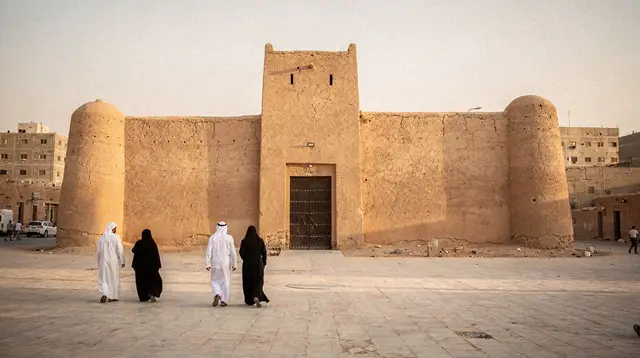
Second, government buildings, military installations, airports, and anywhere with a visible security presence should not be photographed. This includes checkpoints, embassy buildings, and areas around palaces even when they look like ordinary streetscapes. If you see a guard, a barrier, or a sign restricting photography, treat it as absolute rather than testing how strictly it is enforced. Landmark buildings and heritage sites — the Kingdom Centre’s Sky Bridge, At-Turaif in Diriyah, the desert landscapes around Edge of the World — are all fine to photograph freely; it is people and security infrastructure specifically that require care.
Entry rules: visas, passports, and what to check yourself
Saudi Arabia opened to leisure tourism in September 2019, and the entry system has settled into a fairly predictable shape since then. Most Western nationalities — EU and Schengen countries, the UK, the United States, Canada, Australia, Japan, and South Korea among others — need either an e-Visa applied for in advance or a visa on arrival, depending on nationality and how you are travelling. Citizens of Gulf Cooperation Council countries are the only travellers who need no visa at all.
The official application portal is visa.visitsaudi.com, and it is the only source worth trusting for current fees, processing times, and which nationalities qualify for which route. Visa costs and application windows have shifted more than once since 2019, so treat any fixed number you read elsewhere, including on this page, as out of date by the time you travel. Check the portal directly before booking flights, and apply with enough lead time that a processing delay does not put your trip at risk. Full detail on the application process itself is covered in Saudi Arabia e-Visa and entry rules.
Passport validity is worth checking separately from the visa question. Your passport needs to be valid for at least six months from your date of entry, and this is checked both when the e-Visa is issued and again at the airport. It is an easy thing to overlook if you are used to countries with a shorter validity requirement.
| Requirement | What applies | Where to confirm |
|---|---|---|
| Tourism opening | Since September 2019 | — |
| Visa for most Western nationalities | e-Visa or visa on arrival | visa.visitsaudi.com |
| GCC citizens | No visa required | — |
| Passport validity | At least 6 months from entry | Checked at e-Visa stage and on arrival |
| Visa fee | Not fixed — check current amount | visa.visitsaudi.com |
How this plays out day to day
None of the above should make a trip to Riyadh feel like walking through a legal minefield. In practice, the rules that matter for most visitors reduce to a short list: no alcohol anywhere, ask before photographing people, do not photograph anything with a security presence, keep public affection low-key, and arrive with a valid e-Visa and a passport that clears the six-month mark. Tour guides on organised excursions, whether a city tour through central Riyadh or a longer trip through the historic and modern sides of the city, are generally good about flagging anything site-specific, such as photography restrictions at a particular location.
Where visitors most often trip up is not malice but assumption — expecting Riyadh to behave like Dubai on alcohol, or not realising that a photo of a stranger needs permission first. Knowing the short list above before you land removes almost all of the friction. For what to wear alongside these rules, see what to wear in Riyadh; for how the calendar shifts during the fasting month, see visiting Riyadh during Ramadan.
If you are still deciding how much time to give the city and its surroundings, how many days in Riyadh and Riyadh for first-time visitors are good starting points, and is Riyadh safe for tourists covers the practical safety side that pairs with the etiquette rules here. Solo travellers, particularly women, may also want Riyadh for solo female travellers for a more specific look at how these norms apply in practice.
A national museum visit through a guided tour of the Saudi National Museum or a longer VIP itinerary through a full day tour of the city both come with a guide who can answer etiquette questions on the spot, which is often more useful than trying to memorise every rule before you arrive. Budget and logistics questions are covered separately in money, cards, and payments in Riyadh and staying connected in Saudi Arabia, while broader planning starts at Saudi laws and etiquette for visitors and the Riyadh guides hub.
Frequently asked questions about Saudi laws and etiquette
Can I drink alcohol in my hotel in Riyadh?
No. Alcohol is illegal throughout Saudi Arabia, and that includes international hotel chains in Riyadh. Hotels do not serve, sell, or store it for guests, and there is no separate tourist exemption. Bringing alcohol in from abroad, buying it locally, or drinking it in a private room is against the law, not just against hotel policy.
Is it true that Riyadh has bars or hidden alcohol licenses for tourists?
No. Some visitors arrive expecting a discreet minibar or a hotel bar like those in Dubai, but Saudi Arabia has never issued alcohol licenses to any hotel or restaurant. The prohibition is national, not city-specific, and it has not changed alongside the tourism opening.
Can I take photos of people or buildings in Riyadh?
Street photography of places is generally fine, but photographing individuals, especially women, without asking first is not acceptable. Government buildings, military sites, airports, and anything with visible security personnel should not be photographed at all; assume any building with guards or barriers is off-limits.
Do I need a visa to visit Riyadh?
Most Western nationalities, including EU and Schengen countries, the UK, the US, Canada, Australia, Japan, and South Korea, need an e-Visa or a visa on arrival. Only citizens of Gulf Cooperation Council countries travel without any visa. Apply through the official visa.visitsaudi.com portal and check current fees and processing times there rather than relying on secondhand figures.
How long does my passport need to be valid?
Your passport should be valid for at least six months from your date of entry into Saudi Arabia. This is checked at the e-Visa application stage and again at the airport, so it is worth confirming before booking flights.
Is holding hands or hugging in public a problem in Riyadh?
Public displays of affection, including between spouses, are considered inappropriate and can draw unwanted attention from the public or from security staff. A hand on a shoulder or a quick hug in a private setting is not the same issue; it is the visible, public version that causes friction.
What happens if I break one of these rules by accident?
Most first-time visitor mistakes, such as taking a photo of a stranger or briefly holding hands, are met with a polite correction rather than a formal penalty. The exceptions are alcohol and photographing security or government sites, which are taken seriously and are worth avoiding entirely rather than testing the boundary.
Where can I check the current e-Visa cost and requirements?
The official government portal, visa.visitsaudi.com, is the only source that reflects current fees, processing times, and eligible nationalities. Prices and rules have shifted since the 2019 tourism opening, so checking the portal directly before booking is more reliable than relying on a fixed number from an older article.
Planning tips for visiting Riyadh on GetYourGuide
Verified deep-linked GetYourGuide tours. Book through these links and we earn a small commission at no cost to you.
GetYourGuide does not provide a product photo for this activity — the image shows the meeting point, photographed by us.