Free things to do in Riyadh
What can you actually do for free in Riyadh?
Walking Wadi Hanifa, Deera Square and the area around Qasr Al Hukm, browsing (not buying) at Souq Al Zal, strolling Boulevard City outside ticketed events, viewing At-Turaif and Al Bujairi Terrace from the public paths, and watching the trade at Riyadh Camel Market cost nothing to enter. Metro fares, Uber or Careem rides, and any museum ticket are separate costs that still apply on a low-spend day.
What counts as free in Riyadh, and what doesn’t
Riyadh has a short but genuine list of places where you can spend an afternoon without paying an entrance fee: a riverside-style walk, two historic squares, a working souq, a modern promenade, and a livestock market that doubles as unplanned street theatre. This page sticks to that list. It is deliberately narrower than a general budget guide to Riyadh, which weighs cheap paid activities against expensive ones. Here, the bar is simpler: does it cost anything to walk in and look around. If the answer is “only if you buy something” or “only if you go through a certain gate,” it is on this page. If the answer is “yes, there is a ticket,” it is treated as a paid activity elsewhere on the site, not smuggled in here as a free one.
Two things to settle before the list: transport is never free, and neither the abaya nor the headscarf works the way many visitors assume.
Getting to any of these spots involves the Riyadh Metro or a ride with Uber or Careem, both of which have real fares. A day of free attractions can still cost the price of getting between them, especially since Riyadh’s blocks are long and its summer heat rules out much walking between neighbourhoods. Treat transport as its own line item, not a rounding error.
On dress: this is not Iran, and it is no longer the Saudi Arabia of a decade ago either. Foreign women do not need to wear an abaya to walk through Deera Square, browse Souq Al Zal, or watch the camel market. Modest dress — shoulders and knees covered, nothing tight or see-through — is enough in every public space on this list. A headscarf is expected only inside a mosque, never on a public street or in a market, whatever older guidebooks or forum threads claim. Both rules apply exactly the same way whether the activity is free or costs money; they are not stricter because you are not paying.
Walking Wadi Hanifa
Wadi Hanifa is the green corridor that cuts through western Riyadh, and it is the closest thing the city has to a free outdoor amenity used by residents rather than tourists. Paved paths, planted banks and the occasional pool of water (the wadi floods seasonally and is otherwise mostly dry) run for long stretches, with benches and shaded sections in places. It costs nothing to walk, sit, or watch families and joggers use it in the early morning or after sunset, which are the only times the heat allows for it outside winter.
The catch is scale and access. Wadi Hanifa is long, and different sections are more or less developed; getting to a decent stretch usually means a taxi or ride-share rather than a walk from an Olaya hotel. Wadi Namar, the section with a small dammed lake to the south, is a popular free viewpoint and picnic spot but is a further ride out again. None of this costs an entry fee. All of it costs a ride there and back, and in summer, a time slot before roughly 9am or after sunset — midday heat above 40°C makes the whole idea pointless between May and September.
Deera Square and the streets around Qasr Al Hukm
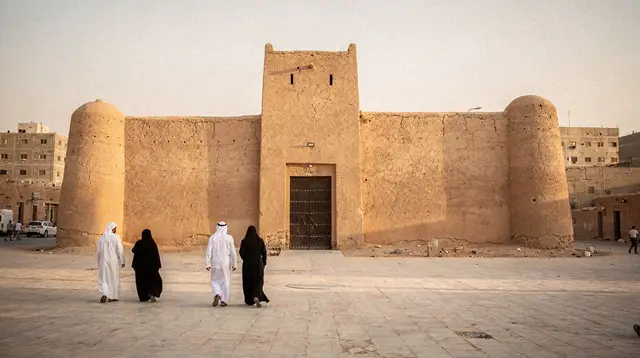
Deera Square, in the old quarter of Al Dirah, is a public square with no entry fee and no gate. Walking it costs nothing, whether you are there to see Masmak Fortress from the outside, look at Qasr Al Hukm (the government palace building facing the square), or simply watch the area’s daily rhythm of shoppers, taxi drivers and older Najdi men who still gather there in the evenings. Masmak itself — the mud-and-clay fort taken by Abdulaziz Ibn Saud in 1902, an event that set off the process leading to the kingdom’s 1932 founding — has historically operated as a museum with a nominal entry arrangement rather than a strict paid ticket, but policies and hours change, so this page does not promise it is free. Treat the fort’s interior as something to check on the day; the square around it, and the view of its walls from outside, cost nothing regardless.
This is also one of the more atmospheric places to be after dark, when the daytime heat has dropped and the square fills with people rather than empties. There is no cover charge for being there at 9pm rather than 3pm.
Souq Al Zal: looking without buying
Souq Al Zal, just off Deera Square, is a traditional market of narrow covered lanes selling carpets, daggers, incense, antiques and other Najdi crafts. Walking through it, stopping to look at a stall, and leaving without buying anything is completely normal here and costs nothing — this is a working market, not a paid attraction with a turnstile. Vendors expect browsers as much as buyers, and haggling is part of the culture if you do decide to buy, though nobody obliges you to.
Souq Al Zal is small enough to walk in under an hour, longer if you stop to talk to stallholders or want to see what people typically end up buying there before deciding you don’t need any of it. It sits close enough to Deera Square and Masmak that the three can be combined into one free loop on foot, which is the most efficient use of a no-spend afternoon in the old city.
Boulevard City, minus the ticketed parts
Boulevard City is Riyadh’s large entertainment promenade, and for most of the year, walking its public areas — looking at the installations, the lighting, the general design of the place — costs nothing. It becomes a different proposition during Riyadh Season (roughly October to March), when Boulevard City and its sister site Boulevard World host concerts, themed zones and events that do require paid tickets. Outside those specific ticketed shows and enclosed zones, the promenade itself remains open to walk through without charge.
The practical approach: check what is running during your dates, then plan to walk the public boulevard for free and decide separately, deliberately, whether any particular Riyadh Season ticket is worth adding to the day. Wandering in expecting everything to be free during the festival period is the mistake to avoid; wandering in outside it and assuming you have to pay for something is the opposite, equally wrong mistake.
At-Turaif and Al Bujairi Terrace, from the outside
Diriyah, the birthplace of the first Saudi state in the 18th century, sits along the Wadi Hanifa northwest of Riyadh — it is a separate town, not a Riyadh neighbourhood, and it is worth keeping that distinction straight when reading anything about it. At-Turaif, the mud-brick citadel of the Al Saud family, has been a UNESCO World Heritage Site since 2010, and its interior is a ticketed, managed visitor experience. That part is not free, and this page does not pretend otherwise.
What is free is the view. Al Bujairi Terrace, the restaurant and café district directly across the wadi from At-Turaif, is open to walk through without a ticket, and its terraces give one of the best views of the citadel’s walls without paying for entry. Walking the public paths along the wadi edge, taking in the mud-brick skyline at golden hour, and sitting in the terrace area itself (without ordering, if you want to keep it entirely free) costs nothing. For most visitors this ends up being the better photograph anyway — the citadel as a whole silhouette rather than a close, ticketed walk through its rooms. If you later decide the interior is worth it, Diriyah tours covering At-Turaif properly and Bujairi Terrace in more depth are a separate, paid decision, not something this page is trying to talk you into or out of.
Getting to Diriyah from central Riyadh is its own logistical question, covered separately in the guide on how to get to Diriyah — again, a transport cost that sits on top of a free activity, not folded into it.
Riyadh Camel Market: watching the trade
Riyadh Camel Market, roughly 30km east of the centre along the Khurais road, is one of the larger camel markets in the region and functions as exactly what it sounds like: a livestock trading ground, not a tourist venue. Walking through it, watching buyers inspect animals, hearing the negotiating, and photographing the scene (with the usual caution about not photographing people directly without permission) costs nothing to do.
It is an unpolished, working place — dust, noise, animals being loaded onto trucks — and it rewards visitors who come with realistic expectations rather than looking for a curated cultural experience. Riyadh Camel Market is genuinely free to walk around; the cost on this outing is entirely the ride there and back, since it sits well outside walking range of any hotel district and there is little reason for a taxi to be waiting nearby. Some visitors combine it with a guided camel and horse experience closer to the city if they want a more structured version of the same theme, which is a paid activity and a different thing entirely from simply watching the market.
A guided visit to the camel market that also covers transport out and backWhat still costs money on a “free” day
None of the above involves an entry fee, but a realistic free day in Riyadh still has real costs attached. Here is roughly where the money actually goes:
| Item | Cost type | Notes |
|---|---|---|
| Metro fare between stops | Small, per ride | Covers parts of central Riyadh; check current network coverage for your route |
| Uber or Careem ride | Moderate, per ride | Needed for Wadi Hanifa, the camel market, and Diriyah from most hotel areas |
| Water and snacks | Small | Worth carrying your own in summer heat |
| Souq Al Zal purchase | Optional | Only if you choose to buy; browsing itself is free |
| At-Turaif interior ticket | Separate paid activity | Not covered by this page; verify current pricing before counting on it |
| National Museum ticket | Separate paid activity | Assume ticketed; not part of a free day |
If you want a single day that mixes some of this list with a paid activity, a city tour or a look at things to do in Riyadh more broadly is the better starting point than trying to stretch this page further than it goes.
A half-day guided introduction to Riyadh’s old city and modern districtsTwo dress-code myths worth retiring
Two ideas keep circulating about visiting Riyadh’s public spaces, and both are outdated. First: no, foreign women are not required to wear an abaya to walk through Deera Square, Souq Al Zal, Boulevard City or the camel market. Modest, non-tight, non-sheer clothing covering shoulders and knees is the actual standard, and it applies to everyone, not specifically to these free attractions. Second: a headscarf is not expected on the street, in a market, or on a promenade — only inside a mosque. If you see conflicting advice online, it is very likely written before the relaxation of these rules or based on Mecca and Medina, which operate under different expectations entirely and are outside the scope of what this site covers for Riyadh.
Being underdressed by local standards (shorts well above the knee, sleeveless tops) will draw looks in these traditional areas even though it is free to enter them; being appropriately modest does not require carrying an abaya you were never told you need. If you want more detail on what actually works day to day, including for solo female travellers, that is covered at length elsewhere, alongside the more general what to wear in Riyadh guide.
If a night out around any of these free spots appeals more than a daytime one, what to do in Riyadh at night covers timing and safety for exactly that.
Frequently asked questions about free things to do in Riyadh
Is Souq Al Zal actually free to visit?
Yes, walking through Souq Al Zal and browsing the stalls of carpets, daggers and antiques costs nothing. You only pay if you decide to buy something, and there is no obligation to.
Do I need to pay to see At-Turaif or Al Bujairi Terrace?
Walking Al Bujairi Terrace and viewing the At-Turaif mud-brick walls from the surrounding public paths and viewpoints is free. Entry inside the At-Turaif district itself is ticketed, so treat the interior as a paid activity and check current pricing before counting on it.
Is the Riyadh Camel Market free to enter?
Yes, walking through and watching the trading is free. It is a working livestock market rather than a tourist attraction with an entrance fee, though a private driver or tour to get there is a separate cost.
Do women need to wear an abaya to visit these free spots?
No. Modest dress (shoulders and knees covered, nothing tight or sheer) is enough for foreign women at Wadi Hanifa, Deera Square, Souq Al Zal, Boulevard City, Bujairi Terrace and the camel market. An abaya is not required.
Is a headscarf required at Souq Al Zal or Deera Square?
No. A headscarf is only expected inside mosques, not in public streets, markets or squares. You will see plenty of women without one in these areas.
Is the National Museum of Saudi Arabia free?
Assume it is not. It is a ticketed museum, and this page does not treat ticketed sites as free without verifying current pricing on-site or through an official source.
Are the metro and Uber included in a free day out?
No, they are transport costs on top of a free-entry activity. A metro fare or an Uber or Careem ride to Wadi Hanifa, Deera Square or the camel market still needs to be budgeted separately.
Is Boulevard City free to walk around?
Yes, walking the public promenade and looking at the installations is free outside Riyadh Season’s ticketed events and concerts. During the festival, some zones and shows require a paid ticket.
Budget-friendly tours and activities on GetYourGuide
Verified deep-linked GetYourGuide tours. Book through these links and we earn a small commission at no cost to you.
GetYourGuide does not provide a product photo for this activity — the image shows the meeting point, photographed by us.