What to buy at Souq Al Zal, and what to skip
Rugs, daggers, incense: what’s actually on the tables
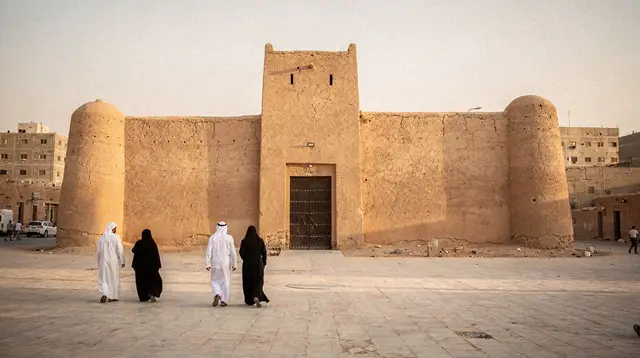
I went to Souq Al Zal expecting a souvenir strip and left with a rug I still use. That’s the honest starting point: this market, tucked next to Masmak Fortress and Deera Square in the old city (Al Dirah/Deera), is a mix of real craft and tourist filler, and the two sit on the same table more often than you’d expect.
Four categories are worth knowing before you go:
Rugs. Wool and goat-hair pieces from Najd and beyond, in a wide range of ages and quality. The good ones have irregular, hand-tied knots and a slightly rough, uneven weave. The generic ones have a machine-even pattern and a synthetic sheen you can spot from a few feet away.
Daggers (khanjars). The curved Najdi dagger is the market’s signature item. Some are genuinely old or hand-finished; a lot of what’s displayed is recent decorative work made for exactly this foot traffic. Weight and handle finish tell you more than the seller’s story does.
Incense and oud. Bakhoor (scented wood chips), oud oil, and burners are sold by weight or by piece across several stalls. This is the category where quality varies the least dramatically — even the simpler stuff is genuinely local and genuinely usable.
Antiques and brass. Coffee pots, old coins, keys, and household brass, some of it decades old, some of it made to look that way. Treat any claim of age as a starting point for a conversation, not a fact.
None of this comes with a fixed price tag, and I’m not going to invent one here — the honest answer is that Souq Al Zal runs on negotiation, and what a rug or dagger goes for depends on the stall, the season, and how the conversation goes.
Sorting craft from reproduction
The single most useful thing I can tell you is this: a good third to half of what’s on display at Souq Al Zal is imported tourist stock — the same incense burners and “antique” coins you’ll find at malls near Kingdom Centre or in airport shops, just displayed on a rug instead of a shelf. That’s not a scandal, it’s just retail. The mistake is paying craft prices for it.
A few tells that helped me: hand-tied rugs have visible irregularities in the knotting, not a perfectly repeating pattern. Old daggers have handles worn smooth in specific places from use, not a uniform matte finish. Genuinely old brass has dents and a patina that doesn’t sit evenly, while reproduction pieces often look artificially aged in one uniform tone. None of this makes you an expert in an afternoon, but it’s enough to ask better questions.
If you want a lower-stakes way in first, a guided stop as part of a wider Riyadh city and heritage tour gives you context on the market before you start spending, which is exactly when I’d have wanted it.
A half-day loop through Masmak Fortress, Souq Al Zal and Murabba PalaceCash, negotiation, and pace
Riyadh runs almost entirely on cards now — hotels, malls, even small shops near Olaya take contactless without a second thought. Souq Al Zal is one of the exceptions. Bring some cash. Larger rug and antique dealers may take a card, but the smaller stalls, and anyone you’re actually negotiating with, will expect notes, and negotiating over a card terminal changes the whole tone of the exchange.
Negotiation itself is expected on the traditional side of the market — rugs, brass, daggers — and it’s unhurried by design. Nobody is trying to close you in ninety seconds. If a seller quotes a price and you walk without countering, that’s a normal part of the process, not an insult. It’s a different rhythm from the fixed-price antique galleries mixed into the same lanes, where the sign really does mean the price.
I’d give the market itself an hour if you’re browsing, longer if you’re actually planning to buy a rug and want to compare a few stalls before deciding. It pairs naturally with the rest of the old city — the fort, Deera Square, and Qasr Al Hukm are all within walking distance, so this isn’t a special trip on its own for most visitors.
A full Riyadh city tour that folds the old town, Masmak and the souq into one dayWhat this page doesn’t cover
Souq Al Zal is a market for buying things, not for sitting down. If you want an evening out rather than a shopping stop, Al Bujairi Terrace in Diriyah, across the wadi from At-Turaif, is the restaurant and café strip — a different destination, a different purpose, and worth keeping separate in your plans.
If it’s modern shopping you’re after — malls, international brands, air conditioning — that’s Kingdom Centre or KAFD, not the old city. And if camels or livestock are the goal, that’s the Riyadh Camel Market out on the Khurais road, a genuinely different kind of morning.
For the wider old-town context — Masmak’s role in the 1902 taking of Riyadh, and how it led to the kingdom’s 1932 founding — the Masmak Fortress guide and the Murabba Palace and King Abdulaziz Historical Center are the better next stops. If you’d rather see the historic quarter with someone who can vouch for a stall before you commit to it, a private tour in Riyadh or hiring a private guide is the more comfortable route for a first visit.
A Riyadh city visit that takes in the old quarter around the souqFor the practical basics — cards versus cash across the city, and what tipping actually looks like here — see money, cards and payments in Riyadh and tipping in Saudi Arabia. And if you’re building this into a wider day, one day in Riyadh and the broader things to do in Riyadh page both fit Souq Al Zal in naturally around the fort and the square.
Frequently asked questions about shopping at Souq Al Zal
Is Souq Al Zal touristy or a real working market?
Both. It sits next to Masmak Fortress and Deera Square, so it draws visitors, but it’s also where some Riyadh residents still buy rugs, incense and household brass. The tourist share and the working-market share sit side by side on the same lanes.
Can I pay by card at Souq Al Zal?
Some of the larger rug and antique stalls take cards, but this is one of the few places in Riyadh where cash still matters. Smaller vendors, and anyone you’re negotiating with, will expect notes.
Are the daggers (khanjars) at Souq Al Zal real?
Some are old or hand-finished pieces, and some are recent decorative copies aimed squarely at visitors. Weight, the finish on the handle and the seller’s own explanation of where a piece came from are better indicators than the price alone.
Is it rude to negotiate at Souq Al Zal?
No, it’s expected on the traditional side of the market, especially for rugs, brass and daggers. A calm, unhurried back and forth is normal; it’s not expected on fixed-price antique or gallery-style stalls.
What should I skip at Souq Al Zal?
Mass-produced incense burners and rugs with a synthetic sheen are usually the same imported stock sold at malls across the city for less hassle. If a stall’s entire table is generic and inexpensive, it’s not the reason to come here.
Is Souq Al Zal the same as Al Bujairi Terrace?
No. Souq Al Zal is a shopping market in the old city, next to Masmak Fortress and Deera Square. Al Bujairi Terrace, across the wadi from At-Turaif in Diriyah, is a restaurant and café strip, not a shopping destination.
tours.Shopping
Verified deep-linked GetYourGuide tours. Book through these links and we earn a small commission at no cost to you.
GetYourGuide does not provide a product photo for this activity — the image shows the meeting point, photographed by us.