The story of Masmak Fortress
A fort in the middle of the old city
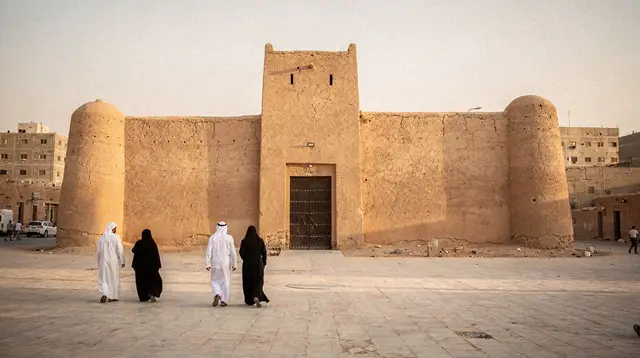
The first time I stood in front of Masmak Fortress, I was more struck by how small it looked than by anything dramatic. It is a squat, sand-coloured mud-brick building with four corner towers, sitting in the middle of Al Dirah, Riyadh’s historic core, which locals also call Deera. Souq Al Zal sprawls along one side, Deera Square opens up in front, and Qasr Al Hukm, the modern seat of provincial government, stands just beyond it. None of it looks like the birthplace of a country. That is exactly why I think it is worth understanding what actually happened here.
I want to be precise about the story, because it gets blurred with a much older one. Masmak is not where the Saudi state began. That earlier chapter, the first Saudi state of the eighteenth century, belongs to Diriyah and its walled quarter, At-Turaif, across the Wadi Hanifa northwest of the city. Masmak is a different, later moment: the recovery of Riyadh in 1902, which set the stage for the founding of the kingdom we know today in 1932. Two dates, thirty years apart, and neither one should be mistaken for the other.
What actually happened in 1902
By the end of the nineteenth century, the Al Saud family had lost Riyadh, and the rival Al Rashid clan of Ha’il controlled the city through a governor stationed in Masmak. Abdulaziz Ibn Saud, still a young man in exile with his family in Kuwait, decided to take the city back. The plan he and a small band of followers carried out in January 1902 is the part of the story that gets told and retold in Riyadh: a night approach to the fort, a scaling of the wall, and a direct confrontation with the Al Rashid governor at the fortress gate.
You can still see a spear mark on one of the wooden doors, kept as physical evidence of that fight. I found it more affecting than any plaque or display case inside. It is a small, unglamorous scar in old timber, and it is treated with real care because of what followed. That single night is what historians point to as the opening move of the process that eventually produced the modern Saudi state. It did not happen all at once. Abdulaziz spent the following three decades consolidating control over the wider Arabian Peninsula, and it was only in 1932 that the kingdom was formally proclaimed. So when someone tells you Masmak is where Saudi Arabia was founded, I would push back gently: 1902 is when Riyadh changed hands. 1932 is when the kingdom itself came into being. The fort matters because it is where the first date happened, not because it is where the second one did.
Standing where it happened
Masmak today is a museum, and a modest one. Inside, you will find displays on the 1902 events, on traditional Najdi weapons and tools, and on the layout of old Riyadh before the city grew outward into Olaya and beyond. I would not plan more than thirty to forty-five minutes here on its own. What makes the visit worthwhile is less the museum itself and more its setting: this is genuinely still the old administrative heart of the city, and you can walk it in one loop.
Deera Square sits right outside the fort. It has a quieter reputation than its history suggests, and I will not dwell on that here, but it is worth knowing that public gatherings and, historically, sentencing announcements have taken place there. Across the square is Qasr Al Hukm, the seat of provincial government, rebuilt in a modern style that deliberately echoes Najdi mud-brick architecture rather than breaking from it. And running alongside the fort is Souq Al Zal, one of the last traditional markets in central Riyadh, worth ten minutes of browsing for rugs, daggers, incense, and secondhand antiques even if you do not buy anything.
A short walk from Masmak takes you to the King Abdulaziz Historical Center in Al Murabba, which holds the National Museum of Saudi Arabia and the Murabba Palace, Abdulaziz’s own former residence built after Riyadh had grown past its old walls. I think the two sites work well together: Masmak gives you the flashpoint, and Murabba gives you what came after it, once the man who took the fort had a kingdom to run.
Keeping the two founding stories straight
| Event | Year | Where | What it means |
|---|---|---|---|
| Recovery of Riyadh at Masmak Fortress | 1902 | Al Dirah, central Riyadh | Ended Al Rashid control of the city; opening move of Abdulaziz’s campaign |
| Founding of the modern Saudi state | 1932 | Formalised nationwide | The kingdom is formally proclaimed, three decades later |
| First Saudi state (a separate, earlier story) | 18th century | Diriyah and At-Turaif | Predates Masmak by more than a century; not part of this narrative |
I keep coming back to that table in my head whenever I hear the story simplified into one date. Riyadh has two founding stories, not one, and they sit in two different places. If you only have time for one heritage stop in the city itself, I would make it this loop around Masmak, Deera Square, and Souq Al Zal, and save Diriyah and At-Turaif for a separate half-day, since the two stories deserve to stay separate in your head as well as on the map.
Practical notes from my visit
Masmak sits inside old Riyadh, close enough to walk from several points in Al Dirah, though most visitors arrive by taxi, Careem, or Uber rather than on foot from further out, since Riyadh’s summer heat makes any long walk unappealing outside the cooler months. There is no fixed entry price I will quote here, since these things change; check the current details on the things to do in Riyadh listings before you go. A guided walking tour is the easiest way to get the 1902 story straight rather than piecing it together from museum labels, and it also gets you into Souq Al Zal and toward Qasr Al Hukm with someone who can point out details you would otherwise miss, like that spear mark on the door.
If you want the fortress with the wider Al Dirah quarter and Murabba Palace in one outing, a guided route through Masmak, Souq Al Zal and Murabba Palace covers the ground efficiently in a morning. For a shorter, fortress-focused visit, a walking tour of Masmak Fortress in old Riyadh is the more compact option. And if you would rather fold the souq and its coffee culture into the same walk, a combined visit to Masmak, Souq Al Zal and a traditional Saudi coffee stop adds that layer without much extra time.
I would pair this with a look at Wadi Hanifah or the National Museum of Saudi Arabia later the same day, then keep Diriyah, Al Bujairi Terrace, and the Diriyah tours that cover At-Turaif for a different day entirely. For trip planning, one day in Riyadh and two days in Riyadh both slot Masmak in as a half-morning stop, which matches how long I actually spent there.
Questions about Masmak Fortress and its place in Riyadh’s history
Is Masmak Fortress where Saudi Arabia was founded?
Not exactly. Masmak is where Abdulaziz Ibn Saud recaptured Riyadh from Al Rashid control in 1902. The kingdom itself was formally founded thirty years later, in 1932. The fort is the opening chapter, not the founding moment.
What is the difference between Masmak and Diriyah’s history?
They are two separate founding stories. Diriyah and its At-Turaif district cover the first Saudi state, established in the eighteenth century. Masmak covers a later, distinct episode: the 1902 recovery of Riyadh that led toward the 1932 kingdom. They should not be merged into one narrative.
How long do I need to visit Masmak Fortress?
Thirty to forty-five minutes is enough for the museum itself. Add another thirty minutes if you want to walk around Deera Square, Qasr Al Hukm, and Souq Al Zal, which all sit right next to the fort.
What can I actually see inside the fort?
Displays on the 1902 events, traditional Najdi weapons and household items, and a spear mark preserved on one of the original wooden doors from the night of the raid. It is a modest, low-tech museum rather than an interactive one.
Is Masmak Fortress in old Riyadh or in a modern district?
It is in Al Dirah, also called Deera, the historic administrative core of Riyadh, not in the modern business districts like Olaya or KAFD. It sits beside Souq Al Zal and across from Qasr Al Hukm.
Do I need a guide to visit Masmak Fortress?
No, but I found a guide useful for getting the 1902 story and its context straight, rather than piecing it together from short museum labels. A guided route also naturally extends into Souq Al Zal and the surrounding Al Dirah quarter.
Can I combine Masmak with Diriyah in the same day?
You can, since travel between them is short, but I would not recommend rushing both. The two sites tell different, centuries-apart stories, and giving each its own half-day makes the history easier to hold onto rather than blurring 1902 with the eighteenth century.
tours.Culture
Verified deep-linked GetYourGuide tours. Book through these links and we earn a small commission at no cost to you.
GetYourGuide does not provide a product photo for this activity — the image shows the meeting point, photographed by us.