The Arabic phrases that actually help in Riyadh
I did not learn Arabic before my first trip to Riyadh, and I did not need to. Every hotel desk, every mall counter and every guide on an organised excursion I booked spoke workable English. What changed my trips was not learning a language but learning a dozen phrases, the kind that shift a transaction from correct to warm. A driver who hears a greeting in his own language before you switch to English relaxes visibly. A souq seller who hears you try, even badly, drops the rehearsed tourist price a notch faster than a flat “final price?” in English ever does.
This is not a language course, and I am not going to pretend fifteen phrases make you fluent. It is a short list of what I actually reach for: greetings, thanks, and a few lines for the three situations where a visitor to Riyadh spends the most time talking to a Saudi who is not a hotel employee — the private driver, the souq seller, and the guard or attendant at a heritage site.
Greetings that open the door
The standard greeting is “as-salamu alaykum” (peace be upon you), answered with “wa alaykum as-salam.” You will hear it constantly, from drivers, guards, shopkeepers, even other guests in a hotel lobby. Using it first, before switching to English, costs nothing and buys you a warmer opening than “hello” does. A simpler, more casual option is “marhaba,” a general-purpose hello that works everywhere from a private guide meeting you at your hotel to a stallholder at Souq Al Zal.
“Kayf halak” (how are you, said to a man) or “kayf halik” (to a woman) is the natural follow-up, and the expected reply is “bikhair, shukran” — fine, thank you. You do not need to actually report on your day; it functions closer to “how’s it going” than a real question.
Thank you, said properly
If you learn one word for a trip built around things to do in Riyadh, make it “shukran” — thank you. It closes almost every exchange politely: a driver dropping you back at your hotel after a long day at the Edge of the World, a guard at Diriyah who has pointed you toward the right gate, a waiter, a taxi driver, a hotel porter. For anyone who has clearly gone out of their way — a driver who waited through a delayed sunset shoot, a guide who answered ten extra questions — “shukran jazeelan,” thank you very much, lands better than the plain version.
“Afwan” covers both “you’re welcome” and “excuse me,” which is a useful bit of overlap: the same word gets a driver’s attention in traffic and answers someone else’s thanks to you.
At the souq: negotiating without pretending you are fluent
I do not haggle in fluent Arabic at Souq Al Zal, and neither should you try to. What works is opening the price conversation with a greeting and one or two Arabic words, then finishing the negotiation in English, which almost every stallholder there speaks well. “Bikam hadha,” how much is this, is the phrase that starts things off on the right foot rather than pointing silently. If a price still feels high, “ghali,” meaning expensive, said with a smile, is understood everywhere and usually gets a counter-offer rather than a shrug.
None of this is about squeezing the lowest possible price. A slower, friendlier negotiation with a few Arabic words tends to land at a fairer price than a rushed one in English, mostly because it signals you are not a one-transaction tourist trying to be handled quickly.
In the car: directions in dense traffic
Riyadh is a driving city, and most visitors get around with a private driver, Uber, or Careem rather than public transport, even with the Riyadh Metro now running. Drivers on longer desert routes generally work from a GPS pin you share rather than spoken directions, so you rarely need more than a destination name and a greeting. Still, a few lines help. “Yasar” is left, “yameen” is right, and “seedha” is straight ahead — useful if a driver hands you his phone to confirm a turn, or if a GPS signal drops on the unpaved stretch toward Shaqra and Ushaiger.
“Min fadlik” (please, to a woman) or “min fadlak” (to a man) softens any request, from asking a driver to slow down to asking a guard at Diriyah’s At-Turaif district which entrance leads to Al Bujairi Terrace. If you booked a half-day city tour through Riyadh’s old and new districts or a walk through the Turaif and Al Bujairi Terrace heritage district, your guide will be doing most of the talking in English anyway — these phrases are for the moments before and after the tour, not during it.
At the gate: a word for guards and attendants
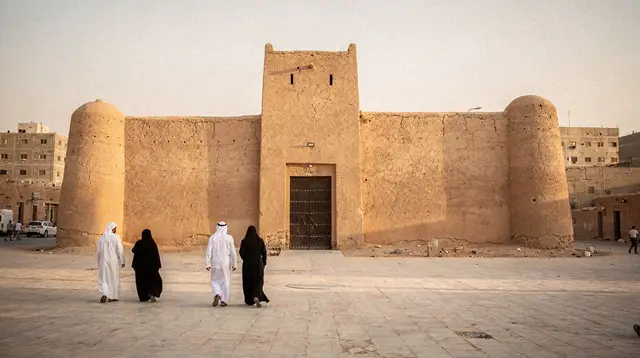
Guards and ticket staff at heritage sites, museums and even some malls appreciate a greeting more than most visitors expect. It is a small thing — “as-salamu alaykum” on arrival, “shukran” on leaving — but it noticeably changes how quickly a guard waves you through or points you the right way. None of this replaces the dress and etiquette guidance that applies at these sites; it just makes the practical, day-to-day interactions a little smoother.
What I deliberately left out
I am not covering hospitality phrases around coffee and dates here — that etiquette gets its own coverage elsewhere on this site, and repeating it in a language list would bury the point. I am also skipping general dress, alcohol and prayer-time etiquette, which belong on the pages built for that rather than a phrasebook. This is meant to travel light: a page you glance at before getting into a car, walking into a souq, or approaching a gate, not a reference to study.
If you are still deciding what to book before you land, a private guide or a smaller group tour, like an evening ride through Wadi Hanifah, gives you more of these small exchanges than a large coach tour does. Either way, a driver hearing an evening ride along Wadi Hanifah described in a mix of English and a greeting in Arabic tends to remember you a little better than a passenger who says nothing at all.
tours.Culture
Verified deep-linked GetYourGuide tours. Book through these links and we earn a small commission at no cost to you.
GetYourGuide does not provide a product photo for this activity — the image shows the meeting point, photographed by us.