Accessible Riyadh: a practical guide for limited mobility
Is Riyadh easy to get around with limited mobility?
It depends more on transport choices than on the sights themselves. The Riyadh Metro is new and only partly step-free by design, so most visitors with limited mobility rely on Uber, Careem, or a private driver door-to-door. Indoor sights like the King Abdulaziz Historical Center and the malls around Boulevard City are far easier to plan than an open-air desert excursion.
Getting around Riyadh with limited mobility
Riyadh is not a walking city for anyone, and that turns out to matter more for accessibility than any single building’s ramp or lift. The distances between sights are long, pavements are inconsistent outside a handful of newer districts, and the heat for most of the year makes even a short walk between a drop-off point and an entrance harder than it looks on a map. If you plan around transport first and sights second, the rest of the trip gets noticeably easier.
This page covers the city itself: the metro, taxis and ride-hailing, and the indoor sights that are simplest to organise. It does not cover the desert side of a Riyadh trip — Edge of the World, the Red Sand Dunes, or Shaqra and Ushaiger — because those excursions involve unpaved ground, a 4x4 for the final stretch, and heat exposure that deserves its own honest treatment. That is covered separately in Riyadh in the heat with limited mobility, and it is worth reading before booking anything in the desert.
The Riyadh Metro: new, but not automatically accessible everywhere
The Riyadh Metro is one of the more useful pieces of city infrastructure to arrive here in years: an automatic six-line network that opened in stages between December 2024 and early 2025, with a line running to King Khalid International Airport. It is modern, air-conditioned, and was designed with lifts and level access between platform and street in most stations.
The honest caveat is that “designed for accessibility” and “verified accessible on the day you travel” are not the same claim. A network this new, opened in stages over little more than a year, will have variation between stations in how consistently lifts are staffed, how well signage is kept up, and how smooth the interchange between lines actually is in practice. Nobody outside Riyadh can respectably promise you that every station on every line works flawlessly for a wheelchair or a walker today. The realistic approach is to treat the metro as a strong option to try for a specific, planned journey — for example, a single hop from a station near your hotel into the Olaya area — rather than as your default way to move around the whole trip on faith.
If a lift is out of service or an interchange proves awkward, Uber and Careem are one tap away, which is the real safety net here. There is also a comparison of the two options if you want it side by side: metro versus Uber in Riyadh, and a blunter outside opinion at is the Riyadh Metro worth using for tourists.
Ride-hailing and taxis: the default, not the backup
For most visitors with limited mobility, Uber, Careem, or a licensed taxi will end up being the main way to move around Riyadh, and that is not a compromise — it is how most of the city gets around anyway, because Riyadh is built for cars first. Vehicles go door-to-door, drivers are accustomed to loading mobility aids or luggage into the boot, and fares are set in the app before you commit to a trip, so there is no negotiation at the curb.
Neither service runs a dedicated wheelchair-accessible vehicle category the way some larger cities do, so in practice you are choosing a standard sedan or a larger SUV and managing the transfer yourself, or with help from whoever is travelling with you. If a full day of sightseeing with several stops is the plan, a private driver booked through a tour is often simpler than juggling multiple ride-hailing pickups, because the same vehicle waits for you at each stop instead of you re-requesting a car every time.
A private full-day city tour with a dedicated vehicle and driver removes a lot of the friction of coordinating transfers between sights, and it is worth the modest premium over public transport for anyone who finds repeated transfers tiring. A shared version with a set group and fixed itinerary, a full-day guided city tour with transport included, is a cheaper way to get the same door-to-door convenience if you are comfortable moving at a group’s pace rather than your own.
Renting a self-drive car is also possible — see renting a car in Riyadh — but between Riyadh’s traffic, unfamiliar signage, and long distances, most visitors with mobility considerations get more value from a driver who already knows the city than from driving themselves.
Airport transfers
King Khalid International Airport sits roughly 35 km north of the centre, and the drive into Olaya takes about 30 to 45 minutes outside peak traffic. The metro’s airport line is an option if your hotel is near a station on the same line, but for a first arrival with luggage and an unfamiliar system, a pre-booked private transfer or a straightforward taxi from the arrivals hall is the lower-friction choice. Details on the route and what to expect on arrival are in the Riyadh airport arrival guide.
Indoor sights that are simple to plan
Riyadh’s newer cultural sites were largely built with wide, level circulation and climate control as a given, which makes them some of the least complicated stops on a limited-mobility itinerary — a useful contrast to the desert excursions the rest of the site talks up.
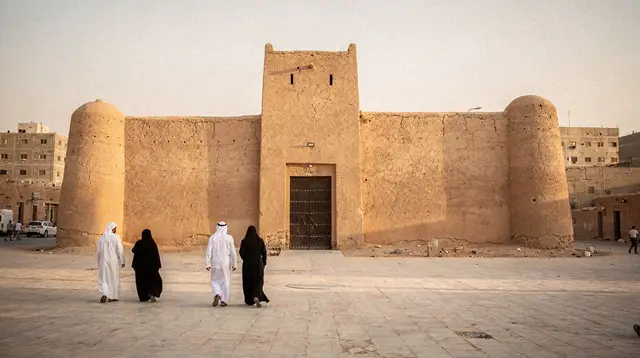
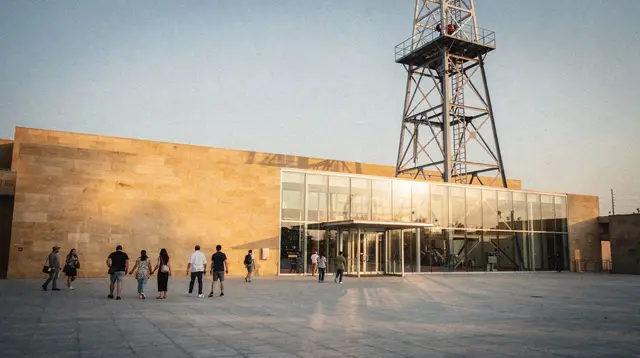
King Abdulaziz Historical Center, in Al Murabba, houses the National Museum of Saudi Arabia and the Murabba Palace, the former residence of the kingdom’s founder. The museum in particular was purpose-built relatively recently, with lifts between levels and broad corridors, and it is one of the more comfortable half-days you can plan in the city regardless of the outside temperature.
A guided tour of the Saudi National Museum with tickets arranged in advance is a practical way to skip the logistics of tickets and orientation and go straight to a paced, guided walk through the exhibits.
The malls and dining areas around Boulevard City and the wider King Abdullah Financial District are similarly easy: covered parking, lifts, level floors, and air conditioning throughout, which matters as much as the lack of stairs given how hot Riyadh gets for much of the year. Boulevard World, the seasonal attraction area nearby, varies more by season and by which specific pavilion you want to visit, so it is worth checking what is currently open rather than assuming everything runs year-round.
Older parts of the historic core, including some entrances around Deera Square and the traditional souqs, were not built with modern accessibility standards in mind and can have a step or an uneven threshold at the door even where the interior is flat. It is a small thing, but worth knowing before you commit to a specific old-town itinerary.
Guided tours as a way to remove uncertainty
A recurring theme across all of this is that a guided tour with transport included tends to solve several accessibility problems at once: it fixes the vehicle, fixes the pace, and puts someone in charge of logistics who already knows which entrances and routes work. For visitors who would rather not gamble on an unfamiliar metro station or piece together several taxi rides in one day, that trade-off is usually worth it.
a guided tour through the historic old city and its main attractions is one way to see the older parts of Riyadh without having to work out the logistics of each stop yourself, since a guide can steer you to the more manageable entrances and skip the ones that are not.
For a longer stay, or a trip where you would rather not re-plan transport every day, a two-day private tour with a dedicated guide and VIP transport covers a wider spread of the city’s indoor and modern sights across two days at a manageable pace, with the same vehicle and driver throughout.
Planning notes
A few practical points that do not fit neatly elsewhere. Riyadh’s summer heat, from roughly May to September and often well above 40°C, makes any outdoor walking segment harder regardless of mobility level, so pairing indoor sights with air-conditioned transport in summer is not just convenient, it is close to necessary. Winter, from November to March, with daytime temperatures closer to 20 to 25°C, is a noticeably easier season for anyone who needs to spend more time outside a vehicle or a building.
If your trip includes a desert day at all, plan it as a separate, deliberately chosen decision rather than a default add-on, and read Riyadh in the heat with limited mobility first. The unpaved final stretch to a site like Edge of the World and the lack of shade at most desert stops are a genuinely different consideration from anything in this guide.
For a first-time orientation to the city that is not accessibility-specific, things to do in Riyadh and a simple one-day Riyadh itinerary are useful starting points to adapt around your own transport choices. If you would rather hand the planning to someone else entirely, private tours in Riyadh and hiring a private guide in Riyadh cover how that works and what it typically includes.
Accessible Riyadh: quick comparison of transport options
| Option | Best for | Honest caveat |
|---|---|---|
| Riyadh Metro | A single, planned journey between known stations | New network (opened Dec 2024–early 2025); station-by-station accessibility not independently verified |
| Uber / Careem | Door-to-door trips, most of the day | No dedicated accessible-vehicle category; you choose a standard car |
| Private driver / guided tour with transport | Multi-stop days, less transfer planning | Costs more than public transport or a single taxi ride |
| Self-drive rental car | Visitors confident driving in Riyadh traffic | Long distances and dense peak traffic; less relaxing than being driven |
FAQ about accessible travel in Riyadh
Is the Riyadh Metro accessible for wheelchair users?
The network is modern and stations were built with lifts and level access in mind, but this is a system that opened in stages between December 2024 and early 2025, and not every station has had the same amount of time to bed in. Treat any given station as unverified until you have checked it yourself or with a local contact, rather than assuming full accessibility.
Is it easier to just use taxis and ride-hailing instead of the metro?
For most visitors with limited mobility, yes. Uber, Careem, and licensed taxis go door-to-door, and drivers are used to loading mobility aids into the boot. Riyadh’s distances are long and the city is built around cars, so this is also simply how most residents get around, not a workaround.
Which indoor sights in Riyadh are simplest to visit with limited mobility?
The King Abdulaziz Historical Center and the National Museum of Saudi Arabia are purpose-built, air-conditioned, and laid out with wide, level circulation. The malls and dining areas around Boulevard City are similarly straightforward: covered parking, lifts, and flat floors throughout.
Can I book a private driver for the whole day?
Yes, and it is a common way to handle a day of sightseeing in Riyadh regardless of mobility. A private guided tour with transport removes the need to plan taxi pickups between stops and lets you set the pace.
What about desert excursions like Edge of the World?
Those trips involve unpaved ground, a 4x4 for the final stretch, and extreme heat for much of the year, which is a different set of considerations from getting around the city. That side of things is covered separately in Riyadh in the heat with limited mobility rather than here.
Do I need to book accessible transport in advance?
Ride-hailing apps in Riyadh do not have a dedicated accessible-vehicle category the way some cities do, so most visitors simply choose a standard sedan or larger vehicle and manage transfers themselves, or arrange a private driver in advance through a tour operator for a full day.
Are Riyadh’s malls and museums free of stairs?
Largely yes for the main circulation routes. Malls are built with lifts and ramps as standard, and the major museums were designed with wide corridors and lift access between levels. Individual older buildings in the historic core can still have steps at entrances, so it is worth checking a specific site if a single step is a problem.
Accessible tours and activities in Riyadh on GetYourGuide
Verified deep-linked GetYourGuide tours. Book through these links and we earn a small commission at no cost to you.
GetYourGuide does not provide a product photo for this activity — the image shows the meeting point, photographed by us.