Riyadh's café culture: where the new city meets
I did not expect Riyadh to be a city where people go out for coffee. I had read about the Arabic coffee ritual — the small cup, the dates, the refill you wave off with a tilt of the wrist — and assumed that was the whole story. It is not. That ritual still happens, mostly in homes and majlis rooms, and it is worth understanding on its own terms elsewhere. What surprised me was something else entirely: a specialty coffee scene that has grown fast in the last few years, spread across new districts, and turned “let’s get a coffee” into one of the most normal things a resident of Riyadh can say on a Thursday evening.
Al Bujairi Terrace, facing history
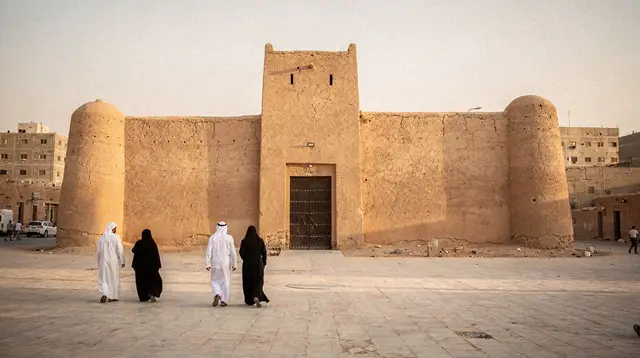
The clearest example of this is Al Bujairi Terrace, the row of restaurants and cafes on one side of the Wadi Hanifa, looking straight across at the mud-brick walls of At-Turaif in Diriyah. I sat there on a weekday evening with a flat white that would not have been out of place in a city with three times the coffee history, and watched families and groups of friends settle in for what was clearly not a five-minute stop. The terrace lights up after dark, the UNESCO walls across the wadi go warm under floodlights, and nobody is in a hurry. It works precisely because it sits next to something old without pretending to be old itself — the coffee culture here is new, the view it is drinking in front of is not.
What struck me is how deliberately social the whole layout is. Tables face outward, toward the view and toward each other, not toward a counter. It is closer to how a European city treats its evening piazza than to a coffee shop as a place to work. If you are staying anywhere near Diriyah or planning a visit to At-Turaif, building in time afterward at Al Bujairi is not really optional — it is the natural way the evening finishes.
A guided tour that covers Turaif and Al Bujairi together with admission includedBoulevard City and the Riyadh Season effect
The other pole is newer still: Boulevard City, which turns into one of the main stages of Riyadh Season roughly from October to March. Outside the festival’s peak months it is already a place with a dense cluster of cafes catering to a young, mixed crowd — a lot of laptops in the daytime, a lot of groups in the evening. During Riyadh Season itself the whole area gets busier and louder, and the cafes around it become as much a place to watch the crowd as to drink anything. It is a different register from Al Bujairi: no wadi, no old city across the water, just a modern entertainment district that has decided coffee belongs in the mix.
I mention this because the two places tell you something about how fast this scene has moved. A few years ago, this kind of café-as-destination culture barely existed in Riyadh in any organized way. Now there are enough specialty roasters and sit-down cafes that choosing where to go has become its own small decision, the way it might be in any city with a real café scene — Melbourne, Amsterdam, wherever. That is the actual news here, more than any single address: the multiplication itself.
Modern Riyadh as the backdrop
Some of this reads best against the newer skyline rather than the old town. Cafes near KAFD and around the Kingdom Centre tend to skew toward a business crowd during the day and a slower, later crowd once the heat breaks in the evening. None of this is dressed up as heritage or tradition — it is glass towers and specialty espresso machines, and it reads that way. If you are curious about how the city presents itself after dark more broadly, that is worth its own look rather than folding into a coffee story.
What actually shapes when a place is busy
Two things you notice quickly if you spend more than a couple of days moving between these spots: the weekend runs Friday to Saturday, not the pattern most Western visitors expect, and Friday around midday empties places out for a stretch before they fill back in. Neither is complicated once you know it, and both are covered properly elsewhere rather than here — the short version is enough to plan an evening around: Thursday and Friday nights are when Al Bujairi and Boulevard City are at their fullest, and the quiet stretch on Friday is a good window if you would rather not queue.
None of this overlaps with the traditional side of coffee in Saudi hospitality, which is really a separate subject: the small cup of Arabic coffee offered in a home or a majlis, refilled without asking, closed by a small shake of the cup rather than a spoken no. That ritual is about welcome, not leisure, and it has its own etiquette worth reading before you rely on guesswork. What I have described here is the opposite kind of coffee moment — paid for, chosen, sat through on your own schedule — and it is the one a visitor is far more likely to stumble into just by walking around Diriyah or Boulevard City in the evening.
A Diriyah heritage tour that ends at Al Bujairi TerraceIf you are building a first visit, I would not plan a whole day around cafes, but I would leave room for at least one evening at Al Bujairi Terrace and, if the dates line up with Riyadh Season, one stop near Boulevard City. Together they say more about where Riyadh is right now than most single landmark does.
A tour covering the season’s best iconic attractions in one outingFAQ: coffee and café culture in Riyadh
Is Riyadh’s café scene new, or has it always been like this?
It is recent. The dense cluster of specialty coffee shops and sit-down cafes has multiplied over the past several years, alongside the opening of districts like Al Bujairi Terrace and the growth of Boulevard City. Traditional Arabic coffee, by contrast, has a much longer history but belongs to home and hospitality settings, not this café-going habit.
Where is the best place to go for coffee in Riyadh?
There is no single best place, but Al Bujairi Terrace, facing At-Turaif in Diriyah, and the cafes around Boulevard City are the two clusters that come up most often. They offer different moods: a historic view versus a modern entertainment district.
Is going to a café in Riyadh the same as the Arabic coffee ritual?
No. The Arabic coffee and dates ritual is a hospitality custom, usually in homes or a majlis, with its own etiquette around cups and refills. Sitting down at a specialty café in Al Bujairi Terrace or Boulevard City is a modern, paid-for social outing closer to café culture in any large city.
Does the Friday-Saturday weekend affect when cafes are busy?
Yes, noticeably. Thursday and Friday evenings tend to be the busiest, since the weekend runs Friday to Saturday rather than the pattern many Western visitors expect. The details of that schedule, including Friday prayer timing, are worth reading up on separately rather than guessing.
Are cafes near Boulevard City only busy during Riyadh Season?
No, but they get noticeably busier and louder during the Riyadh Season months, roughly October to March. Outside that window the area still has a steady daytime and evening café crowd, just at a calmer pace.
Can I combine a café stop with visiting At-Turaif?
Yes, and it is arguably the natural order to do it in. At-Turaif closes for the day before Al Bujairi Terrace’s evening really gets going, so most visitors see the UNESCO site first and settle into a café afterward as the light changes.
Is there a dress code for sitting at a café in Riyadh?
The same general modesty guidance that applies across the city applies here: shoulders and knees covered for everyone, nothing more specific required at a café. It is a relaxed, casual setting rather than a formal one.
tours.Food
Verified deep-linked GetYourGuide tours. Book through these links and we earn a small commission at no cost to you.
GetYourGuide does not provide a product photo for this activity — the image shows the meeting point, photographed by us.